
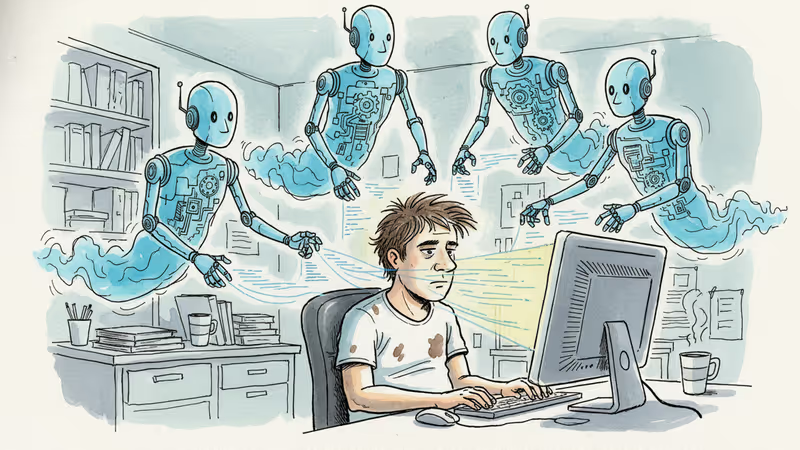
Apple Just Changed How Developers Work With AI Forever
Apple's Xcode 26.3 introduces full AI agent support via MCP protocol, connecting OpenAI Codex and Claude Agent. What this means for the future of software development.
While 47% of developers already use AI coding tools, most are still glorified autocomplete. Apple just changed that game entirely.
The tech giant announced Xcode 26.3, featuring full support for agentic AI coding tools like OpenAI's Codex and Claude Agent. But this isn't just another AI integration—it's a fundamental shift in how developers interact with their development environment. Through a new side panel interface, developers can assign complex tasks to AI agents and watch them work through entire workflows, not just suggest the next line of code.
The Protocol That Changes Everything
The magic happens through the Model Context Protocol (MCP), an open standard that lets AI agents access external tools and structured resources. Xcode acts as an MCP endpoint, exposing machine-invocable interfaces that give AI tools deep access to IDE primitives—file graphs, documentation search, project settings, and more.
This goes far beyond the AI chat and basic workflows Xcode supported before. Now, AI agents can understand your entire project context, navigate complex codebases, and execute multi-step development tasks autonomously.
What's particularly clever is Apple's approach to openness. While OpenAI and Anthropic get privileged positions in the settings, any MCP-compatible tool can connect. This means developers aren't locked into specific AI providers—they can even use locally-running models for sensitive projects.
From Code Completion to Code Collaboration
This shift represents a fundamental change in how we think about software development. We're moving from AI as a smart autocomplete tool to AI as a capable development partner.

For individual developers, this could be transformative. A single developer with AI agent support might accomplish what previously required a small team. Startups and indie developers suddenly have access to capabilities that were once exclusive to large engineering teams.
But there's a flip side. As AI agents become more capable, the skills that make developers valuable are shifting. Writing syntax becomes less important than architecting solutions, understanding business requirements, and knowing how to effectively collaborate with AI systems.
The Strategic Play Behind Openness
Apple's decision to use an open protocol isn't just technical—it's strategic. While Microsoft dominated early AI coding with GitHub Copilot, Apple is betting on a more open ecosystem approach.
By making MCP open, Apple positions Xcode as the hub for AI-powered development while avoiding vendor lock-in concerns. Developers get choice, and Apple gets to define the standard for how AI agents interact with development environments.
This openness also addresses a key concern in enterprise environments: flexibility. Companies can choose which AI providers to trust with their code, potentially using different models for different types of work or keeping sensitive projects on local models.
The Questions We're Not Asking
But this advancement raises uncomfortable questions about the future of software development. If AI agents can handle increasingly complex coding tasks, what happens to entry-level developer positions? How do new developers learn fundamental skills when AI can handle the basics?
There's also the dependency question. As development workflows become more AI-integrated, what happens when these systems fail or make subtle errors that compound over time? We're creating powerful tools, but also new forms of technical debt.
The security implications are equally complex. Opening development environments to AI agents creates new attack vectors and data privacy concerns. How do you audit code that was partially written by an AI system you don't fully understand?
Authors
Related Articles
After 15 years of fragmented mobile messaging, Apple and Google are rolling out end-to-end encrypted RCS messaging between iPhones and Android devices. Here's what changed, why it took so long, and what it means for your privacy.
Apple agreed to pay $250 million to settle claims it misled iPhone 16 buyers about Apple Intelligence features. What this means for consumers, Big Tech marketing, and the AI industry.
Apple quietly removed the entry-level $599 Mac Mini, raising the starting price to $799 — just one day after Tim Cook warned of chip supply constraints on the earnings call.

Apple names John Ternus, its hardware engineering chief, as the next CEO. The shift from operator to product person signals where Apple thinks its next decade of growth will come from — and raises real questions about what comes next.
After 15 years of fragmented mobile messaging, Apple and Google are rolling out end-to-end encrypted RCS messaging between iPhones and Android devices. Here's what changed, why it took so long, and what it means for your privacy.
Apple agreed to pay $250 million to settle claims it misled iPhone 16 buyers about Apple Intelligence features. What this means for consumers, Big Tech marketing, and the AI industry.
Apple quietly removed the entry-level $599 Mac Mini, raising the starting price to $799 — just one day after Tim Cook warned of chip supply constraints on the earnings call.
Apple names John Ternus, its hardware engineering chief, as the next CEO. The shift from operator to product person signals where Apple thinks its next decade of growth will come from — and raises real questions about what comes next.
Thoughts
Share your thoughts on this article
Sign in to join the conversation