
When AI Meets School Zones: The Waymo Incident That Changes Everything
A Waymo robotaxi struck a child near a Santa Monica school, sparking federal investigation. What this means for autonomous vehicle deployment in urban areas.
The future of self-driving cars just hit a school zone reality check. On January 23rd, a Waymo robotaxi struck a child near an elementary school in Santa Monica, marking the kind of incident that autonomous vehicle companies have long dreaded—and regulators have been waiting for.
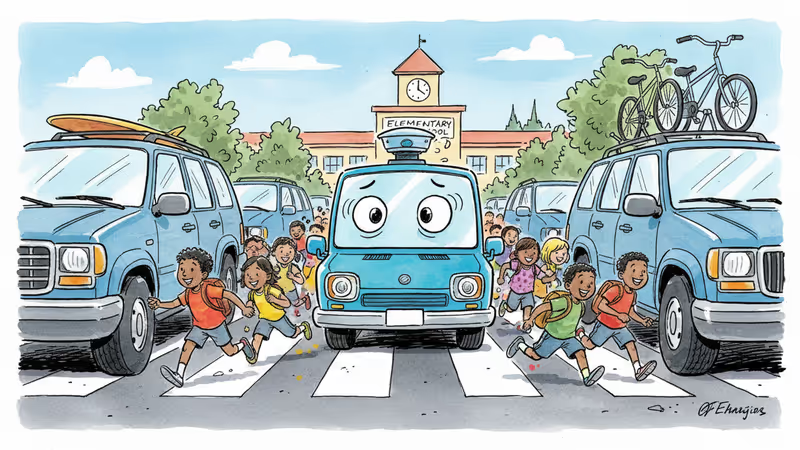
The collision occurred during the morning school rush, that chaotic ballet of double-parked SUVs, running children, and harried parents that defines drop-off time at elementary schools across America. According to the National Highway Traffic Safety Administration (NHTSA), which immediately opened an investigation, the child ran across the street from behind a double-parked vehicle toward the school when the Waymo vehicle struck them.
Waymo's response was swift and technical: their vehicle was traveling at 17 mph when its autonomous system detected the child and "braked hard." The child sustained minor injuries, but the implications are anything but minor.
The Perfect Storm of Urban Complexity
This wasn't a highway accident or a simple intersection mishap. This was autonomous AI confronting one of the most unpredictable environments in urban America: the school zone during drop-off hours. Picture the scene—double-parked vehicles creating blind spots, children darting between cars, crossing guards managing chaos, and parents focused on everything except traffic patterns.
For years, Waymo and other autonomous vehicle companies have touted their superior reaction times and 360-degree awareness. Their vehicles don't get tired, don't text while driving, and don't have emotional reactions. But this incident reveals a fundamental challenge: predicting human behavior, especially children's behavior, in complex urban environments.
The 17 mph speed limit compliance shows the system was following traffic rules. The "hard braking" indicates the sensors detected the child. Yet the collision still occurred, raising uncomfortable questions about the gap between technological capability and real-world performance.

What This Means for the AV Industry
The timing couldn't be worse—or more telling. Waymo has been expanding its robotaxi services across multiple cities, positioning itself as the leader in commercial autonomous vehicle deployment. The company operates hundreds of vehicles in San Francisco, Phoenix, and Los Angeles, completing thousands of rides monthly.
But school zones represent a particular vulnerability. Unlike highway driving, where vehicles move predictably in lanes, or even urban intersections with traffic signals, school areas during drop-off and pickup times are studies in controlled chaos. Children don't follow traffic patterns. Parents create temporary obstacles with double-parking. The environment changes dramatically based on time of day and school calendar.
This incident will likely influence how cities regulate autonomous vehicle operations. Some municipalities may consider restricting AV operations near schools during certain hours, similar to how some areas limit ride-sharing pickups. Others might require additional safety measures or human oversight in these zones.
The Broader Questions We're Not Asking
Beyond the immediate safety concerns lies a more fundamental question: Are we deploying autonomous vehicles in the right environments? The technology excels on highways and in structured environments, but struggles with the unpredictability of urban life—especially around schools, construction zones, and special events.
The incident also highlights the challenge of liability in an AI-driven world. When a human driver strikes a child, we understand the framework of responsibility. When an autonomous system makes split-second decisions that result in injury, who's accountable? The manufacturer? The software developer? The city that permitted the deployment?
Parents dropping their children at Santa Monica schools will now look at every Waymo vehicle differently. That shift in public perception may prove more significant than any regulatory response. Trust, once broken, is difficult to rebuild—especially when children's safety is involved.
Authors
Related Articles
Waymo's new Ojai robotaxi isn't just a vehicle upgrade. It's the company's most serious attempt yet at cracking the cost problem that has kept autonomous vehicles from scaling. Here's what's really at stake.
Sam Nelson, 19, died after following ChatGPT's advice to mix Kratom and Xanax. His parents are suing OpenAI for wrongful death, raising urgent questions about AI trust, liability, and design.
The Musk v. Altman trial in Oakland isn't just a contract dispute. It's become an unscripted window into how AI's most powerful figures actually operate—and who they think should control the technology's future.
Tesla expanded its driverless robotaxi to Dallas and Houston, even after reporting 14 crashes in Austin. What does this tell us about how autonomous vehicles actually get built?
Waymo's new Ojai robotaxi isn't just a vehicle upgrade. It's the company's most serious attempt yet at cracking the cost problem that has kept autonomous vehicles from scaling. Here's what's really at stake.
Sam Nelson, 19, died after following ChatGPT's advice to mix Kratom and Xanax. His parents are suing OpenAI for wrongful death, raising urgent questions about AI trust, liability, and design.
The Musk v. Altman trial in Oakland isn't just a contract dispute. It's become an unscripted window into how AI's most powerful figures actually operate—and who they think should control the technology's future.
Tesla expanded its driverless robotaxi to Dallas and Houston, even after reporting 14 crashes in Austin. What does this tell us about how autonomous vehicles actually get built?
Thoughts
1 thoughts
Share your thoughts on this article
Sign in to join the conversation