
Beyond 'Poor Girl Meets Secret Billionaire Werewolf' - The Real Problem With Billion-Dollar Microdrama
While microdrama apps rake in billions with formulaic content, Watch Club bets on quality storytelling and social communities. Can it work?
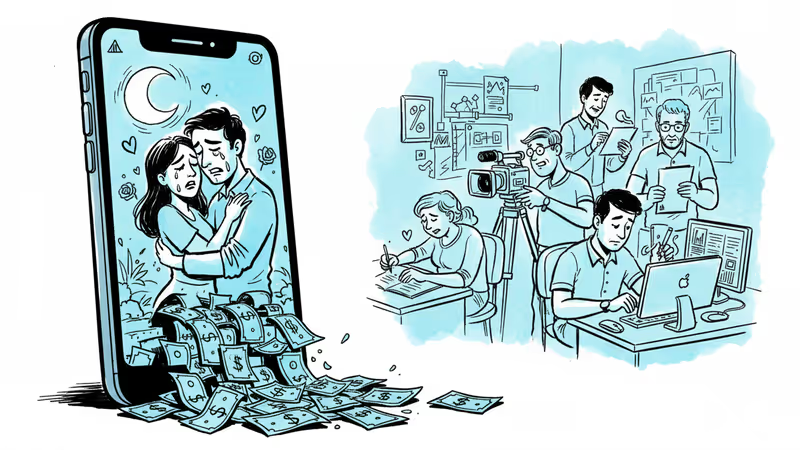
ReelShort made $1.2 billion in in-app purchases last year. DramaBox pulled in $276 million. But if you've ever watched their content, you might wonder: how is this even possible?
The Formula That Prints Money
Henry Soong, founder of Watch Club, isn't mincing words about the current state of microdrama. "Ninety percent of these stories are, 'I'm a poor girl! I fell in love with a secret billionaire! He's a werewolf, and his mother is a vampire, and she disapproves of me!'" The former Meta product manager argues that most content is so formulaic it could feasibly be generated by AI.
Yet the numbers don't lie. Users are paying real money to watch these bite-sized episodes, often getting hooked on cliffhangers that require premium unlocks. The success isn't about storytelling quality—it's about addiction mechanics and aggressive monetization.
Soong sees an opportunity in this gap. What if microdrama could be both profitable and actually good?
The Social TV Experiment
Watch Club's answer goes beyond just hiring better talent (though they do work with SAG and WGA union members, unlike leading competitors). They're embedding a social network directly into the viewing experience.
"I think you can actually build such a more interesting business if you take what makes TV truly the most fun," Soong explains, pointing to shows like "Succession" that spawn endless online discussions. Right now, people dissect "Severance" theories on Reddit or react to finales on Tumblr. Watch Club wants to house both the show and the fan forums in one place.
It's an intriguing premise. Anyone who's tried to avoid spoilers for a major series knows how central community discussion has become to the viewing experience. But can you manufacture that organic engagement?

The Monetization Question Mark
Like most early-stage startups, Watch Club is punting on the revenue model for now. The company secured seed funding led by GV, with backing from Patreon CEO Jack Conte and executives from Hulu, HBO Max, and Meta. Even The Sidemen's investment firm participated.
Soong's confidence comes from his unusual background. At Meta from 2016 to 2019, his job was figuring out how to make money in China—a country where no one could actually use Meta's products. By 2019, he'd built a $5 billion annual business selling ads to Chinese companies wanting to reach audiences outside China.
That experience gave him insight into microdrama economics, since Chinese apps like ReelShort and DramaBox were spending heavily on Instagram ads to acquire Western users. "I know how expensive and capital intensive it is," he says, "and I think you can build a way better microdrama business if you aren't 100% dependent on paid user acquisition."
Quality vs. Scale
The first test comes with "Return Offer," a series about tech interns in San Francisco competing for full-time positions. It's notably mundane compared to the werewolf billionaire fantasies dominating the space—and that might be the point.
Soong's bet is that audiences are ready for microdrama that doesn't insult their intelligence. He's planning ten shows with WGA writers, offering "huge creative latitude to go do something that Amazon would never let them do at a speed and velocity that feels way more exciting than the glacial pace of the television industry."
But there's a tension here. The current microdrama model works precisely because it's cheap, formulaic, and optimized for compulsive consumption. Higher production values and union talent cost more. Thoughtful storytelling might be less addictive than cliffhanger-driven soap operas.
The Creator Economy Angle
What's potentially more interesting is Watch Club's positioning as a creator-friendly alternative. While established platforms lock creators into rigid content guidelines and revenue splits, Soong promises creative freedom in exchange for smaller budgets.
This echoes broader trends in the creator economy, where artists increasingly value creative control over guaranteed payouts. If Watch Club can prove that quality content drives sustainable engagement—not just quick dopamine hits—it could attract talent tired of formulaic content mills.
Authors
Related Articles
From a niche experiment in 2018 to a mainstream disruption in 2026, AI-generated music is forcing the industry to rethink creativity, copyright, and compensation.

Indonesia introduces age-tiered social media restrictions, allowing 13+ for low-risk platforms and 16+ for high-risk ones. How does this compare to Australia's blanket ban?
From Australia's $34M fines to France's parliamentary vote, 10 countries are restricting teen social media access. A global experiment in digital parenting begins.
FCC Chairman supports Paramount-WBD merger while Netflix deal faced regulatory hurdles. A new regulatory playbook for streaming consolidation emerges.
From a niche experiment in 2018 to a mainstream disruption in 2026, AI-generated music is forcing the industry to rethink creativity, copyright, and compensation.
Indonesia introduces age-tiered social media restrictions, allowing 13+ for low-risk platforms and 16+ for high-risk ones. How does this compare to Australia's blanket ban?
From Australia's $34M fines to France's parliamentary vote, 10 countries are restricting teen social media access. A global experiment in digital parenting begins.
FCC Chairman supports Paramount-WBD merger while Netflix deal faced regulatory hurdles. A new regulatory playbook for streaming consolidation emerges.
Thoughts
Share your thoughts on this article
Sign in to join the conversation