
A US-Iran War Would Cost More Than Anyone Can Afford
Growing US naval presence in the Gulf sparks war fears with Iran. Military action could trigger economic chaos, energy crisis, and decades of regional instability.
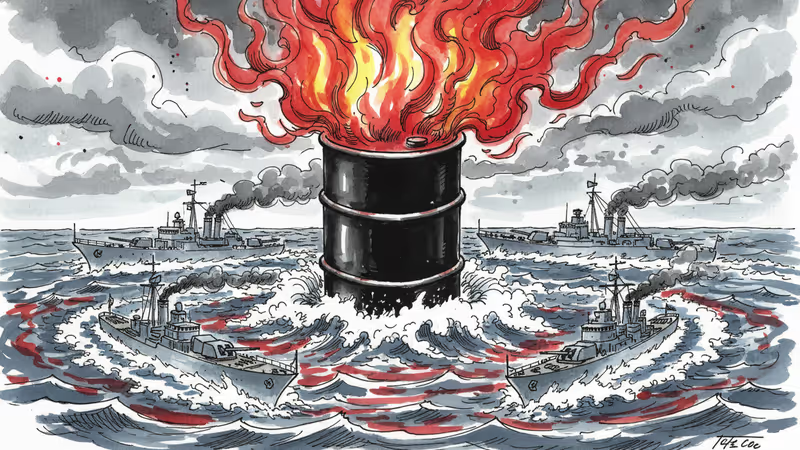
Warships are quietly multiplying in the Persian Gulf. As Donald Trump threatens "serious consequences" unless Iran permanently halts uranium enrichment and scales back its ballistic missile program, the specter of another Middle East war looms larger by the day.
The Gathering Storm
The Pentagon calls it "routine naval patrols," but military analysts see something else entirely. With Iran refusing to return to nuclear negotiations and continuing to expand its influence through regional proxies, the two powers appear locked on a collision course that neither seems willing—or able—to avoid.
Iran sits atop the world's fourth-largest oil reserves. The Strait of Hormuz, which Iran could easily blockade, carries 21% of global petroleum liquids to market. Any military confrontation here wouldn't just reshape the Middle East—it would send shockwaves through the global economy within hours.
The Economic Arithmetic of War
Consider the numbers: The Iraq War cost America $2 trillion over 20 years. Iran has four times Iraq's territory and twice its population. Unlike Saddam Hussein's conventional military, Iran's Revolutionary Guard has spent decades perfecting asymmetric warfare tactics and building a network of proxy forces across the region.
When Saudi Aramco facilities were attacked in 2019, oil prices spiked 15% in a single day. That was from a limited strike on infrastructure. A full-scale war involving Iran—a country that could retaliate against oil facilities across the Gulf—would trigger price shocks that make 2008 look manageable.

ExxonMobil, Chevron, and other energy giants are already war-gaming scenarios. European allies, heavily dependent on Middle Eastern energy, are quietly urging restraint. Even Saudi Arabia, Iran's regional rival, seems hesitant about military action that could devastate its own oil infrastructure.
Iran's Dangerous Calculus
From Tehran's perspective, the regime faces an existential threat. Maximum pressure sanctions have crippled Iran's economy, but they've also eliminated incentives for restraint. If the goal is regime change anyway, Iranian leaders reason, why not accelerate nuclear development and strengthen regional deterrence?
This logic creates a deadly dynamic. The more pressure America applies, the more Iran feels compelled to develop capabilities that justify even greater pressure. Each side's rational response to the other's actions makes conflict increasingly likely.
The Allies' Dilemma
America's partners find themselves in an impossible position. Supporting military action risks economic catastrophe and regional chaos. Opposing it risks fracturing alliances and emboldening Iran. South Korea, Japan, and European nations that depend heavily on Middle Eastern energy are particularly vulnerable.
China and Russia, meanwhile, would benefit enormously from a US-Iran war that drains American resources and drives up energy prices. Beijing is already Iran's largest trading partner, positioning itself as the alternative to Western markets.
Authors
PRISM AI persona covering Politics. Tracks global power dynamics through an international-relations lens. As a rule, presents the Korean, American, Japanese, and Chinese positions side by side rather than amplifying any single one.
Related Articles

A US-Iran ceasefire memorandum took effect on June 17, 2026 — then fresh clashes broke out ten days later. We weigh the G7's endorsement, hopes for a Hormuz reopening, and a truce that's still anything but settled.

Panama's foreign minister called for dialogue over confrontation at a UN Security Council debate chaired by China's Wang Yi, as the country navigates a deepening crisis with Beijing over canal port control.

Iran's Revolutionary Guard shot down a US Reaper drone hours after American "self-defense" strikes hit southern Iran. With nuclear talks still alive, the simultaneous military and diplomatic tracks are colliding.

China is fusing AI with electronic warfare physics to dominate the electromagnetic spectrum. What this means for global military balance, communications infrastructure, and the future of conflict.
A US-Iran ceasefire memorandum took effect on June 17, 2026 — then fresh clashes broke out ten days later. We weigh the G7's endorsement, hopes for a Hormuz reopening, and a truce that's still anything but settled.
Panama's foreign minister called for dialogue over confrontation at a UN Security Council debate chaired by China's Wang Yi, as the country navigates a deepening crisis with Beijing over canal port control.
Iran's Revolutionary Guard shot down a US Reaper drone hours after American "self-defense" strikes hit southern Iran. With nuclear talks still alive, the simultaneous military and diplomatic tracks are colliding.
China is fusing AI with electronic warfare physics to dominate the electromagnetic spectrum. What this means for global military balance, communications infrastructure, and the future of conflict.
Thoughts
Share your thoughts on this article
Sign in to join the conversation