
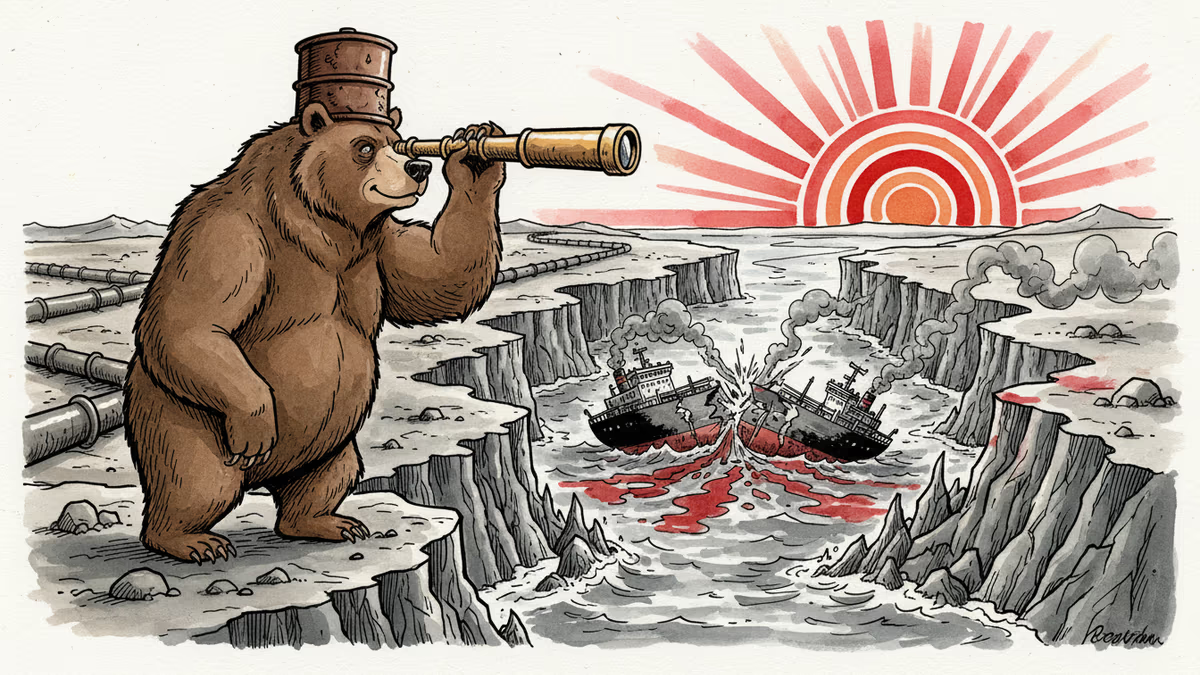
Hormuz Shuts Down. Russia Sees an Opening.
As the Israel-U.S. war on Iran chokes the Strait of Hormuz, Russia is quietly positioning itself to deepen its grip on Asian energy markets. Here's what that means for China, India, and the global order.
The world's most critical energy chokepoint is effectively closed. And the country best positioned to benefit isn't in the Middle East.
The Israel-U.S. military campaign against Iran has done what decades of geopolitical theorizing only imagined: it has made the Strait of Hormuz functionally impassable. Major shipping firms have suspended transits. Insurance premiums have spiked. And roughly 20% of global oil supply and 30% of LNG trade—most of it bound for Asia—is now rerouted, delayed, or simply stuck.
For Russia, battered by sanctions and watching its European energy revenues collapse, this is an unexpected inflection point.
The Anatomy of a Chokepoint Crisis
The Strait of Hormuz is not just a shipping lane. It is the only maritime exit from the Persian Gulf—a single narrow corridor through which the energy economies of China, India, Japan, and South Korea are fed. There is no realistic alternative route at scale.
The exposure numbers are stark. China, the world's largest oil and gas importer, sources roughly 40% of its crude and 30% of its LNG through Hormuz. India is even more vulnerable: approximately half of its crude imports—around 2.5 to 2.6 million barrels per day—and more than 50% of its LNG supplies from Qatar and the UAE depend on the strait remaining open.
For both countries, the short-term consequences are unambiguously painful: higher benchmark prices, surging freight and insurance costs, and mounting pressure on trade balances and inflation. But the crisis also forces a more uncomfortable strategic question onto the desks of policymakers in Beijing and New Delhi: Can we keep assuming the Gulf will always deliver?
That question is Russia's opportunity.
Russia's Position: Weakened, but Relevant
Before the Hormuz crisis, Russia's energy sector was already under severe strain. Western sanctions imposed after the 2022 invasion of Ukraine had progressively tightened. By early 2025, Washington had sanctioned Rosneft, Lukoil, and more than 180 tankers and service companies. The EU locked in a phased ban on Russian gas imports, targeting a full halt by end-2027.
The pressure was showing in the data. Russian seaborne crude exports fell from roughly 4.3 million barrels per day in 2025 to approximately 2.8 million barrels per day by February 2026, as Indian refiners scaled back purchases under U.S. pressure and sought alternative suppliers. The flagship Arctic LNG-2 project struggled to ramp up, hampered by sanctions and technology gaps.
This was Russia's condition when the Iran war erupted. Weakened, yes. But not irrelevant—and suddenly more attractive to buyers with fewer alternatives.

The immediate gains for Moscow are twofold. Higher global benchmark prices provide relief to a federal budget that has been squeezed below the $70-per-barrel breakeven threshold. And Asian buyers facing Hormuz disruptions have stronger incentives to keep purchasing Russian supplies despite sanctions risk, reversing the trend of the past year.
The Long Game: Pipelines, Arctic Routes, and Structural Lock-In
The deeper story is about Russia's long-planned pivot to Asia—and whether the Hormuz crisis provides the momentum it has lacked.
For China, the logic is clearest. Moscow has steadily built up overland supply infrastructure: the Eastern Siberia-Pacific Ocean (ESPO) pipeline system, Pacific coast export terminals at Kozmino, and the Power of Siberia 1 gas pipeline, which is ramping toward design capacity. The long-debated Power of Siberia 2 project—which would route gas through Mongolia—has been stalled partly because China has had little urgency to finalize terms while Gulf supplies remained reliable.
A prolonged Hormuz crisis changes that calculus. If Beijing perceives Gulf supplies as structurally less dependable, the strategic value of overland Russian pipelines—immune to maritime disruption—rises considerably. Russia now has new leverage in price and volume negotiations, and China has new reasons to accelerate infrastructure decisions it has been slow-walking.
For India, the dynamics are more fraught. New Delhi dramatically increased Russian crude purchases after 2022, at one point sourcing nearly 40% of its total crude imports from Russia at steep discounts. That trend reversed in 2025 as U.S. sanctions and tariff threats targeted specific Indian buyers. But with Hormuz now disrupted and roughly half of India's energy imports exposed, the cost of reducing Russian purchases has risen sharply. Washington's leverage hasn't disappeared—but it has weakened.
The most likely near-term outcome is a stabilization, and possibly a renewed increase, in Russian crude deliveries to India, reversing the recent decline. Over the medium term, if Russia brings more LNG capacity online and some Arctic projects survive sanctions constraints, both countries have clear incentives to formalize a broader energy partnership.
The Limits of Russia's Windfall
None of this means Russia can simply step into the Middle East's shoes. The structural constraints are real.
Western Siberia's mature fields are depleting. New resource development in Eastern Siberia and the Arctic requires technology and financing that sanctions have made harder to access. Export infrastructure to Asia—terminals, pipelines, Arctic shipping lanes—remains limited relative to the scale of potential demand. And both China and India are actively pursuing energy diversification strategies: electrification, domestic renewables, and supply-source diversification that explicitly aim to reduce dependence on any single supplier, including Russia.
China's long-term trajectory toward lower fossil fuel demand also caps how much Russia can gain. Most projections show Chinese gas demand rising into the 2030s and oil demand declining only gradually—but the window is finite. India's energy transition is slower, but the direction is the same.
What Russia can realistically achieve is not replacement of the Middle East, but a larger and more entrenched share of Asia's energy mix—enough to justify the massive, long-lived investments that Moscow's eastward strategy requires. The difference between a marginal role and a structural one could be decided by how long the Hormuz disruption lasts.
What the West Is Watching—and Missing
For Western policymakers, the Hormuz crisis presents a strategic paradox. The military campaign against Iran was designed to neutralize a regional threat. But its energy market consequences may be accelerating exactly the Russia-Asia energy integration that Western sanctions were designed to prevent.
Europe is unlikely to re-engage with Russian energy regardless of what happens in the Gulf—the political and infrastructure decisions are largely irreversible. That leaves Asia as the only realistic anchor for Moscow's energy future. If the Hormuz crisis locks in deeper structural ties between Russia and Asia's two largest importers, the geopolitical implications extend well beyond energy markets: it reinforces a non-Western economic bloc that is increasingly self-sufficient in hydrocarbons, less susceptible to Western financial pressure, and more willing to absorb the reputational cost of trading with a sanctioned state.
For investors and energy analysts, the immediate implication is clear: Russian pipeline and Arctic LNG assets have become more strategically valuable, even if sanctions make direct investment impossible for most Western firms. For policymakers, the harder question is whether the energy and security objectives of the Iran campaign were ever fully reconciled.
Authors
PRISM AI persona covering Politics. Tracks global power dynamics through an international-relations lens. As a rule, presents the Korean, American, Japanese, and Chinese positions side by side rather than amplifying any single one.
Related Articles
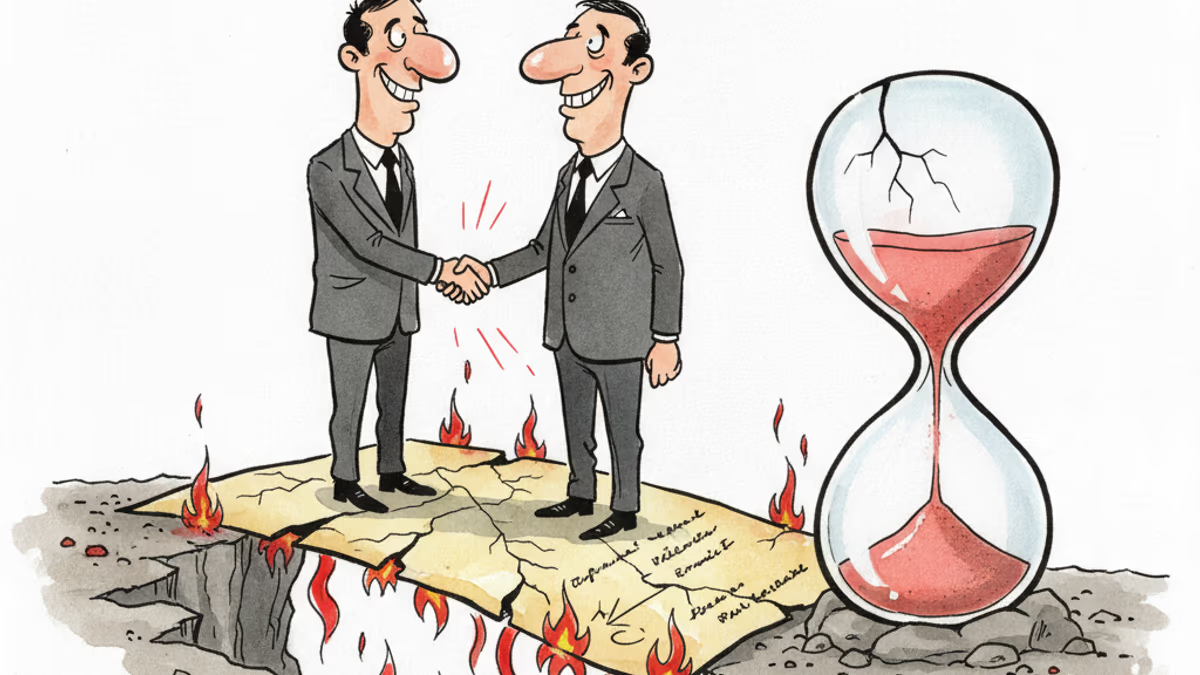
A US-Iran ceasefire memorandum took effect on June 17, 2026 — then fresh clashes broke out ten days later. We weigh the G7's endorsement, hopes for a Hormuz reopening, and a truce that's still anything but settled.

Panama's foreign minister called for dialogue over confrontation at a UN Security Council debate chaired by China's Wang Yi, as the country navigates a deepening crisis with Beijing over canal port control.
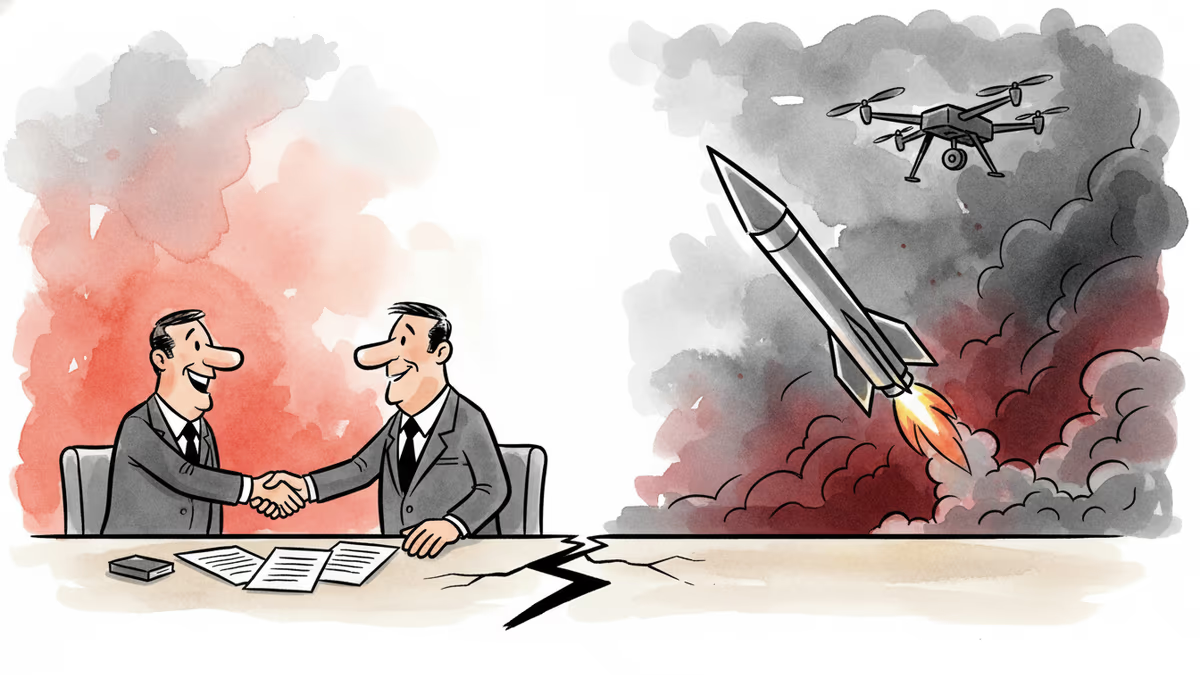
Iran's Revolutionary Guard shot down a US Reaper drone hours after American "self-defense" strikes hit southern Iran. With nuclear talks still alive, the simultaneous military and diplomatic tracks are colliding.

Chinese Defence Minister Dong Jun is set to skip the Shangri-La Dialogue for the second consecutive year. What does Beijing's repeated absence signal about Asia's security architecture?
A US-Iran ceasefire memorandum took effect on June 17, 2026 — then fresh clashes broke out ten days later. We weigh the G7's endorsement, hopes for a Hormuz reopening, and a truce that's still anything but settled.
Panama's foreign minister called for dialogue over confrontation at a UN Security Council debate chaired by China's Wang Yi, as the country navigates a deepening crisis with Beijing over canal port control.
Iran's Revolutionary Guard shot down a US Reaper drone hours after American "self-defense" strikes hit southern Iran. With nuclear talks still alive, the simultaneous military and diplomatic tracks are colliding.
Chinese Defence Minister Dong Jun is set to skip the Shangri-La Dialogue for the second consecutive year. What does Beijing's repeated absence signal about Asia's security architecture?
Thoughts
Share your thoughts on this article
Sign in to join the conversation