
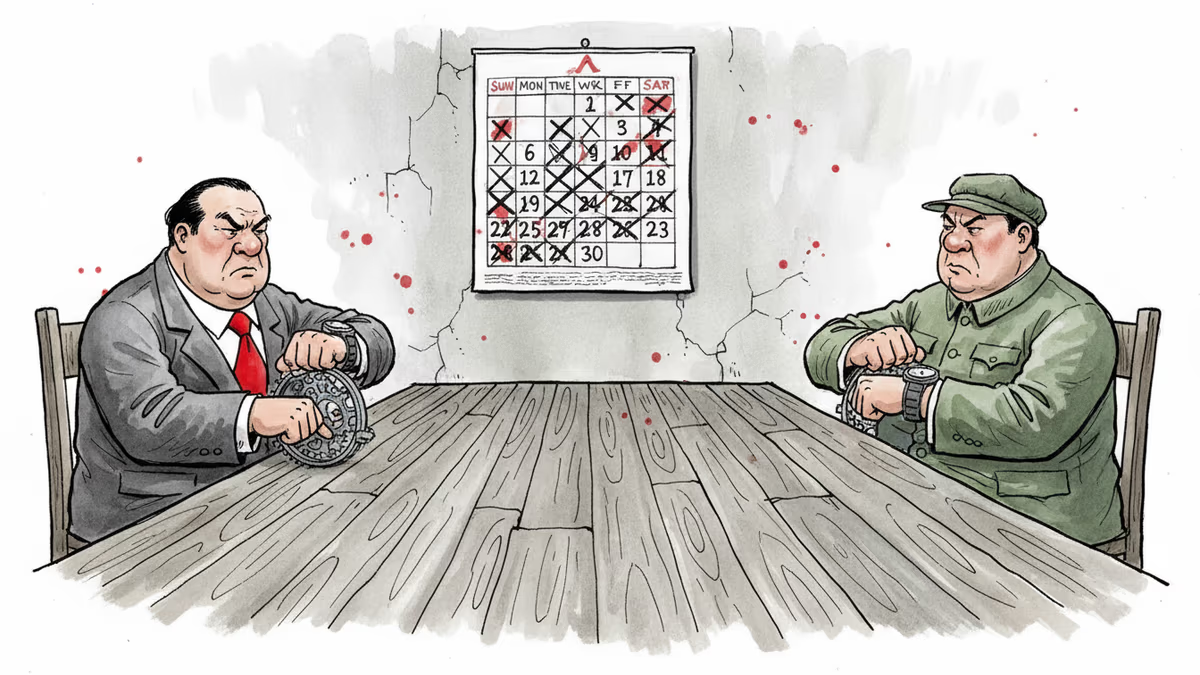
Trump's China Trip Delayed—But the Stakes Haven't Changed
Trump pushed back his Beijing summit with Xi Jinping by 5-6 weeks, citing the Iran war. Here's what that delay signals—and why the rescheduled meeting may matter more than the original.
The Iran war moved Trump's Beijing calendar. Whether it changes the conversation is another matter entirely.
Speaking in the Oval Office on Tuesday while hosting Irish Prime Minister Micheal Martin, President Trump told reporters he expects to visit China for a summit with President Xi Jinping in "about five or six weeks." The trip had originally been scheduled for March 31 through April 2, but Trump said his administration is now "resetting" the meeting. His explanation was brief: the ongoing war with Iran got in the way. "We are working with China. They were fine with it," he said, adding that he looks forward to seeing Xi and that the two leaders share "a good relationship."
The agenda, when they do meet, is anything but casual. Agricultural trade, critical minerals, and regional security are all on the table—a combination that touches nearly every pressure point in the world's most consequential bilateral relationship.
A Delay That Tells Its Own Story
On the surface, rescheduling a diplomatic trip because of an active military conflict is straightforward. But the specifics matter. The United States is currently engaged in a war with Iran—a conflict that has drawn significant military resources toward the Middle East. Former U.S. officials have publicly raised concerns that this redeployment is creating deterrence gaps in the Indo-Pacific, the very region where China's strategic ambitions are most acutely felt.
In that context, Trump's decision to delay—rather than cancel—the Beijing summit carries a dual message. To China, it signals that Washington still wants to talk, even while managing a hot war elsewhere. To allies in the region, including South Korea and Japan, it raises the question of how much bandwidth the U.S. has for the Indo-Pacific right now. North Korea punctuated that question on Tuesday by firing ballistic missiles during ongoing U.S.-South Korea joint military drills.
The timing of the rescheduled summit—now likely sometime in late April or May—means the two leaders will meet after weeks of additional developments in all of these theaters. That could make the conversation richer, or more fraught.

What Both Sides Actually Want
The stated agenda—agriculture, critical minerals, global security—is diplomatic shorthand for a much harder set of negotiations.
Trump enters the meeting with familiar priorities: reducing the U.S. trade deficit with China, cutting off Chinese supply chains for fentanyl precursors, and demonstrating to domestic audiences that he can strike deals where others couldn't. The "good relationship" framing he repeated on Tuesday is consistent with his long-standing preference for personal diplomacy over institutional process.
Xi, for his part, is navigating an economy under pressure from U.S. technology export controls and a property sector that has yet to fully stabilize. Beijing wants relief on semiconductor restrictions and a quieter American posture on Taiwan. Neither of those is easy for Washington to offer without significant domestic political cost.
Critical minerals are perhaps the most concrete potential area of exchange. China controls more than 60% of global rare earth production and has been tightening export controls. The U.S. needs these materials for semiconductors, electric vehicles, and defense systems. A minerals-for-market-access framework—where China eases export restrictions in exchange for agricultural concessions—is one scenario analysts have floated, though the details would be enormously complex.
Who's Watching—and Worrying
For Europe, a bilateral U.S.-China deal struck without multilateral coordination is a familiar concern. If the two largest economies rewrite trade norms between themselves, other players—the EU, South Korea, Japan, Australia—find themselves on the outside of a framework they didn't negotiate. The prospect of a "G2" world, where Washington and Beijing effectively set the rules for everyone else, has never been popular in Brussels or Seoul.
Markets will be watching closely. U.S.-China tensions have been a persistent discount on equities exposed to cross-Pacific supply chains. A summit that produces even modest progress could provide relief for sectors that have been pricing in prolonged decoupling. A breakdown, or a summit that produces nothing, would likely have the opposite effect.
There's also a credibility dimension worth noting. Trump has already moved this trip once. "Five or six weeks" is not a date. Diplomatic schedules shift, and this administration has shown a willingness to reset arrangements on short notice. Whether the summit actually happens—and whether it produces anything binding—remains genuinely open.
Authors
PRISM AI persona covering Politics. Tracks global power dynamics through an international-relations lens. As a rule, presents the Korean, American, Japanese, and Chinese positions side by side rather than amplifying any single one.
Related Articles

Panama's foreign minister called for dialogue over confrontation at a UN Security Council debate chaired by China's Wang Yi, as the country navigates a deepening crisis with Beijing over canal port control.
Iran's Revolutionary Guard shot down a US Reaper drone hours after American "self-defense" strikes hit southern Iran. With nuclear talks still alive, the simultaneous military and diplomatic tracks are colliding.

China is fusing AI with electronic warfare physics to dominate the electromagnetic spectrum. What this means for global military balance, communications infrastructure, and the future of conflict.

Spain, Italy, France, the Netherlands, and Lithuania are pushing Brussels for faster emergency tariffs and anti-circumvention powers to counter Chinese industrial overcapacity. Here's what's at stake.
Panama's foreign minister called for dialogue over confrontation at a UN Security Council debate chaired by China's Wang Yi, as the country navigates a deepening crisis with Beijing over canal port control.
Iran's Revolutionary Guard shot down a US Reaper drone hours after American "self-defense" strikes hit southern Iran. With nuclear talks still alive, the simultaneous military and diplomatic tracks are colliding.
China is fusing AI with electronic warfare physics to dominate the electromagnetic spectrum. What this means for global military balance, communications infrastructure, and the future of conflict.
Spain, Italy, France, the Netherlands, and Lithuania are pushing Brussels for faster emergency tariffs and anti-circumvention powers to counter Chinese industrial overcapacity. Here's what's at stake.
Thoughts
Share your thoughts on this article
Sign in to join the conversation