

Vivo's Global Ultra Gambit: Can Camera Specs Crack the Premium Market?
Vivo announces first global Ultra phone launch with 200MP telephoto camera. Chinese brand challenges Samsung-Apple duopoly with hardware-first approach
The $800 Billion Question: Can Hardware Alone Win Hearts?
Vivo just threw down the gauntlet at MWC 2026. For the first time, the Chinese brand will launch its X Ultra series outside China, starting with the X300 Ultra and its 200MP telephoto camera. But here's the twist: they're not revealing specs, pricing, or launch dates. Just a promise and a professional camera cage that makes your phone look like a film set.
Timing matters. With Galaxy S26 and iPhone 18 launches looming, Vivo is betting everything on camera superiority. The question isn't whether they can build better hardware—it's whether hardware alone can crack the premium market that Samsung and Apple have locked down for over a decade.
The Ecosystem Elephant in the Room
Vivo's hardware prowess isn't in question. The 200MP telephoto and professional accessories signal serious intent. But global smartphone success isn't just about megapixels anymore—it's about integration, optimization, and trust.

Chinese brands face a unique challenge: convincing consumers to abandon established ecosystems. Even OnePlus, with its enthusiast following, struggles to break into true premium territory. Xiaomi dominates value segments but remains niche in flagship categories.
The real test isn't whether Vivo can match camera quality—it's whether they can match the seamless experience users expect from their $1,000+ investment.
Samsung's Silent Advantage
Interestingly, Vivo's aggressive camera push might actually help Samsung. As Chinese brands emphasize raw specs, they're training consumers to care more about camera performance—exactly where Samsung excels with its AI-powered processing and multi-lens coordination.
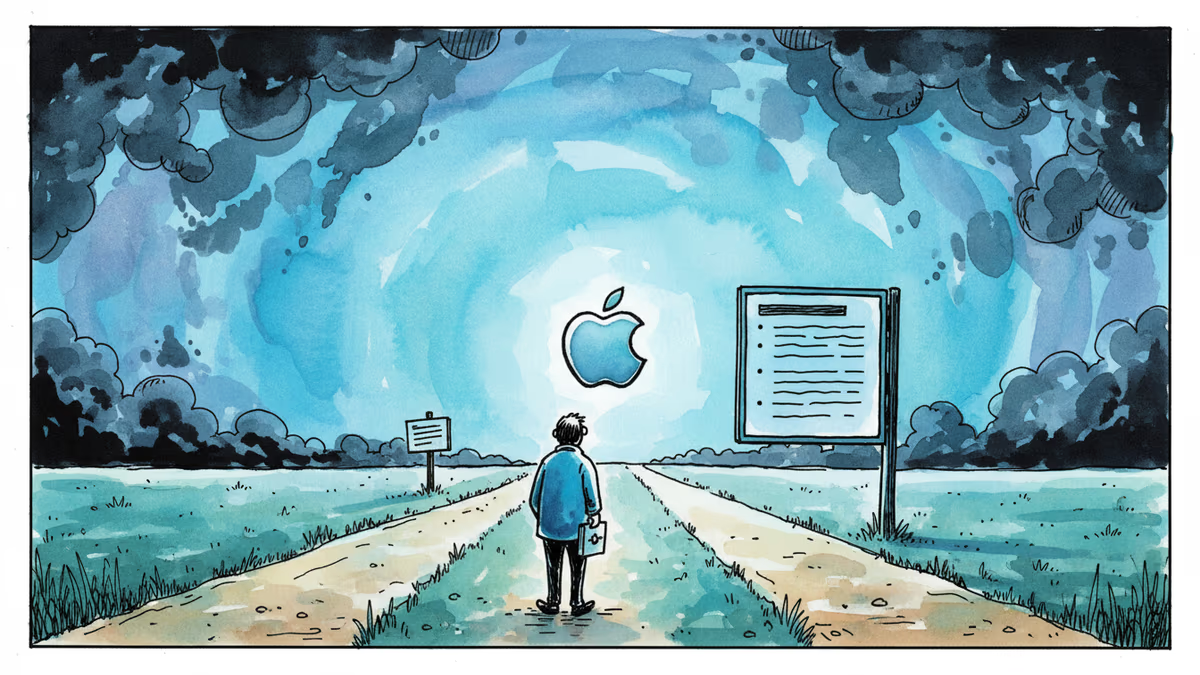
Apple benefits too. While competitors fight spec wars, Apple continues refining computational photography and ecosystem integration. The iPhone's strength isn't its megapixel count—it's how effortlessly those photos sync across devices and integrate with apps.
Authors
Related Articles

Google Gemini's new task automation on the Pixel 10 Pro and Galaxy S26 Ultra lets AI operate apps on your behalf. It's slow, limited, and beta — but it's the first real agentic AI on a consumer phone.

The Galaxy S26 Ultra's built-in Privacy Display is the rare smartphone hardware feature that changes everyday behavior. But is it worth $1,300 when the rest is incremental?
Apple's iPhone 17E improves on its predecessor, but with the iPhone 17 sitting just $200 away, the real question is who this phone is actually for.

Google's Pixel 10a offers flagship-level performance at $499 with 7-year software support, potentially disrupting the premium smartphone market dominated by Apple and Samsung.
Google Gemini's new task automation on the Pixel 10 Pro and Galaxy S26 Ultra lets AI operate apps on your behalf. It's slow, limited, and beta — but it's the first real agentic AI on a consumer phone.
The Galaxy S26 Ultra's built-in Privacy Display is the rare smartphone hardware feature that changes everyday behavior. But is it worth $1,300 when the rest is incremental?
Apple's iPhone 17E improves on its predecessor, but with the iPhone 17 sitting just $200 away, the real question is who this phone is actually for.
Google's Pixel 10a offers flagship-level performance at $499 with 7-year software support, potentially disrupting the premium smartphone market dominated by Apple and Samsung.
Thoughts
Share your thoughts on this article
Sign in to join the conversation