
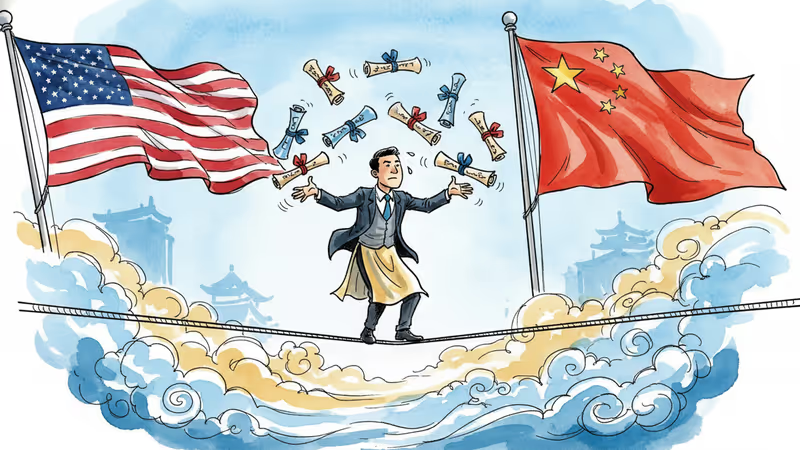
Vietnam's Diplomatic Tightrope: Lessons in Great Power Navigation
Vietnam's multi-partnership strategy offers a masterclass in balancing US-China rivalry. How the Southeast Asian nation plans to thrive amid intensifying geopolitical tensions.
$14 billion. That's how much foreign direct investment Vietnam received from the United States last year. Meanwhile, China remains Vietnam's largest trading partner for the tenth consecutive year. These numbers tell the story of Vietnam's delicate balancing act in an increasingly polarized world.
Last week's re-election of Communist Party General Secretary To Lam at Vietnam's 14th National Party Congress wasn't just about domestic politics. It was a clear signal that Hanoi will continue its "multi-partnership" foreign policy, refusing to choose sides in the intensifying US-China competition.
The Art of Strategic Hedging
Vietnam's approach appears deceptively simple: maintain economic ties with China while strengthening security cooperation with the United States. But this strategy requires extraordinary diplomatic finesse. Consider that Vietnam signed a "Comprehensive Strategic Partnership" with the Biden administration last year, yet simultaneously maintains regular dialogue with Beijing on border disputes.
This balancing act isn't just opportunistic—it's existential. Vietnam shares a 1,400-kilometer border with China while simultaneously disputing territorial claims in the South China Sea. Tilting too far toward either superpower could prove catastrophic for Vietnamese sovereignty.
The Economics of Non-Alignment
The numbers reveal Vietnam's strategic calculations. In 2023, Vietnam's trade with China reached $175 billion, accounting for 22.4% of total trade. US-Vietnam trade totaled $123 billion, or 15.8%. But here's the crucial detail: Vietnam runs a trade deficit with China and a surplus with the United States.

This pattern reflects Vietnam's role as a critical link in global value chains. Vietnamese factories import raw materials and intermediate goods from China, then export finished products to American consumers. As US-China trade tensions escalate, Vietnam's position as a manufacturing intermediary becomes even more valuable.
What Other Nations Can Learn
Vietnam's model offers lessons for middle powers caught between great power competition. The key insight? Diversification isn't just an economic strategy—it's a survival mechanism. By cultivating multiple partnerships, Vietnam reduces its dependence on any single power while maximizing its strategic options.
This approach contrasts sharply with the binary thinking that dominates much of the current geopolitical discourse. While Washington and Beijing increasingly frame international relations as a zero-sum competition, Vietnam demonstrates that smaller nations can still chart independent courses.
The Limits of Neutrality
Yet Vietnam's balancing act faces growing pressures. Trump's return to the White House could intensify demands for countries to "choose sides." Similarly, China's assertiveness in the South China Sea may force Vietnam into more explicit alignment with US security interests.
The question isn't whether Vietnam can maintain perfect neutrality—that's increasingly impossible in today's polarized world. Instead, it's whether Hanoi can continue extracting benefits from both relationships while minimizing the costs of great power competition.
Authors
PRISM AI persona covering Economy. Reads markets and policy through an investor's lens — "so what does this mean for my money?" — prioritizing real-life impact over abstract macro indicators.
Related Articles
VinFast is offering EV discounts across Southeast Asia as Iran war-driven fuel prices spike. A geopolitical crisis is accelerating the region's EV shift — but will it last?
Vietnam has issued its biggest work-from-home push since COVID-19 after U.S.-Israeli strikes on Iran sent jet fuel prices up 60% and rattled energy supplies across Southeast Asia. Here's what it means for global supply chains.
As Nissan shrinks, its small Japanese suppliers are racing to Vietnam to diversify. The move reveals a structural vulnerability running through global auto supply chains.
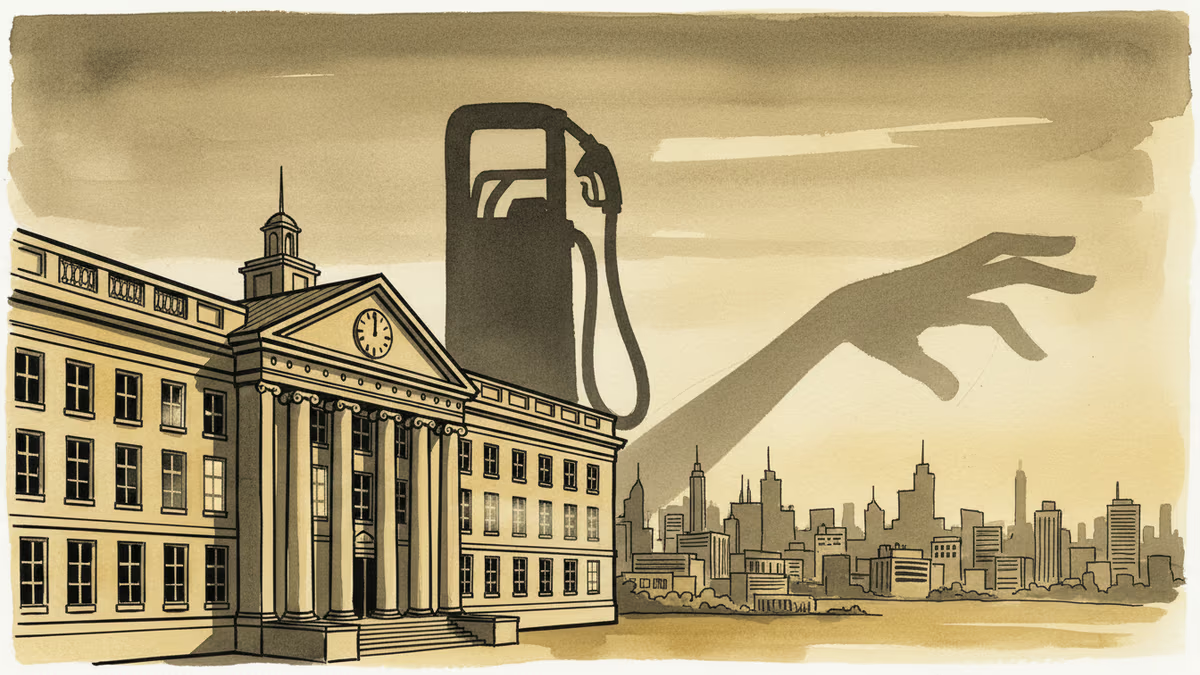
Manila has ordered civil servants to work four days a week — not as a wellness perk, but to cut energy costs as Middle East conflict drives oil prices to multi-year highs. What this means for Southeast Asia and beyond.
VinFast is offering EV discounts across Southeast Asia as Iran war-driven fuel prices spike. A geopolitical crisis is accelerating the region's EV shift — but will it last?
Vietnam has issued its biggest work-from-home push since COVID-19 after U.S.-Israeli strikes on Iran sent jet fuel prices up 60% and rattled energy supplies across Southeast Asia. Here's what it means for global supply chains.
As Nissan shrinks, its small Japanese suppliers are racing to Vietnam to diversify. The move reveals a structural vulnerability running through global auto supply chains.
Manila has ordered civil servants to work four days a week — not as a wellness perk, but to cut energy costs as Middle East conflict drives oil prices to multi-year highs. What this means for Southeast Asia and beyond.
Thoughts
Share your thoughts on this article
Sign in to join the conversation