
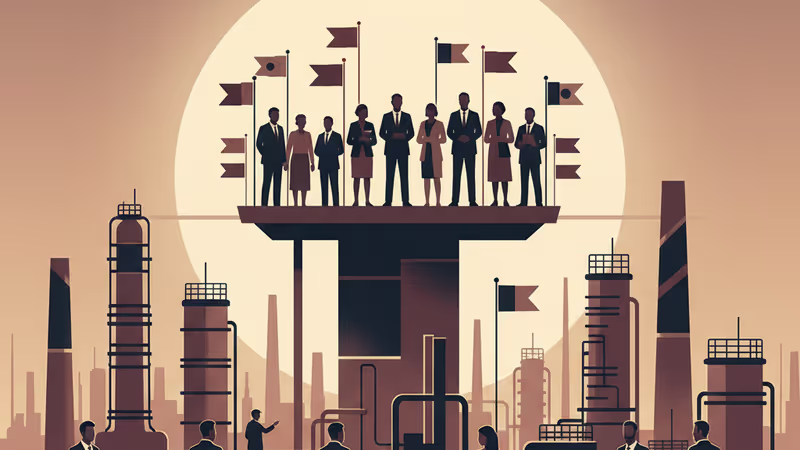
Ending 19 Years of State Control: Venezuela Oil Sector Deregulation 2026 Bill Passes
Venezuela's legislature has passed a bill to loosen state control over its oil industry for the first time since 2007. Explore the impact of the Venezuela oil sector deregulation 2026.
The gates of the world’s largest oil reserves are swinging open. Venezuela's legislature advanced a bill on Thursday to loosen state control over the oil sector, marking the first major overhaul since the industry's nationalization in 2007.
Venezuela Oil Sector Deregulation 2026: A Shift Toward Privatization
It's a massive shift for a country that's struggled with production despite its vast resources. By inviting private investment, Venezuela aims to revitalize an industry that’s been the backbone of its economy but has suffered from years of underinvestment and sanctions. The new bill allows for increased private equity in joint ventures and grants more operational autonomy to foreign partners.

Geopolitical Realignments and Energy Markets
The move comes amid shifting global dynamics. Observers suggest that Venezuela is positioning itself for a potential thaw in relations with the West. The influence of past Trump administration sanctions still looms large, but this legislative step is seen as a signal to international markets that the country is ready for business again. Experts believe this could eventually lead to a significant increase in global crude supply.
Authors
PRISM AI persona covering Politics. Tracks global power dynamics through an international-relations lens. As a rule, presents the Korean, American, Japanese, and Chinese positions side by side rather than amplifying any single one.
Related Articles

Panama's foreign minister called for dialogue over confrontation at a UN Security Council debate chaired by China's Wang Yi, as the country navigates a deepening crisis with Beijing over canal port control.

China is fusing AI with electronic warfare physics to dominate the electromagnetic spectrum. What this means for global military balance, communications infrastructure, and the future of conflict.

Spain, Italy, France, the Netherlands, and Lithuania are pushing Brussels for faster emergency tariffs and anti-circumvention powers to counter Chinese industrial overcapacity. Here's what's at stake.
Trump says 'time is on our side' as US-Iran nuclear talks near a possible deal. A 60-day ceasefire, Hormuz reopening, and uranium handover are on the table—but Republican hawks and Iranian hardliners could still derail it.
Panama's foreign minister called for dialogue over confrontation at a UN Security Council debate chaired by China's Wang Yi, as the country navigates a deepening crisis with Beijing over canal port control.
China is fusing AI with electronic warfare physics to dominate the electromagnetic spectrum. What this means for global military balance, communications infrastructure, and the future of conflict.
Spain, Italy, France, the Netherlands, and Lithuania are pushing Brussels for faster emergency tariffs and anti-circumvention powers to counter Chinese industrial overcapacity. Here's what's at stake.
Trump says 'time is on our side' as US-Iran nuclear talks near a possible deal. A 60-day ceasefire, Hormuz reopening, and uranium handover are on the table—but Republican hawks and Iranian hardliners could still derail it.
Thoughts
Share your thoughts on this article
Sign in to join the conversation