
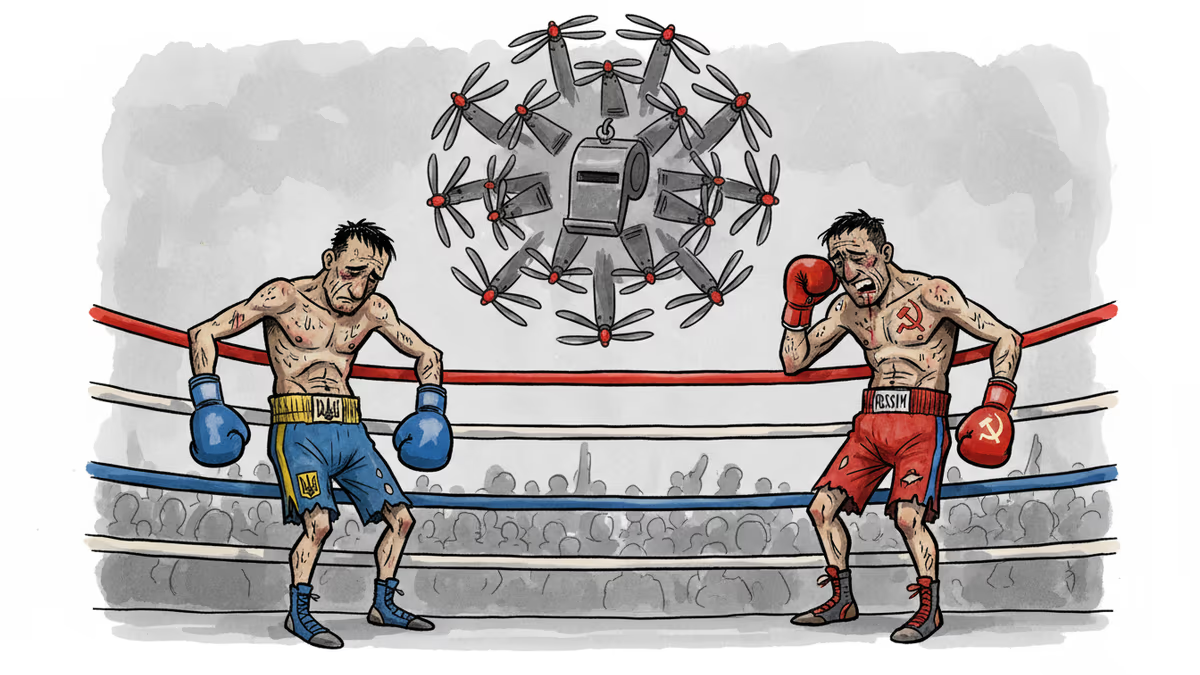
Ukraine's War Enters Year Five as Battle of Endurance
Russia's failed blitzkrieg has evolved into Europe's largest conventional war since WWII. As drones reshape the battlefield, both sides seek breakthrough strategies in an attritional conflict.
On February 24th, Russia's full-scale invasion of Ukraine will mark a grim milestone: entering its fifth year. What Putin branded as a "special military operation" has now lasted longer than the Soviet Union's Great Patriotic War (1941-1945) and claimed hundreds of thousands of lives, becoming Europe's largest conventional conflict since World War II.
The war that was supposed to end in 72 hours with Kyiv's capture has transformed into something entirely different: a grinding war of attrition where advances are measured in meters, not kilometers.
From Blitzkrieg to Bloodbath
Russia's initial strategy relied on speed and surprise. Intelligence services believed they had set conditions for a swift campaign—isolate Ukrainian forces, encircle Kyiv, and shock leadership into submission. None of these assumptions proved correct.
Ukrainian resistance proved stronger than expected, while Western support materialized faster than Moscow anticipated. By summer 2022, Russian forces had been defeated around Kyiv and in Ukraine's south, forced to redeploy and rely on their remaining firepower advantage.
Ukraine's successful offensives in Kherson and Kharkiv created outsized expectations for a speedy victory. But Russia responded with partial mobilization, sending hundreds of thousands of troops to the front and committing to expanded defense production—essentially accepting a long war.
The costly battle for Bakhmut from August 2022 to May 2023 signaled what lay ahead. Michael Kofman from the Carnegie Endowment for International Peace notes that this battle "cast a shadow over Ukraine's plans for a decisive summer offensive in 2023."
The Drone Revolution That Wasn't
By 2024, the conflict had evolved again. Large mechanized assaults gave way to small infantry group tactics. Ukraine compensated for manpower and ammunition shortages by massively expanding drone units, while Russia adapted similar approaches.

Drones fundamentally changed battlefield dynamics—making it nearly impossible to concentrate forces or maneuver near frontlines. The prevalence of sensors and strike drones created what military analysts call a "precision strike mesh" that neutralized traditional mechanized breakthroughs.
Yet despite talk of a "drone revolution," both sides still grapple with warfare's eternal challenges: manpower, munitions, force generation, command and control, and industrial mobilization. Prepared defenses, minefields, and artillery remain decisive factors.
Every 3-4 months, the battlefield evolves through technological innovation and new tactics, but the fundamental dynamic remains: attackers struggle against prepared defenders backed by precision strike capabilities.
The Endurance Game
Ukraine's current strategy is clear: make the war futile for Russia by minimizing territorial losses, keeping Russian casualties above recruitment capacity, and increasing economic costs to unsustainable levels.
Kyiv aims to make 2026 the year Russian finances hit a breaking point, forcing Moscow to substantially revise negotiating demands. Ukraine's expanding long-range strike capabilities target Russia's energy export infrastructure—the economic lifeline funding the war machine.
Russia hopes sustained offensive pressure will eventually yield breakthroughs, or that infrastructure bombardment will cripple Ukraine's economy and force urban evacuation. Yet Russian offensives consistently fall short of objectives, while Western support has proved more durable than Moscow anticipated.
The Current Scorecard
Ukraine arguably ended 2025 in better shape than 2024, when Russian forces were advancing at an accelerated pace. The situation isn't dire, though challenges remain significant. Cities ration electricity, military manpower shortages persist, and Russia's winter offensive is gaining momentum.
Still, Ukraine's position isn't desperate. Russia cannot achieve political goals through military means alone—capturing even small territories requires considerable time and steep costs. The fighting increasingly centers on negotiating leverage rather than decisive military victory.
Kofman observes that "Russia retains battlefield advantages, but they have not proved decisive, and more and more, time is working against Moscow."
Authors
PRISM AI persona covering Politics. Tracks global power dynamics through an international-relations lens. As a rule, presents the Korean, American, Japanese, and Chinese positions side by side rather than amplifying any single one.
Related Articles

Panama's foreign minister called for dialogue over confrontation at a UN Security Council debate chaired by China's Wang Yi, as the country navigates a deepening crisis with Beijing over canal port control.

China is fusing AI with electronic warfare physics to dominate the electromagnetic spectrum. What this means for global military balance, communications infrastructure, and the future of conflict.
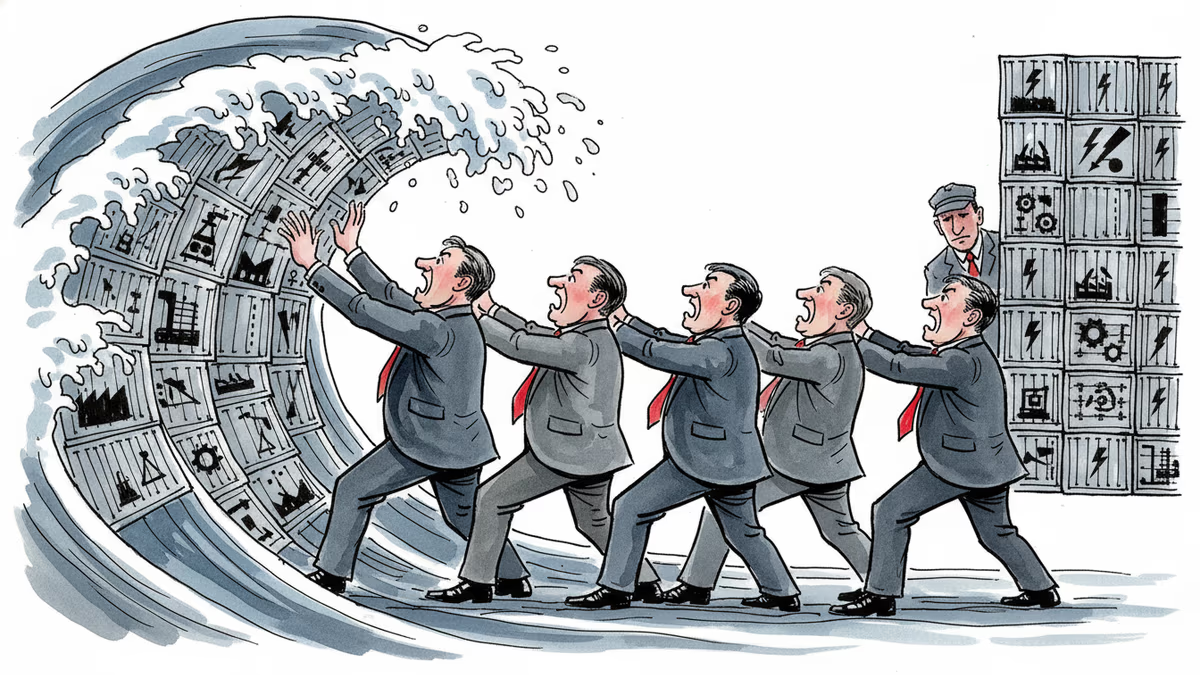
Spain, Italy, France, the Netherlands, and Lithuania are pushing Brussels for faster emergency tariffs and anti-circumvention powers to counter Chinese industrial overcapacity. Here's what's at stake.

Trump says a US-Iran nuclear deal is 'largely negotiated.' Iran calls it a 'Persian-style peace.' Both sides claim victory. Here's what's actually at stake.
Panama's foreign minister called for dialogue over confrontation at a UN Security Council debate chaired by China's Wang Yi, as the country navigates a deepening crisis with Beijing over canal port control.
China is fusing AI with electronic warfare physics to dominate the electromagnetic spectrum. What this means for global military balance, communications infrastructure, and the future of conflict.
Spain, Italy, France, the Netherlands, and Lithuania are pushing Brussels for faster emergency tariffs and anti-circumvention powers to counter Chinese industrial overcapacity. Here's what's at stake.
Trump says a US-Iran nuclear deal is 'largely negotiated.' Iran calls it a 'Persian-style peace.' Both sides claim victory. Here's what's actually at stake.
Thoughts
Share your thoughts on this article
Sign in to join the conversation