
Ancient Giants Deep in Earth Have Been Controlling Our Magnetic Field for 265 Million Years
Scientists discovered continent-sized hot structures 2,900km below Earth's surface have shaped our planet's magnetic field for 265 million years, revolutionizing our understanding of geodynamics.
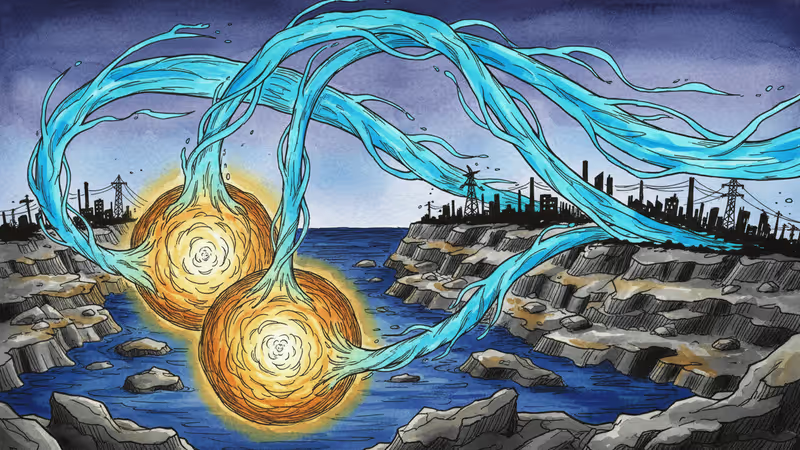
Two continent-sized hot blobs buried 2,900 kilometers beneath our feet have been secretly orchestrating Earth's magnetic field for the past 265 million years. And we're only just figuring it out now.
A team from the University of Liverpool has cracked one of geology's most enduring mysteries: why Earth's magnetic field looks so wonky, and how it's maintained these irregular patterns across geological time. Their findings, published this week in Nature Geoscience, reveal that these ancient structures aren't just passive lumps of hot rock—they're active players in one of our planet's most crucial systems.
The Hidden Architects
These mysterious masses go by the unwieldy name of Large Low-Shear-Velocity Provinces (LLSVPs), but think of them as Earth's internal weather systems. Each roughly the size of Africa, they're not solid chunks but regions where the mantle material runs hotter, denser, and chemically distinct from everything around it.
What makes them particularly intriguing is the "ring" of cooler material that surrounds each blob, creating a thermal landscape that's been shaping our planet's behavior since before the dinosaurs.
Geologists have suspected these anomalies existed since the late 1970s, confirmed them in the 1990s, and only now—after another decade of research—can directly link them to magnetic field behavior. It's taken nearly half a century to connect these dots.
The Iron Flow Connection
Here's where it gets fascinating. The temperature differences between these hot blobs and the surrounding mantle material don't just sit there—they actively alter how liquid iron flows in Earth's core. And that iron flow? That's what generates our magnetic field.

The research team used supercomputer simulations to compare two scenarios: how the magnetic field should behave if the mantle were uniform versus how it actually behaves with these heterogeneous hot spots. Only the model incorporating the LLSVPs reproduced the real magnetic field's irregularities, tilts, and patterns.
It's like discovering that the engine of your car has been running differently for millions of years because of two hot spots you never knew existed—and somehow, that's exactly what's been keeping it running smoothly.
Rewriting Geological History
The implications stretch far beyond understanding Earth's magnetic quirks. According to lead researcher Andy Biggin, these findings could help resolve "long-standing uncertainties in ancient climate, paleobiology, and the formation of natural resources."
The simulations revealed that some parts of the magnetic field have remained relatively stable for hundreds of millions of years, while others have changed dramatically. This challenges the long-held assumption that Earth's magnetic field, when averaged over long periods, behaves like a perfect bar magnet aligned with the planet's rotational axis.
"Our findings are that this may not quite be true," Biggin noted—a statement that might sound modest but represents a fundamental shift in how we understand our planet's deep dynamics.
Beyond Academic Curiosity
This isn't just about satisfying scientific curiosity. Understanding these deep Earth processes could improve climate models, enhance natural resource exploration, and help us better predict how Earth's magnetic field might change in the future.
The magnetic field isn't just a navigation tool for compasses—it's our planet's shield against harmful solar radiation. Any significant changes could have profound implications for everything from satellite operations to the evolution of life itself.
Authors
Related Articles

Samsung Electronics' union branch revealed that 84% of survey respondents oppose the government's roughly $290 billion (₩400 trillion) semiconductor megaproject in Gwangju. Government, management, the union and shareholders are all reading the same national project in sharply different ways.

Nvidia shipped roughly a billion RISC-V cores in 2024, then announced it would run CUDA on the open standard. We break down how royalty-free instruction sets and open software stacks are trying to route around CUDA's lock-in. Part 2 of the Semiconductor Sovereignty series.

US AI-chip export controls split into three layers in the first half of 2026 — January easing, a May crackdown on circumvention, and a pending bill. Nvidia erased China from its guidance and still posted a record $81.6 billion quarter. A look at the export policy that both shields and cages it.
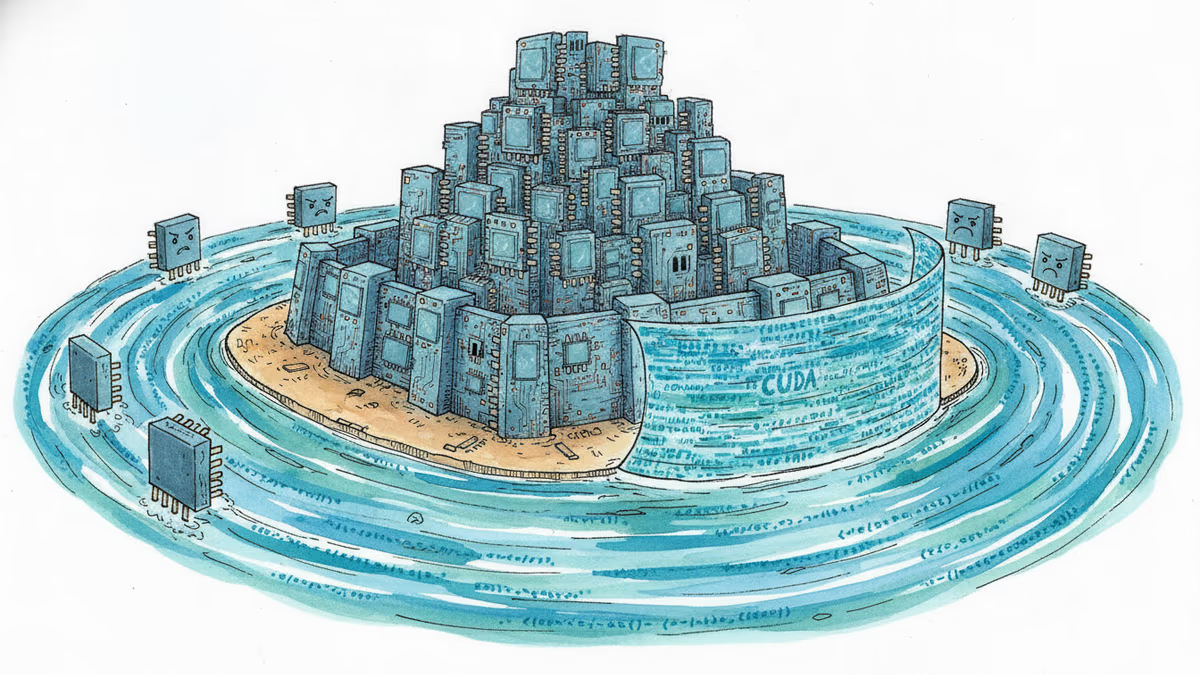
AMD's MI325X matches or beats Nvidia on memory and bandwidth — yet Nvidia's 86-92% share holds. The real moat is CUDA, 20 years in the making. Part 1 of 4.
Samsung Electronics' union branch revealed that 84% of survey respondents oppose the government's roughly $290 billion (₩400 trillion) semiconductor megaproject in Gwangju. Government, management, the union and shareholders are all reading the same national project in sharply different ways.
Nvidia shipped roughly a billion RISC-V cores in 2024, then announced it would run CUDA on the open standard. We break down how royalty-free instruction sets and open software stacks are trying to route around CUDA's lock-in. Part 2 of the Semiconductor Sovereignty series.
US AI-chip export controls split into three layers in the first half of 2026 — January easing, a May crackdown on circumvention, and a pending bill. Nvidia erased China from its guidance and still posted a record $81.6 billion quarter. A look at the export policy that both shields and cages it.
AMD's MI325X matches or beats Nvidia on memory and bandwidth — yet Nvidia's 86-92% share holds. The real moat is CUDA, 20 years in the making. Part 1 of 4.
Thoughts
Share your thoughts on this article
Sign in to join the conversation