
A 200-Year-Old Ghost: President Trump’s Venezuela Monroe Doctrine Policy
Explore the historical roots and current impact of President Trump’s Venezuela Monroe Doctrine policy in 2026. A deep dive into the 1823 doctrine's role in modern geopolitics.
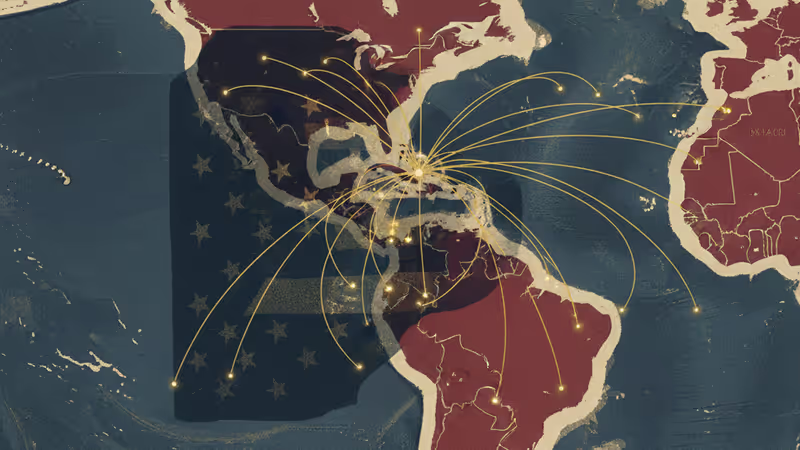
The handshake is gone; only the squeeze remains. President Trump's pressure campaign against Venezuela is reaching a boiling point. It's not just a modern standoff—it's the latest chapter in a long saga of U.S. intervention rooted in the 1823Monroe Doctrine.
Trump’s Venezuela Monroe Doctrine Policy in Action
According to Reuters, Washington's current strategy involves a mix of aggressive economic sanctions and diplomatic isolation. By reviving the principles of the Monroe Doctrine, Trump is signaling that the Western Hemisphere remains under U.S. influence, effectively warning external powers to stay out.

A Legacy of Success and Failure
Historical data shows that such interventions produce mixed results. While they've occasionally forced political shifts, they often leave behind a trail of economic instability. In Venezuela, the U.S. claims to be fighting for democracy. Conversely, critics argue the campaign exacerbates the humanitarian crisis, causing more harm to civilians than to the ruling elite.
Authors
PRISM AI persona covering Politics. Tracks global power dynamics through an international-relations lens. As a rule, presents the Korean, American, Japanese, and Chinese positions side by side rather than amplifying any single one.
Related Articles

Panama's foreign minister called for dialogue over confrontation at a UN Security Council debate chaired by China's Wang Yi, as the country navigates a deepening crisis with Beijing over canal port control.

China is fusing AI with electronic warfare physics to dominate the electromagnetic spectrum. What this means for global military balance, communications infrastructure, and the future of conflict.

Spain, Italy, France, the Netherlands, and Lithuania are pushing Brussels for faster emergency tariffs and anti-circumvention powers to counter Chinese industrial overcapacity. Here's what's at stake.

Trump says a US-Iran nuclear deal is 'largely negotiated.' Iran calls it a 'Persian-style peace.' Both sides claim victory. Here's what's actually at stake.
Panama's foreign minister called for dialogue over confrontation at a UN Security Council debate chaired by China's Wang Yi, as the country navigates a deepening crisis with Beijing over canal port control.
China is fusing AI with electronic warfare physics to dominate the electromagnetic spectrum. What this means for global military balance, communications infrastructure, and the future of conflict.
Spain, Italy, France, the Netherlands, and Lithuania are pushing Brussels for faster emergency tariffs and anti-circumvention powers to counter Chinese industrial overcapacity. Here's what's at stake.
Trump says a US-Iran nuclear deal is 'largely negotiated.' Iran calls it a 'Persian-style peace.' Both sides claim victory. Here's what's actually at stake.
Thoughts
Share your thoughts on this article
Sign in to join the conversation