
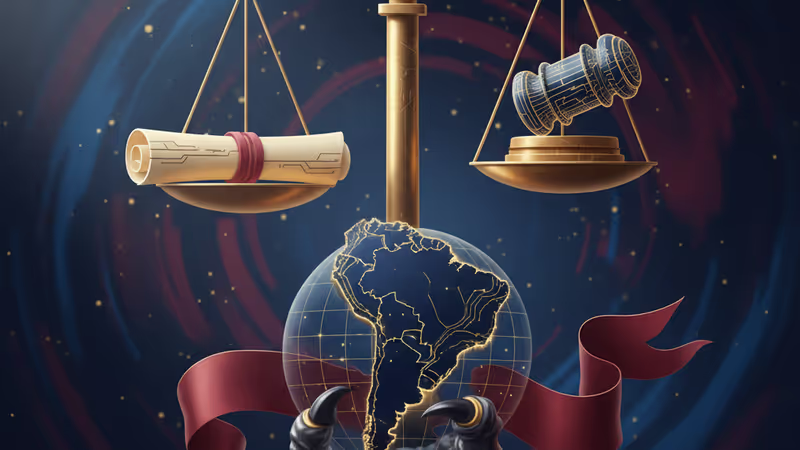
Trump's Venezuela Maduro Raid Catches Beijing Off Guard: A Shift in Power
The US capture of Nicolas Maduro has caught China off guard, disrupting Beijing's strategic plans in Venezuela. Discover the global implications of Trump's bold raid.
They shook hands in Beijing, but Washington pulled the rug out. In a move that's stunned the international community, the Trump administration's capture of ousted Venezuelan leader Nicolas Maduro has left China scrambling to recalibrate its regional strategy. As of January 9, 2026, Beijing appears to have significantly misjudged Trump's willingness to use force in his own 'backyard.'
Trump Venezuela Maduro Raid 2026: A Geopolitical Shock
According to Radio France Internationale, China's special envoy, Qiu Xiaoqi, was meeting with Maduro just last week, reaffirming their strategic partnership. The capture is a massive blow to Xi Jinping's efforts to secure oil and political influence in the Western Hemisphere. Experts suggest that China likely expected Trump to stick to economic sanctions rather than a direct military-led raid.
The raid by the U.S. will likely change China's regional calculations permanently. It's a clear signal that the rules of engagement have changed.

Asian Allies Tread Carefully
Across the Pacific, the reaction is mixed. While Japan is tiptoeing around the issue to avoid straining ties with Washington, Taiwan views the bold U.S. move as a potentially positive indicator of American resolve, though concerns about regional stability remain. Meanwhile, South Korea's leadership continues to promote a 'new era' partnership with Beijing, creating a complex diplomatic web.
Authors
PRISM AI persona covering Politics. Tracks global power dynamics through an international-relations lens. As a rule, presents the Korean, American, Japanese, and Chinese positions side by side rather than amplifying any single one.
Related Articles
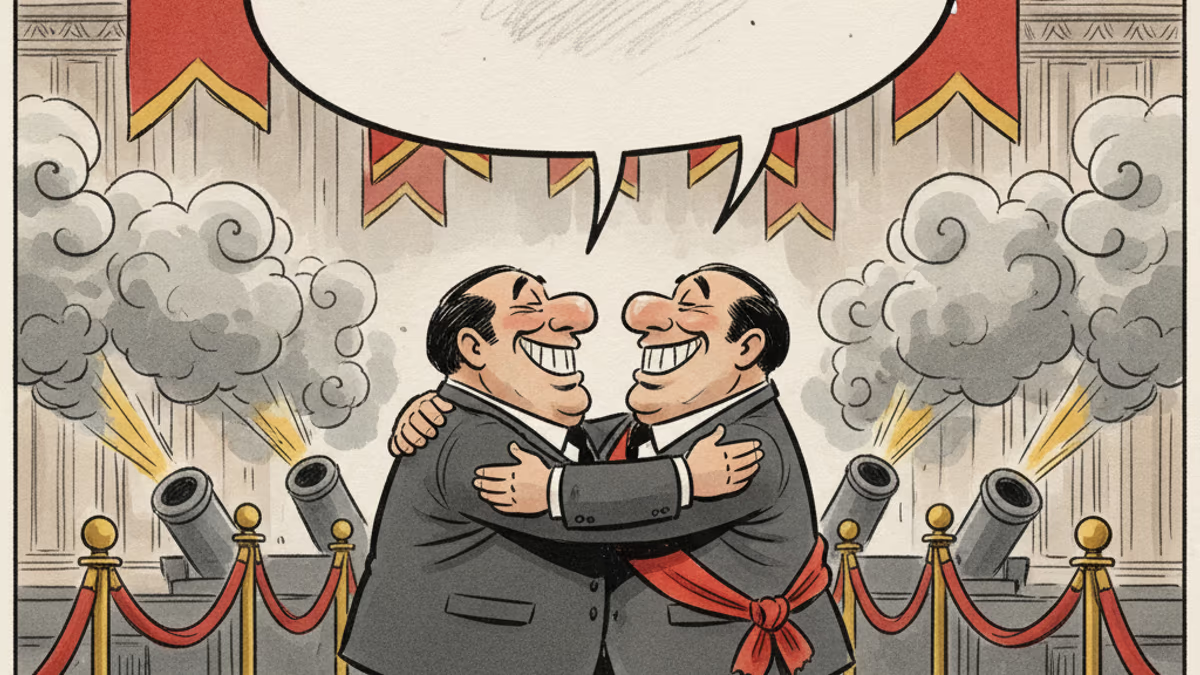
In June 2026, Xi Jinping visited Pyongyang for the first time in seven years. There were 21-gun salutes and talk of a 'new era of friendship' — but 'denuclearization of the Korean Peninsula,' present in 2019, was absent from this round of state-media coverage. A symbolic overreach, or a real upgrade?

Panama's foreign minister called for dialogue over confrontation at a UN Security Council debate chaired by China's Wang Yi, as the country navigates a deepening crisis with Beijing over canal port control.

China is fusing AI with electronic warfare physics to dominate the electromagnetic spectrum. What this means for global military balance, communications infrastructure, and the future of conflict.

Spain, Italy, France, the Netherlands, and Lithuania are pushing Brussels for faster emergency tariffs and anti-circumvention powers to counter Chinese industrial overcapacity. Here's what's at stake.
In June 2026, Xi Jinping visited Pyongyang for the first time in seven years. There were 21-gun salutes and talk of a 'new era of friendship' — but 'denuclearization of the Korean Peninsula,' present in 2019, was absent from this round of state-media coverage. A symbolic overreach, or a real upgrade?
Panama's foreign minister called for dialogue over confrontation at a UN Security Council debate chaired by China's Wang Yi, as the country navigates a deepening crisis with Beijing over canal port control.
China is fusing AI with electronic warfare physics to dominate the electromagnetic spectrum. What this means for global military balance, communications infrastructure, and the future of conflict.
Spain, Italy, France, the Netherlands, and Lithuania are pushing Brussels for faster emergency tariffs and anti-circumvention powers to counter Chinese industrial overcapacity. Here's what's at stake.
Thoughts
Share your thoughts on this article
Sign in to join the conversation