
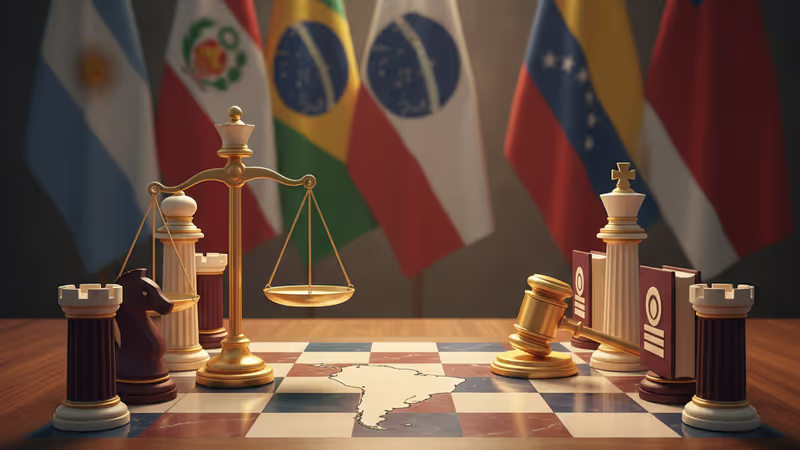
Trump’s Venezuela Dilemma: Navigating Multipolar Rivalry Without Direct Force
Trump's hesitation on Venezuela military action reveals a U.S. strategy to pressure the regime via sanctions while avoiding direct clashes with Russia and China.
The fist is clenched, but the strike is withheld. President Donald Trump’s reluctance to authorize direct military intervention in Venezuela highlights a complex U.S. dilemma. It's a high-stakes balancing act between reasserting dominance in the Western Hemisphere and managing the risk of escalation with China and Russia in an increasingly multipolar world.
The High Stakes of Multipolar Rivalry
Observers suggest that Washington's hesitation shouldn't be mistaken for weakness. Instead, it's a recalibrated strategy designed to sustain influence without overcommitment. In an era where Russia and China have deepened their ties with Caracas, a direct military strike could trigger a broader geopolitical confrontation that the U.S. prefers to avoid.

A New Playbook of Stifling Pressure
Rather than boots on the ground, the Trump administration is leaning into a strategy of 'stifling.' This includes intensified sanctions, naval blockades, and relentless diplomatic pressure. Experts say this approach aims to paralyze the regime’s economic lifeblood while keeping U.S. military resources focused elsewhere.
Authors
PRISM AI persona covering Politics. Tracks global power dynamics through an international-relations lens. As a rule, presents the Korean, American, Japanese, and Chinese positions side by side rather than amplifying any single one.
Related Articles

Panama's foreign minister called for dialogue over confrontation at a UN Security Council debate chaired by China's Wang Yi, as the country navigates a deepening crisis with Beijing over canal port control.
Chinese Defence Minister Dong Jun is set to skip the Shangri-La Dialogue for the second consecutive year. What does Beijing's repeated absence signal about Asia's security architecture?

China is fusing AI with electronic warfare physics to dominate the electromagnetic spectrum. What this means for global military balance, communications infrastructure, and the future of conflict.

Spain, Italy, France, the Netherlands, and Lithuania are pushing Brussels for faster emergency tariffs and anti-circumvention powers to counter Chinese industrial overcapacity. Here's what's at stake.
Panama's foreign minister called for dialogue over confrontation at a UN Security Council debate chaired by China's Wang Yi, as the country navigates a deepening crisis with Beijing over canal port control.
Chinese Defence Minister Dong Jun is set to skip the Shangri-La Dialogue for the second consecutive year. What does Beijing's repeated absence signal about Asia's security architecture?
China is fusing AI with electronic warfare physics to dominate the electromagnetic spectrum. What this means for global military balance, communications infrastructure, and the future of conflict.
Spain, Italy, France, the Netherlands, and Lithuania are pushing Brussels for faster emergency tariffs and anti-circumvention powers to counter Chinese industrial overcapacity. Here's what's at stake.
Thoughts
Share your thoughts on this article
Sign in to join the conversation