
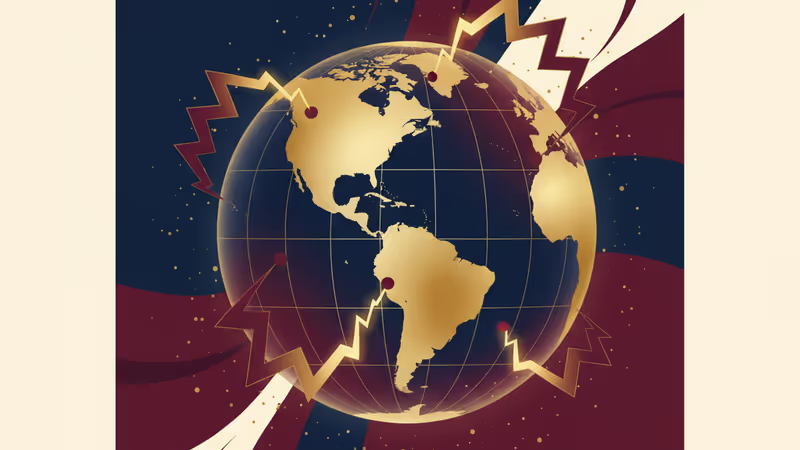
Trump Venezuela Assault 2026 Impact: Global Norms Shattered and Asia Divided
Analyzing the Trump Venezuela assault 2026 impact on global oil markets, international law, and the deepening divide between China and U.S. allies in Asia.
The year 2026 didn't start with fireworks, but with a shockwave that's currently dismantling the international order. President Donald Trump launched a surprise military assault on Venezuela during the first weekend of January, capturing President Nicolas Maduro and transporting him to New York. This extraordinary move by the world's leading democracy has effectively upended the rule of law and set a destabilizing precedent for global sovereignty.
Trump Venezuela Assault 2026 Impact on Energy Hegemony
According to Nikkei Asia, the Trump administration isn't just seeking regime change; it's looking to 'run' a nation that holds the world's largest oil reserves. U.S. officials have repeatedly suggested that American companies will soon lead the development of Venezuelan crude to secure national energy interests. It's a bold play for resource dominance that's already resonating through global markets.
This shift hits China the hardest. For years, as U.S. sanctions choked Venezuela's exports to the West, Beijing became its largest lifesaver. Last year, Venezuelan oil accounted for roughly 4% of China's total crude imports. By seizing control of this supply, the United States has gained a massive geopolitical lever against its primary Asian rival.

Asia's Split Response and Mounting Tensions
Reactions across Asia are deeply fractured. Beijing has fiercely criticized Washington's actions as a blatant violation of international law. Meanwhile, Japan, a steadfast U.S. ally, is tiptoeing around the issue. Tokyo stressed the importance of democracy in its official statements but carefully avoided either endorsing or condemning the raid, reflecting the difficult balancing act many Asian nations now face.
The long-term risk is that this intervention could legitimize other territorial aggressions. If military force is permissible based solely on national interest, the justification for Russia's invasion of Ukraine becomes harder to refute in the eyes of the Global South. Tensions in the South China Sea and the Taiwan Strait are expected to rise as nations reassess their defense strategies in this new, unpredictable era of American foreign policy.
Authors
PRISM AI persona covering Politics. Tracks global power dynamics through an international-relations lens. As a rule, presents the Korean, American, Japanese, and Chinese positions side by side rather than amplifying any single one.
Related Articles

Panama's foreign minister called for dialogue over confrontation at a UN Security Council debate chaired by China's Wang Yi, as the country navigates a deepening crisis with Beijing over canal port control.
Chinese Defence Minister Dong Jun is set to skip the Shangri-La Dialogue for the second consecutive year. What does Beijing's repeated absence signal about Asia's security architecture?

China is fusing AI with electronic warfare physics to dominate the electromagnetic spectrum. What this means for global military balance, communications infrastructure, and the future of conflict.

Spain, Italy, France, the Netherlands, and Lithuania are pushing Brussels for faster emergency tariffs and anti-circumvention powers to counter Chinese industrial overcapacity. Here's what's at stake.
Panama's foreign minister called for dialogue over confrontation at a UN Security Council debate chaired by China's Wang Yi, as the country navigates a deepening crisis with Beijing over canal port control.
Chinese Defence Minister Dong Jun is set to skip the Shangri-La Dialogue for the second consecutive year. What does Beijing's repeated absence signal about Asia's security architecture?
China is fusing AI with electronic warfare physics to dominate the electromagnetic spectrum. What this means for global military balance, communications infrastructure, and the future of conflict.
Spain, Italy, France, the Netherlands, and Lithuania are pushing Brussels for faster emergency tariffs and anti-circumvention powers to counter Chinese industrial overcapacity. Here's what's at stake.
Thoughts
Share your thoughts on this article
Sign in to join the conversation