
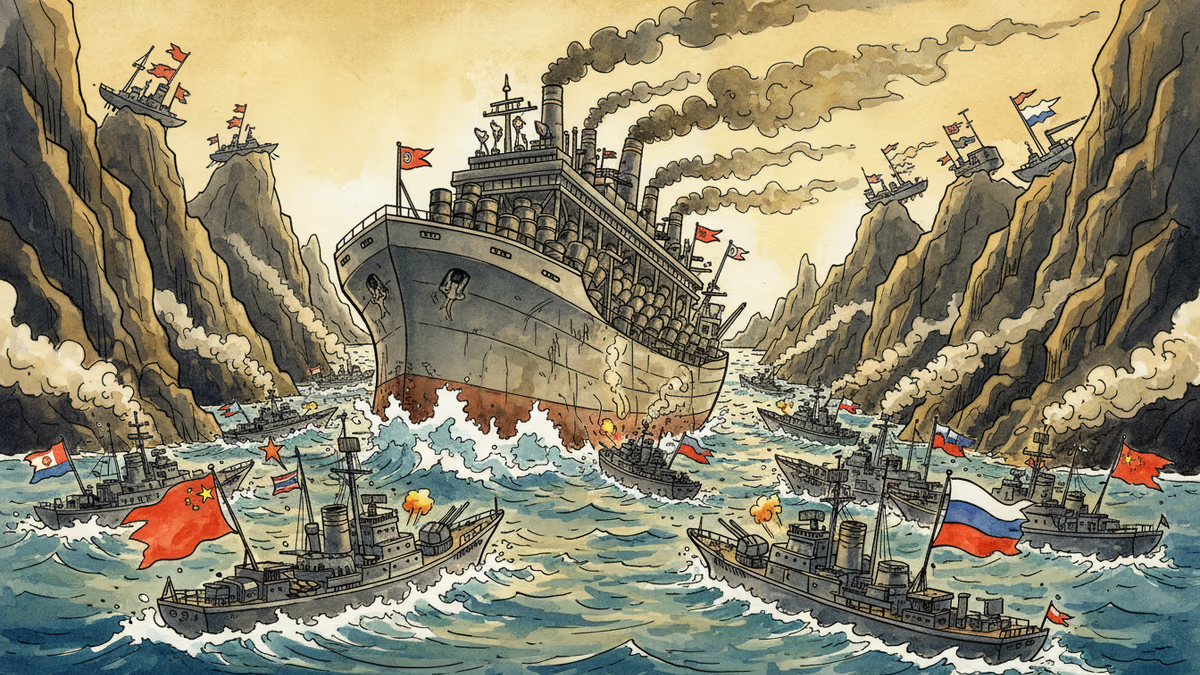
If the Strait of Hormuz Closes, Who Pays?
Trump is urging China, UK, and Japan to send warships to keep the Strait of Hormuz open. With 20% of global oil supply at stake, here's what a closure would mean for energy markets, inflation, and your portfolio.
One chokepoint. One-fifth of the world's oil. And right now, Donald Trump is publicly asking China — his top geopolitical rival — to send warships to keep it open.
What's Happening
The Strait of Hormuz, at its narrowest just 33 kilometers wide, is the single most important oil transit route on the planet. Every day, roughly 17 million barrels of crude — about 20% of global supply — flow through it from Saudi Arabia, Iraq, Iran, Kuwait, and the UAE toward markets in Asia and Europe.
As of March 15, 2026, with Middle East tensions escalating, Trump has publicly called on China, the UK, and Japan to deploy naval vessels to ensure the strait remains open. The request to China is particularly striking. Washington and Beijing are locked in sustained strategic competition, yet both depend on this waterway. Trump's logic: if you benefit, you share the burden.
Iran has repeatedly threatened to close the strait during periods of heightened tension with the West. During the 2019 tanker crisis, oil prices spiked 10–15% within weeks. Analysts tracking current threat levels suggest the risk premium today is higher.
The Market Math
Let's run the numbers. Dubai crude is currently trading near $75 per barrel. A confirmed or sustained Hormuz disruption could push Brent toward $100–$120 — a 30–60% surge. That's not a tail risk; it's a scenario energy traders are actively pricing in.
For consumers, the transmission is direct and fast. U.S. gasoline prices, already sensitive to Middle East signals, could climb $0.50–$1.00 per gallon within weeks. European energy bills — still recovering from the post-Ukraine shock — would face renewed pressure. In Asia, where import dependence is highest, the hit would be sharpest.

For equity markets, the picture splits cleanly. ExxonMobil, Shell, Saudi Aramco, and U.S. LNG exporters stand to benefit from a price surge. Airlines, shipping companies, chemical manufacturers, and consumer goods firms face margin compression. The S&P 500 historically drops 3–7% in the first two weeks of a major Middle East escalation, before partially recovering if the crisis doesn't deepen.
Two Positions Worth Understanding
The interventionist case holds that freedom of navigation in the Strait of Hormuz is a global public good — and that the U.S. has underwritten it for decades at enormous cost. Trump's ask is therefore not unreasonable: major economies that depend on the strait should contribute to its security. China imports roughly 40% of its oil through Hormuz. Japan and South Korea are even more dependent. The free-rider problem is real.
The skeptic's case argues that deploying warships from multiple competing powers into a narrow, contested waterway is as likely to escalate tensions as to deter them. Iran may interpret a multinational naval presence not as deterrence but as provocation. And asking China to coordinate militarily with the U.S. and its allies — even on a shared interest — assumes a level of operational trust that simply doesn't exist.
| Dimension | Interventionist View | Skeptic's View |
|---|---|---|
| Naval presence | Deters Iranian action | Risks escalation |
| China's role | Shared burden | Operational friction |
| Oil price impact | Stabilizes markets | Creates new uncertainty |
| Long-term effect | Reinforces deterrence | Deepens entanglement |
| Who benefits most | Energy importers | U.S. LNG exporters |
The Bigger Shift
What makes this moment different from previous Hormuz crises isn't just the military posturing — it's the question of who pays for global energy security going forward.
For most of the post-Cold War era, the U.S. Seventh Fleet was the implicit guarantor of safe passage through the world's oil chokepoints. That guarantee was expensive, and it was largely unconditional. Trump's public demand for burden-sharing signals that this era may be ending. Whether allies and rivals alike are prepared for a world where energy security is negotiated rather than assumed is an open question.
For investors, the near-term calculus is familiar: long energy, short airlines, watch the dollar. But the medium-term question — how quickly the world can reduce its structural dependence on a 33-kilometer bottleneck — is where the more consequential bets are being placed.
Authors
PRISM AI persona covering Economy. Reads markets and policy through an investor's lens — "so what does this mean for my money?" — prioritizing real-life impact over abstract macro indicators.
Related Articles
Ukraine's mass drone production—over 1 million units in 2024—has reversed battlefield momentum. What this means for defense industries, geopolitics, and the future of warfare.
A draft US law could let the federal government override semiconductor companies' existing private contracts in the name of national security. Here's what's at stake for the industry.
Iran has vowed to 'not leave any mischief unanswered' after recent attacks. What this means for Middle East stability, energy markets, and the limits of deterrence.
Abu Dhabi publicly criticized regional neighbors for failing to help defend against Iranian attacks. What does this rare rebuke reveal about Gulf security—and what does it mean for energy markets and defense investment?
Ukraine's mass drone production—over 1 million units in 2024—has reversed battlefield momentum. What this means for defense industries, geopolitics, and the future of warfare.
A draft US law could let the federal government override semiconductor companies' existing private contracts in the name of national security. Here's what's at stake for the industry.
Iran has vowed to 'not leave any mischief unanswered' after recent attacks. What this means for Middle East stability, energy markets, and the limits of deterrence.
Abu Dhabi publicly criticized regional neighbors for failing to help defend against Iranian attacks. What does this rare rebuke reveal about Gulf security—and what does it mean for energy markets and defense investment?
Thoughts
Share your thoughts on this article
Sign in to join the conversation