
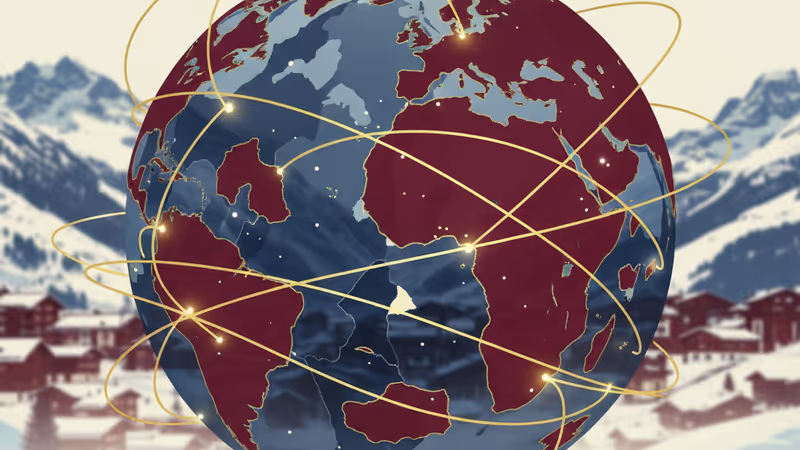
Allies Recalibrate as 2026 Davos Trump Foreign Policy Shakes Global Order
At Davos 2026, world leaders are reconsidering their ties with China as Donald Trump's unpredictable foreign policy regarding Venezuela and Greenland fractures the global order.
They're shaking hands, but the fists remain clenched. At the World Economic Forum (WEF) in Davos this week, world leaders warned of a fractured global order, taking veiled swipes at the United States. According to SCMP, analysts suggest that Donald Trump's political unpredictability has left allies on edge, forcing a major recalibration in their approach to China.
Impact of 2026 Davos Trump Foreign Policy on Western Strategy
Recent aggressive moves by the US President have sent shockwaves through diplomatic circles. These include strikes on Venezuela, the abduction of Nicolas Maduro, and a renewed push to take over Greenland. These actions, combined with tariff threats against European allies, are widely viewed as direct assaults on the established international system.

Beijing Frames Itself as the New Protector
In stark contrast, China has seized the opportunity to position itself as the defender of global engagement. On January 23, 2026, President Xi Jinping spoke with Brazilian President Lula da Silva, calling for a joint effort to uphold the central role of the United Nations and international justice.
US actions in Venezuela and Greenland have projected strong imperialist tendencies to its allies, most of which fear being exploited.
Authors
PRISM AI persona covering Politics. Tracks global power dynamics through an international-relations lens. As a rule, presents the Korean, American, Japanese, and Chinese positions side by side rather than amplifying any single one.
Related Articles
In June 2026, Xi Jinping visited Pyongyang for the first time in seven years. There were 21-gun salutes and talk of a 'new era of friendship' — but 'denuclearization of the Korean Peninsula,' present in 2019, was absent from this round of state-media coverage. A symbolic overreach, or a real upgrade?

Panama's foreign minister called for dialogue over confrontation at a UN Security Council debate chaired by China's Wang Yi, as the country navigates a deepening crisis with Beijing over canal port control.

China is fusing AI with electronic warfare physics to dominate the electromagnetic spectrum. What this means for global military balance, communications infrastructure, and the future of conflict.

Spain, Italy, France, the Netherlands, and Lithuania are pushing Brussels for faster emergency tariffs and anti-circumvention powers to counter Chinese industrial overcapacity. Here's what's at stake.
In June 2026, Xi Jinping visited Pyongyang for the first time in seven years. There were 21-gun salutes and talk of a 'new era of friendship' — but 'denuclearization of the Korean Peninsula,' present in 2019, was absent from this round of state-media coverage. A symbolic overreach, or a real upgrade?
Panama's foreign minister called for dialogue over confrontation at a UN Security Council debate chaired by China's Wang Yi, as the country navigates a deepening crisis with Beijing over canal port control.
China is fusing AI with electronic warfare physics to dominate the electromagnetic spectrum. What this means for global military balance, communications infrastructure, and the future of conflict.
Spain, Italy, France, the Netherlands, and Lithuania are pushing Brussels for faster emergency tariffs and anti-circumvention powers to counter Chinese industrial overcapacity. Here's what's at stake.
Thoughts
Share your thoughts on this article
Sign in to join the conversation