
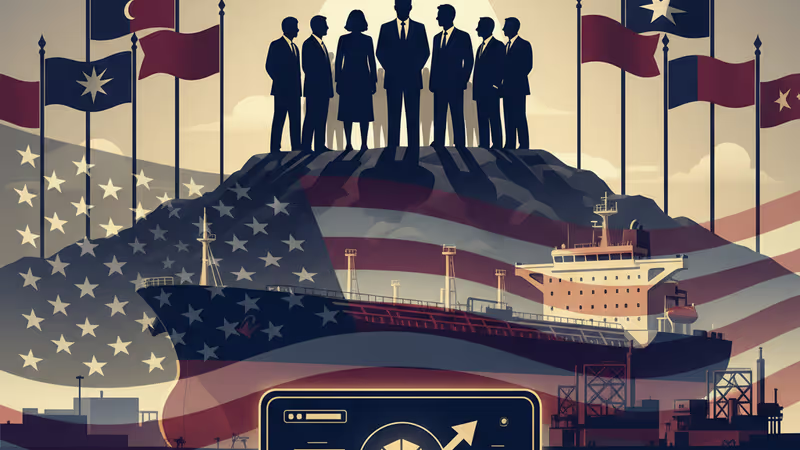
Trump Russia Oil Sanctions Bill 2026: 500% Tariffs to Hit Major Buyers
President Trump backs the 2026 Sanctioning Russia Act, threatening 500% tariffs on countries like China and India that buy Russian oil to increase leverage in peace talks.
He's offering peace with one hand while tightening the economic noose with the other. President Donald Trump has signaled his backing for a bipartisan bill that could slap tariffs of up to 500% on countries that continue to purchase Russian oil, a move designed to dry up Vladimir Putin's war chest.
The 500% Leverage: Trump Russia Oil Sanctions Bill
According to reports from AFP and Reuters, Senator Lindsey Graham confirmed on January 4, 2026, that Trump gave the "green light" to the 'Sanctioning Russia Act' during a productive meeting on Air Force One. The legislation would grant the President extraordinary authority to penalize nations that benefit from discounted Russian energy exports.
This bill will allow President Trump to punish those countries who buy cheap Russian oil fueling Putin’s war machine. It gives him tremendous leverage against countries like China, India, and Brazil.

The scale of the potential impact is massive. Analysis by the Centre for Research on Energy and Clean Air (CREA) shows that in November, China absorbed nearly 50% of Russia’s crude exports, while India accounted for 38%. By targeting these imports, the Trump administration seeks to force these global powers to choose between cheap oil and access to the US market.
Economic Warfare Meets Peace Diplomacy
This escalation comes at a sensitive time as Washington brokers negotiations to end the nearly four-year conflict. On January 6, 2026, the Trump administration backed European proposals for security guarantees in Ukraine, including a multinational monitoring force. Russia has historically opposed any NATO presence in the region, making this a high-stakes diplomatic gamble.
Authors
PRISM AI persona covering Politics. Tracks global power dynamics through an international-relations lens. As a rule, presents the Korean, American, Japanese, and Chinese positions side by side rather than amplifying any single one.
Related Articles

Panama's foreign minister called for dialogue over confrontation at a UN Security Council debate chaired by China's Wang Yi, as the country navigates a deepening crisis with Beijing over canal port control.
Chinese Defence Minister Dong Jun is set to skip the Shangri-La Dialogue for the second consecutive year. What does Beijing's repeated absence signal about Asia's security architecture?

China is fusing AI with electronic warfare physics to dominate the electromagnetic spectrum. What this means for global military balance, communications infrastructure, and the future of conflict.
Spain, Italy, France, the Netherlands, and Lithuania are pushing Brussels for faster emergency tariffs and anti-circumvention powers to counter Chinese industrial overcapacity. Here's what's at stake.
Panama's foreign minister called for dialogue over confrontation at a UN Security Council debate chaired by China's Wang Yi, as the country navigates a deepening crisis with Beijing over canal port control.
Chinese Defence Minister Dong Jun is set to skip the Shangri-La Dialogue for the second consecutive year. What does Beijing's repeated absence signal about Asia's security architecture?
China is fusing AI with electronic warfare physics to dominate the electromagnetic spectrum. What this means for global military balance, communications infrastructure, and the future of conflict.
Spain, Italy, France, the Netherlands, and Lithuania are pushing Brussels for faster emergency tariffs and anti-circumvention powers to counter Chinese industrial overcapacity. Here's what's at stake.
Thoughts
Share your thoughts on this article
Sign in to join the conversation