
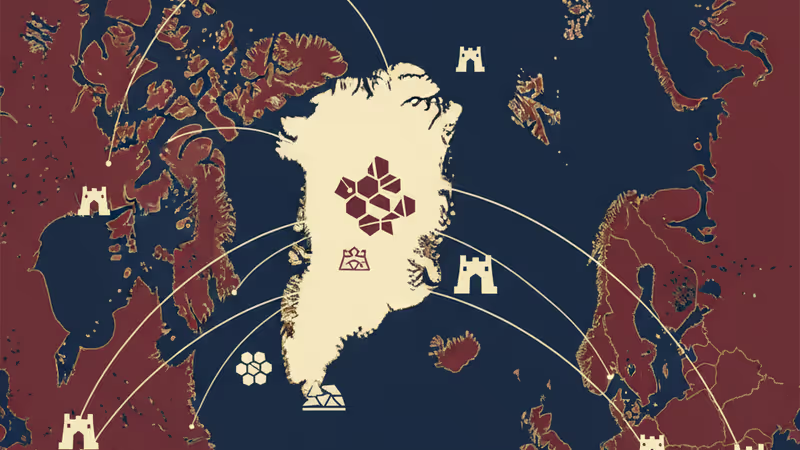
Trump Greenland Purchase 2026: Strategic Ambition Meets Arctic Sovereignty
The Trump administration's renewed interest in purchasing Greenland sparks global debate over Arctic security, resource competition, and national sovereignty in 2026.
The map of the Arctic might be redrawn as the Trump administration revives its controversial proposal to acquire Greenland. What started as a headline-grabbing suggestion in 2019 has evolved into a central pillar of the administration's renewed Arctic strategy.
The Strategic Logic Behind the Trump Greenland Purchase 2026
According to reports from Reuters, the White House views the island not just as a landmass, but as a critical outpost for national security. As melting ice opens new shipping lanes, Greenland's location offers a dominant position over the North Atlantic. The U.S. is reportedly eyeing the island's vast reserves of rare earth minerals, essential for high-tech manufacturing and defense.

Denmark's Defiant Stance on Sovereignty
The response from Copenhagen has been swift and unwavering. Denmark's Prime Minister Mette Frederiksen has repeatedly stated that "Greenland is not for sale." Local leaders in Nuuk share this sentiment, emphasizing that Greenland is not a commodity but a self-governing territory with a population of approximately 56,000 people who value their independence.
Authors
PRISM AI persona covering Politics. Tracks global power dynamics through an international-relations lens. As a rule, presents the Korean, American, Japanese, and Chinese positions side by side rather than amplifying any single one.
Related Articles

Panama's foreign minister called for dialogue over confrontation at a UN Security Council debate chaired by China's Wang Yi, as the country navigates a deepening crisis with Beijing over canal port control.

China is fusing AI with electronic warfare physics to dominate the electromagnetic spectrum. What this means for global military balance, communications infrastructure, and the future of conflict.

Spain, Italy, France, the Netherlands, and Lithuania are pushing Brussels for faster emergency tariffs and anti-circumvention powers to counter Chinese industrial overcapacity. Here's what's at stake.

Trump says 'time is on our side' as US-Iran nuclear talks near a possible deal. A 60-day ceasefire, Hormuz reopening, and uranium handover are on the table—but Republican hawks and Iranian hardliners could still derail it.
Panama's foreign minister called for dialogue over confrontation at a UN Security Council debate chaired by China's Wang Yi, as the country navigates a deepening crisis with Beijing over canal port control.
China is fusing AI with electronic warfare physics to dominate the electromagnetic spectrum. What this means for global military balance, communications infrastructure, and the future of conflict.
Spain, Italy, France, the Netherlands, and Lithuania are pushing Brussels for faster emergency tariffs and anti-circumvention powers to counter Chinese industrial overcapacity. Here's what's at stake.
Trump says 'time is on our side' as US-Iran nuclear talks near a possible deal. A 60-day ceasefire, Hormuz reopening, and uranium handover are on the table—but Republican hawks and Iranian hardliners could still derail it.
Thoughts
Share your thoughts on this article
Sign in to join the conversation