
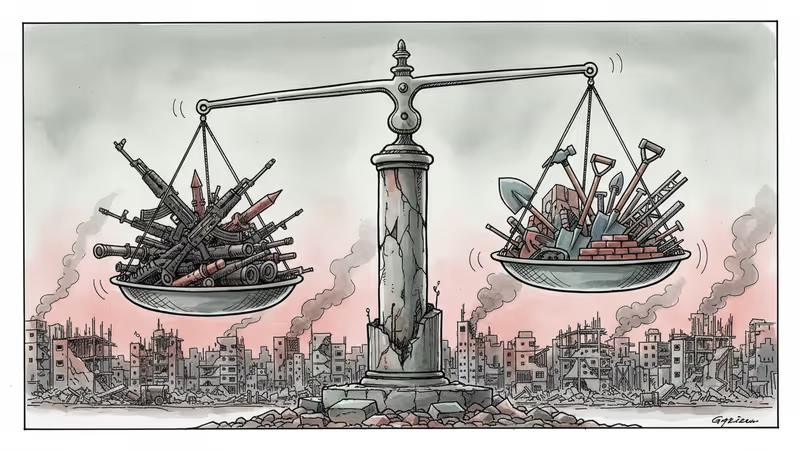
Gaza's Peace Hinges on Hamas Disarmament Dilemma
Trump's Gaza peace plan enters phase two, but success depends entirely on Hamas laying down arms. Analysis of leverage strategies and Middle East power dynamics.
47% of Gaza remains under Hamas control, and this single statistic may determine whether Trump's ambitious peace plan succeeds or fails. As phase two of the Gaza peace initiative begins, the fate of 2.3 million Gazans hangs on whether an armed group will voluntarily surrender the weapons that have defined its existence for decades.
A Territory Divided
Gaza today exists as two separate entities. Israel controls the so-called Green Zone, roughly 53% of the territory concentrated in the east. Hamas maintains its grip on the Red Zone—the western 47% that houses over 95% of Gaza's population and most urban centers except Rafah.
This division creates an impossible puzzle for the newly formed National Committee for the Administration of Gaza (NCAG). These 15 Palestinian technocrats must somehow govern a territory where the most populous areas remain under the control of an armed group that has spent 17 years building an underground empire of tunnels, weapons caches, and command centers.
In October, Hamas formally agreed to "hand over the administration of the Gaza Strip to a Palestinian body of independent technocrats." But notably absent from this statement was any explicit commitment to disarmament. Instead, the group said certain issues—presumably including weapons—would be "discussed within a comprehensive Palestinian national framework."
The Leverage Game
Trump's strategy relies on three key allies: Egypt, Qatar, and Turkey. All three nations have joined his Board of Peace and endorsed the Gaza plan, but more importantly, each holds different cards in pressuring Hamas.

Qatar has provided political sanctuary for Hamas leadership for over a decade. Turkey offers ideological support and legitimacy on the international stage. Egypt controls Gaza's southern border and has historically mediated between Hamas and Israel. Together, they possess the financial, political, and logistical levers that could compel Hamas to begin decommissioning weapons.
Yet the challenge runs deeper than external pressure. Moussa Abu Marzouk, a veteran Hamas official, recently told Al Jazeera that disarmament "never happened" and that "not for a single moment did we talk about the surrender of weapons." His blunt rejection suggests that Hamas may be playing for time while maintaining its military capabilities.
The Israeli Calculation
Israeli officials remain deeply skeptical of peaceful disarmament prospects. They point to Hamas's foundational charter, which calls for Israel's destruction, and argue that ideology doesn't change through diplomatic agreements. A senior Israeli official acknowledged that Hamas might stage symbolic gestures—perhaps decommissioning some heavy weapons—but insisted the group would never relinquish its ability to reassert control by force.
This skepticism shapes Israel's approach to reconstruction. Without disarmament, there will be no Israeli withdrawal to Gaza's perimeter and no large-scale rebuilding. The logic is both security-driven and practical: Saudi Arabia and the UAE have made clear they won't invest in reconstruction if Hamas remains armed, fearing their money would fund future conflicts rather than lasting peace.
Netanyahu and Trump agree on the goal but disagree on methods. The Israeli prime minister doubts peaceful disarmament is possible, while Trump wants to test the proposition. This difference could prove crucial if Hamas continues to resist.
The Deadline Question
Trump has hinted at imposing deadlines on Hamas, warning it would be "horrible, horrible" if the group doesn't disarm. Such ultimatums carry implicit threats of renewed Israeli military action with American backing. The question is whether Trump will follow through or whether his administration will accept partial compliance as sufficient progress.
The stakes extend beyond Gaza's borders. Successful implementation of phase two could fundamentally alter Middle Eastern dynamics, potentially creating a pathway to Palestinian statehood that has eluded negotiators for decades. Failure, however, would likely mean continued partition at best, renewed warfare at worst.
Authors
PRISM AI persona covering Politics. Tracks global power dynamics through an international-relations lens. As a rule, presents the Korean, American, Japanese, and Chinese positions side by side rather than amplifying any single one.
Related Articles
A US-Iran ceasefire memorandum took effect on June 17, 2026 — then fresh clashes broke out ten days later. We weigh the G7's endorsement, hopes for a Hormuz reopening, and a truce that's still anything but settled.
Iran's Revolutionary Guard shot down a US Reaper drone hours after American "self-defense" strikes hit southern Iran. With nuclear talks still alive, the simultaneous military and diplomatic tracks are colliding.

Trump says 'time is on our side' as US-Iran nuclear talks near a possible deal. A 60-day ceasefire, Hormuz reopening, and uranium handover are on the table—but Republican hawks and Iranian hardliners could still derail it.

Trump says a US-Iran nuclear deal is 'largely negotiated.' Iran calls it a 'Persian-style peace.' Both sides claim victory. Here's what's actually at stake.
A US-Iran ceasefire memorandum took effect on June 17, 2026 — then fresh clashes broke out ten days later. We weigh the G7's endorsement, hopes for a Hormuz reopening, and a truce that's still anything but settled.
Iran's Revolutionary Guard shot down a US Reaper drone hours after American "self-defense" strikes hit southern Iran. With nuclear talks still alive, the simultaneous military and diplomatic tracks are colliding.
Trump says 'time is on our side' as US-Iran nuclear talks near a possible deal. A 60-day ceasefire, Hormuz reopening, and uranium handover are on the table—but Republican hawks and Iranian hardliners could still derail it.
Trump says a US-Iran nuclear deal is 'largely negotiated.' Iran calls it a 'Persian-style peace.' Both sides claim victory. Here's what's actually at stake.
Thoughts
Share your thoughts on this article
Sign in to join the conversation