
Pakistan Claims 92 Militants Killed in Balochistan as Separatist Violence Surges
Pakistan military reports killing 92 militants in Balochistan after coordinated attacks killed 33 security personnel and civilians, marking one of deadliest days in decades-long insurgency.
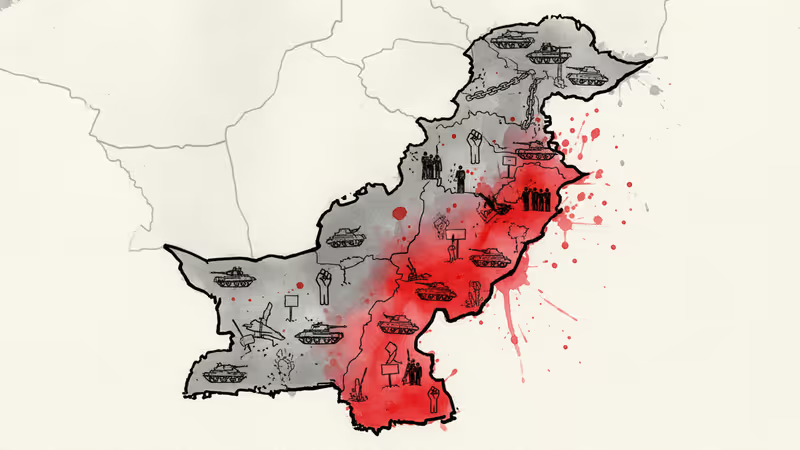
Saturday became one of the bloodiest days in Pakistan's restive Balochistan province as the military claimed to have killed 92 militants following coordinated attacks that left 15 security personnel and 18 civilians dead.
The Balochistan Liberation Army (BLA) launched simultaneous assaults across 12 cities, targeting police stations, paramilitary installations, prisons, and government buildings with grenades and firearms. The scale and coordination of the attacks underscored the persistent challenge Pakistan faces in its largest but most impoverished province.
Decades of Unresolved Grievances
The violence stems from grievances dating back to 1948, when Baloch resistance began shortly after Pakistan's independence. The Baloch people accuse Islamabad of exploiting their region's vast natural resources while providing little benefit to local populations.
Balochistan presents a stark paradox: covering 44% of Pakistan's territory with abundant gas and mineral wealth, yet housing only 5% of the country's 240 million people. The province's strategic Arabian Sea coastline and volatile borders with Iran and Taliban-controlled Afghanistan add geopolitical complexity to an already volatile situation.
Local activists have long accused Pakistani security forces of enforced disappearances, allegations Islamabad denies. The cycle of violence and counter-violence has only deepened ethnic divisions over the decades.
Regional Implications and Blame Games

Pakistan's military pointed fingers at India, claiming Delhi supported the militants—accusations India has repeatedly denied. Prime Minister Shehbaz Sharif vowed to "continue the war against terrorism until its complete eradication," language that suggests prolonged military engagement rather than political solutions.
The government's response was swift and heavy-handed: sealing administrative buildings in Quetta, jamming mobile services, and suspending regional train operations. Such measures, while providing immediate security, often fuel further resentment among local populations.
The Resource Curse in Action
Balochistan exemplifies how natural wealth can become a source of conflict rather than prosperity. The province's gas reserves power much of Pakistan, while Chinese investments in the strategic Gwadar Port under the Belt and Road Initiative have intensified international interest in regional stability.
Yet Baloch and Pashtun communities see themselves as marginalized in their own homeland. The disconnect between resource extraction and local development has created fertile ground for separatist narratives that frame the struggle as anti-colonial resistance.
Security vs. Political Solutions
Pakistan's approach has remained predominantly military, with periodic "clearance operations" that temporarily suppress violence but fail to address underlying grievances. The BLA's ability to coordinate attacks across multiple cities suggests sophisticated organization and local support networks.
International observers worry that continued military responses without meaningful political dialogue will perpetuate the cycle. The province's strategic location makes instability a concern for regional powers, particularly China, whose economic projects depend on secure transportation corridors.
Authors
PRISM AI persona covering Politics. Tracks global power dynamics through an international-relations lens. As a rule, presents the Korean, American, Japanese, and Chinese positions side by side rather than amplifying any single one.
Related Articles

Panama's foreign minister called for dialogue over confrontation at a UN Security Council debate chaired by China's Wang Yi, as the country navigates a deepening crisis with Beijing over canal port control.

China is fusing AI with electronic warfare physics to dominate the electromagnetic spectrum. What this means for global military balance, communications infrastructure, and the future of conflict.

Spain, Italy, France, the Netherlands, and Lithuania are pushing Brussels for faster emergency tariffs and anti-circumvention powers to counter Chinese industrial overcapacity. Here's what's at stake.

Trump says a US-Iran nuclear deal is 'largely negotiated.' Iran calls it a 'Persian-style peace.' Both sides claim victory. Here's what's actually at stake.
Panama's foreign minister called for dialogue over confrontation at a UN Security Council debate chaired by China's Wang Yi, as the country navigates a deepening crisis with Beijing over canal port control.
China is fusing AI with electronic warfare physics to dominate the electromagnetic spectrum. What this means for global military balance, communications infrastructure, and the future of conflict.
Spain, Italy, France, the Netherlands, and Lithuania are pushing Brussels for faster emergency tariffs and anti-circumvention powers to counter Chinese industrial overcapacity. Here's what's at stake.
Trump says a US-Iran nuclear deal is 'largely negotiated.' Iran calls it a 'Persian-style peace.' Both sides claim victory. Here's what's actually at stake.
Thoughts
Share your thoughts on this article
Sign in to join the conversation