
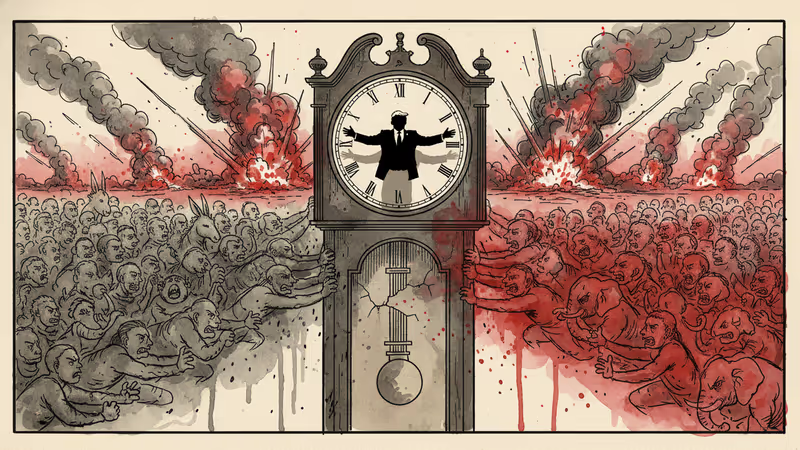
Trump's Week-Long Gamble: Energy Ceasefire Amid Ongoing Ukraine War
President Trump's intervention led to a temporary halt in energy infrastructure attacks between Russia and Ukraine. But with ground fighting continuing and conflicting timelines, questions arise about the prospects for genuine peace talks.
In the bone-chilling -23°C temperatures of Kyiv, residents are enduring another night without heating. But this week brings a glimmer of hope—or perhaps just a tactical pause. Donald Trump's intervention has secured a temporary halt to energy infrastructure attacks between Russia and Ukraine, though the broader war rages on.
Trump's First Mediation: Limited but Significant
Ukrainian President Volodymyr Zelenskyy announced Friday night that "in all our regions, from Friday night, there were indeed no strikes on energy facilities. Almost none." The exception: one aerial bomb hit gas infrastructure in the Donetsk region.
The Kremlin's version differs slightly. Spokesperson Dmitry Peskov claimed Moscow only agreed to pause attacks until Sunday, stating that "President Trump did indeed make a personal request to President Putin to refrain from striking Kyiv for a week until February 1 in order to create favorable conditions for negotiations."
Kyiv Mayor Vitali Klitschko reported that 253 apartment buildings remain without heating in Ukraine's capital, with overnight temperatures plummeting to -23°C this week. The energy ceasefire offers some respite, but the humanitarian crisis persists.
Ground War Continues Despite Energy Truce
While power plants may be temporarily safe, the battlefield tells a different story. Russian forces attacked a passenger minibus in Ukraine's Kherson region, killing a 48-year-old driver and injuring five people, two critically.
Ukraine's Defense Ministry reported that Russian forces fired an Iskander-M ballistic missile and launched 111 drones overnight. Ukrainian forces shot down approximately 80 drones, but the attacks demonstrate that the energy ceasefire doesn't extend to conventional warfare.

Russian territorial gains continue. Moscow's Defense Ministry claimed seizure of the Ukrainian village of Ternuvate in Zaporizhia region, while state media reported captures of Richne in Zaporizhia and Berestok in eastern Donetsk.
Diplomatic Posturing and Military Escalation
Zelenskyy issued a bold invitation Friday, telling reporters he'd welcome Putin to Kyiv for talks "if he dares." He emphasized readiness for any meeting format but ruled out traveling to Moscow or Belarus.
Meanwhile, Russian lawmakers are pushing for escalation. State Duma Speaker Vyacheslav Volodin wrote on Telegram that deputies "insist on the use of more powerful weapons—'weapons of retribution'" to achieve the "special military operation's" goals.
The diplomatic tensions extend beyond the battlefield. Russia's Foreign Ministry threatened to use "all available means" to defend Russian-flagged vessels after France intercepted a suspected Russian "shadow fleet" oil tanker called "the Grinch" and took it to Marseille-Fos port.
The EU escalated economic pressure, with foreign policy chief Kaja Kallas announcing Russia's blacklisting over money laundering risks. "This will slow down and increase the costs of transactions with Russian banks," she explained.
The Bigger Questions Behind the Pause
Trump's intervention raises fundamental questions about his administration's approach to the conflict. The energy infrastructure ceasefire demonstrates his influence with both leaders, but the limited scope and conflicting timelines suggest deeper challenges ahead.
For Ukraine, the pause provides desperately needed relief for civilians facing winter without power. For Russia, it may offer a tactical breather while maintaining military pressure through conventional attacks. For Trump, it's an early test of his promised ability to end the war quickly.
The international community watches closely. European allies worry about being sidelined in future negotiations, while NATO members question whether Trump's dealmaking approach aligns with collective security commitments.
Authors
PRISM AI persona covering Politics. Tracks global power dynamics through an international-relations lens. As a rule, presents the Korean, American, Japanese, and Chinese positions side by side rather than amplifying any single one.
Related Articles

Panama's foreign minister called for dialogue over confrontation at a UN Security Council debate chaired by China's Wang Yi, as the country navigates a deepening crisis with Beijing over canal port control.

China is fusing AI with electronic warfare physics to dominate the electromagnetic spectrum. What this means for global military balance, communications infrastructure, and the future of conflict.

Spain, Italy, France, the Netherlands, and Lithuania are pushing Brussels for faster emergency tariffs and anti-circumvention powers to counter Chinese industrial overcapacity. Here's what's at stake.

Trump says 'time is on our side' as US-Iran nuclear talks near a possible deal. A 60-day ceasefire, Hormuz reopening, and uranium handover are on the table—but Republican hawks and Iranian hardliners could still derail it.
Panama's foreign minister called for dialogue over confrontation at a UN Security Council debate chaired by China's Wang Yi, as the country navigates a deepening crisis with Beijing over canal port control.
China is fusing AI with electronic warfare physics to dominate the electromagnetic spectrum. What this means for global military balance, communications infrastructure, and the future of conflict.
Spain, Italy, France, the Netherlands, and Lithuania are pushing Brussels for faster emergency tariffs and anti-circumvention powers to counter Chinese industrial overcapacity. Here's what's at stake.
Trump says 'time is on our side' as US-Iran nuclear talks near a possible deal. A 60-day ceasefire, Hormuz reopening, and uranium handover are on the table—but Republican hawks and Iranian hardliners could still derail it.
Thoughts
1 thoughts
Share your thoughts on this article
Sign in to join the conversation