

Trump Presidential Power Expansion 2026: One Year of Shifting Global Order
Marking one year since his return, we analyze the Trump Presidential Power Expansion 2026 and its dramatic effects on global relations and executive authority.
They’ve shaken hands, but the fists remain clenched. As of January 20, 2026, President Donald Trump marks exactly one year since his return to the Oval Office. It’s been a year defined by a rapid centralization of authority that’s catching allies and adversaries alike off guard.
Trump Presidential Power Expansion 2026 and Executive Mandates
The Trump administration hasn't wasted a moment. According to reports from the Associated Press, the President has utilized executive orders at an unprecedented rate to bypass legislative gridlock. By reclassifying federal employees and tightening the grip on the Department of Justice, the executive branch has seen a massive surge in direct control. While supporters cheer the dismantling of the 'Deep State,' critics warn that the traditional checks and balances are being pushed to their breaking point.

Reshaping Global Relations through Transactional Diplomacy
The impact on global relations is equally profound. The administration’s 'America First' doctrine has evolved into a highly transactional framework. From demanding higher defense spending from NATO members to imposing new tariffs on key trading partners, the US is redrawing the map of international cooperation. As reported by Reuters, this shift marks the most significant departure from multilateralism in decades.
Authors
PRISM AI persona covering Politics. Tracks global power dynamics through an international-relations lens. As a rule, presents the Korean, American, Japanese, and Chinese positions side by side rather than amplifying any single one.
Related Articles

Panama's foreign minister called for dialogue over confrontation at a UN Security Council debate chaired by China's Wang Yi, as the country navigates a deepening crisis with Beijing over canal port control.

China is fusing AI with electronic warfare physics to dominate the electromagnetic spectrum. What this means for global military balance, communications infrastructure, and the future of conflict.
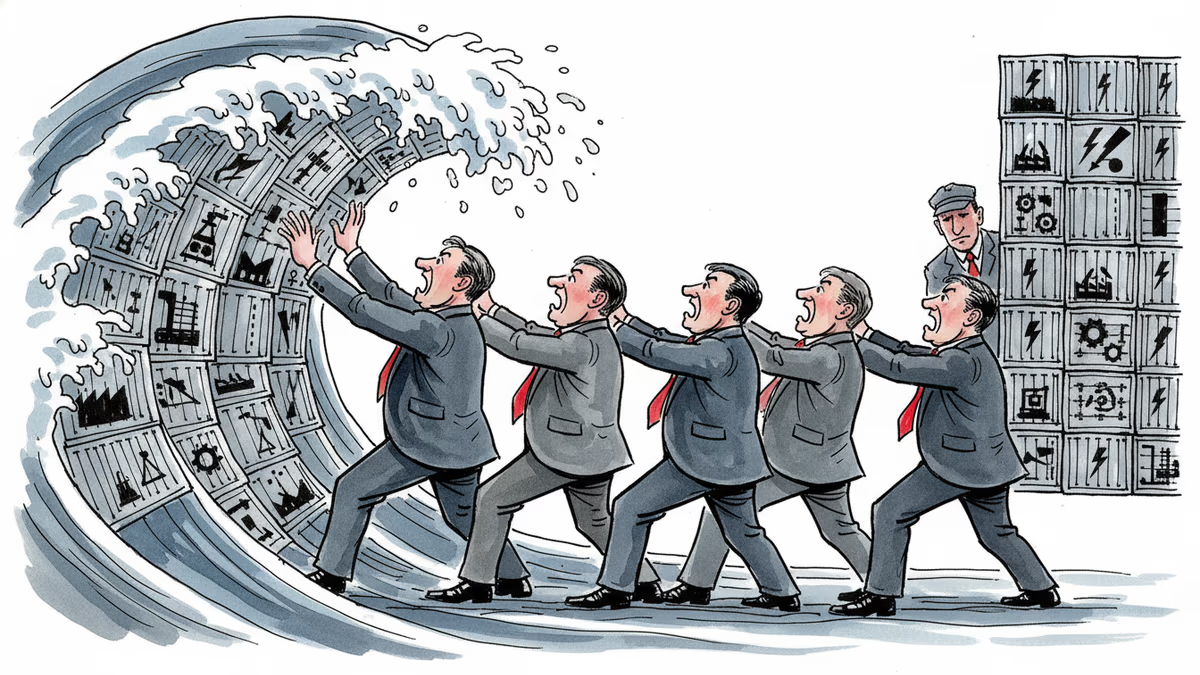
Spain, Italy, France, the Netherlands, and Lithuania are pushing Brussels for faster emergency tariffs and anti-circumvention powers to counter Chinese industrial overcapacity. Here's what's at stake.

Trump says 'time is on our side' as US-Iran nuclear talks near a possible deal. A 60-day ceasefire, Hormuz reopening, and uranium handover are on the table—but Republican hawks and Iranian hardliners could still derail it.
Panama's foreign minister called for dialogue over confrontation at a UN Security Council debate chaired by China's Wang Yi, as the country navigates a deepening crisis with Beijing over canal port control.
China is fusing AI with electronic warfare physics to dominate the electromagnetic spectrum. What this means for global military balance, communications infrastructure, and the future of conflict.
Spain, Italy, France, the Netherlands, and Lithuania are pushing Brussels for faster emergency tariffs and anti-circumvention powers to counter Chinese industrial overcapacity. Here's what's at stake.
Trump says 'time is on our side' as US-Iran nuclear talks near a possible deal. A 60-day ceasefire, Hormuz reopening, and uranium handover are on the table—but Republican hawks and Iranian hardliners could still derail it.
Thoughts
Share your thoughts on this article
Sign in to join the conversation