
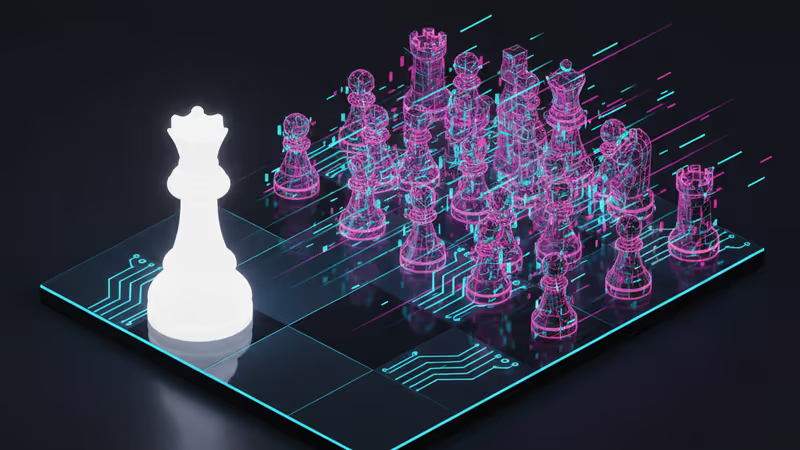
The Trillion-Dollar Bet: Why Apple is Deliberately Losing the AI Hype Race
Apple's delayed Siri upgrade isn't a weakness, but a high-stakes bet on a different AI future. PRISM analyzes the strategy, risks, and what it means for investors.
The Lede
While Silicon Valley burns billions in a frantic race for AI supremacy, Apple appears to be sitting on the sidelines. The delay of its next-generation Siri until 2026 is being framed as a failure to keep pace. This is a profound misreading of the situation. Apple isn't stumbling; it's making a calculated, high-stakes wager that the future of AI isn't in the cloud, but in your pocket. This delay isn't a sign of weakness—it's the clearest signal yet of a fundamentally different, and far riskier, strategy to redefine personal computing for the next decade.
Why It Matters
For investors, executives, and consumers, Apple's deliberate pace creates a clear schism in the AI landscape. We are witnessing the emergence of two competing philosophies:
- The Cloud-First Arms Race: Led by Google, Microsoft, and Amazon, this approach involves spending hundreds of billions on massive, centralized data centers to power ever-larger language models. Their goal is to create a universal, conversational intelligence accessible from any device.
- The On-Device Citadel: Apple's strategy is to build a deeply integrated, privacy-centric AI that lives within its hardware ecosystem. The goal isn't a chatbot, but a true digital valet that leverages intimate personal context (your messages, calendar, photos) without sending it to a server.
The outcome of this strategic clash will determine the next dominant user interface and define what 'privacy' means in an AI-native world. If Apple fails, the iPhone risks becoming a commoditized portal to other companies' AI. If it succeeds, it could trigger the largest hardware upgrade cycle in its history and lock users into its ecosystem for another generation.
The Analysis: Deconstructing Apple's Gambit

The 'Perfection or Nothing' Paradox
Apple's brand is built on polished, seamless user experiences. As Deepwater's Gene Munster noted, they "have to deliver a 10 out of 10." Unlike rivals who can iterate on public betas, a buggy, unreliable, or 'hallucinating' Siri would cause irreparable brand damage. The mixed reception to 'Apple Intelligence' features in 2024, like the faulty news notification rewriter, was a warning shot. The delay until 2026 isn't just about engineering challenges; it's about meeting a bar for user trust and reliability that is orders of magnitude higher than for a web-based chatbot. They are choosing polish over pace, a classic Apple move.
Cloud vs. Citadel: A Tale of Two Checkbooks
The source material highlights a critical divergence: Google, Microsoft, Meta, and Amazon committed a staggering $380 billion to capital expenditures this year, much of it on Nvidia-powered AI data centers. Apple's capex was a comparatively modest $12.71 billion. This isn't because Apple can't afford it; it's because they are playing a different game. Their focus is on hyper-efficient on-device processing via their own silicon. The recent, and very public, hiring of Amar Subramanya—who led engineering for Google's Gemini—isn't about copying Google's cloud strategy. It's about poaching top-tier talent to build a world-class AI that conforms to Apple's privacy-first, on-device philosophy.
The Trojan Horse: Is the iPhone Ecosystem Enough?
For now, booming iPhone 17 sales provide Apple with a crucial buffer. Its billion-plus active devices represent an unparalleled distribution network for any future AI launch. However, even Apple's own executives, like Eddy Cue, recognize the long-term existential threat: AI-native hardware could make the smartphone obsolete. While rivals are unconstrained by legacy operating systems, Apple must weave its next-gen AI into the fabric of iOS without disrupting the experience millions know. This massive user base is both Apple's greatest asset and its greatest constraint.
PRISM's Take
Apple isn't losing the AI race; it is refusing to run on the same track. While the world is mesmerized by conversational chatbots, Apple is quietly building an 'action engine'—a deeply personal AI designed to do things for you, not just talk to you. The Siri delay is a calculated bet that a truly helpful, privacy-preserving assistant that can reliably book a trip based on a text message exchange is infinitely more valuable than a chatbot that can write a poem about it. The stakes are immense. By 2026, we will discover if this patient, integrated strategy was Tim Cook's masterstroke or the moment the world's most valuable company was outmaneuvered by a new paradigm.
Authors
Related Articles
Google's Gmail Live lets you ask your inbox questions out loud. Announced at I/O 2026, it's AI's pitch to skeptics — and a reminder of how much Google already knows about you.
Apple agreed to pay $250 million to settle claims it misled iPhone 16 buyers about Apple Intelligence features. What this means for consumers, Big Tech marketing, and the AI industry.
Five major publishers and author Scott Turow have filed a class action lawsuit against Meta, alleging the company used illegal pirate sites like LibGen to train its Llama AI models without permission.
Apple names John Ternus, its hardware engineering chief, as the next CEO. The shift from operator to product person signals where Apple thinks its next decade of growth will come from — and raises real questions about what comes next.
Google's Gmail Live lets you ask your inbox questions out loud. Announced at I/O 2026, it's AI's pitch to skeptics — and a reminder of how much Google already knows about you.
Apple agreed to pay $250 million to settle claims it misled iPhone 16 buyers about Apple Intelligence features. What this means for consumers, Big Tech marketing, and the AI industry.
Five major publishers and author Scott Turow have filed a class action lawsuit against Meta, alleging the company used illegal pirate sites like LibGen to train its Llama AI models without permission.
Apple names John Ternus, its hardware engineering chief, as the next CEO. The shift from operator to product person signals where Apple thinks its next decade of growth will come from — and raises real questions about what comes next.
Thoughts
Share your thoughts on this article
Sign in to join the conversation