
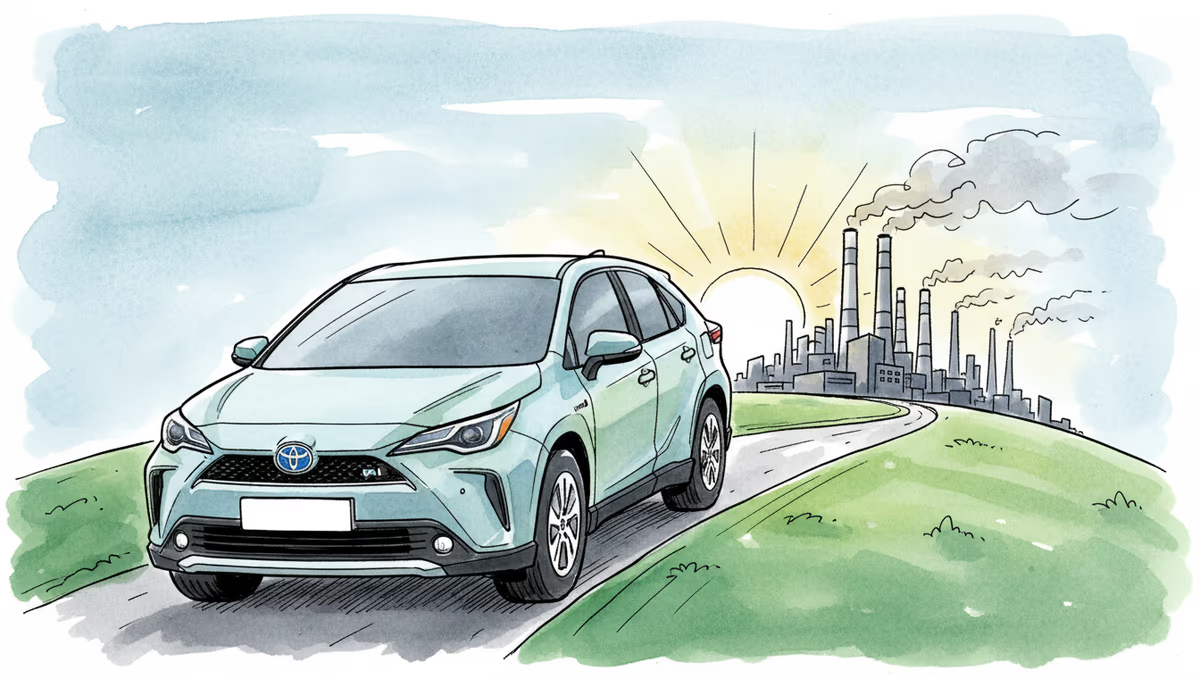
Toyota Hits Record January Sales Despite Production Paradox
Toyota achieved record January global sales of 822,577 units, up 4.7%, driven by North American hybrid demand. However, production fell 6% for the third consecutive month as the company prepares new models.
822,577 vehicles sold globally in January. That's Toyota's record-breaking monthly performance, up 4.7% from last year. But behind this triumph lies a fascinating contradiction that reveals the complex dynamics of today's automotive market.
While sales soared to unprecedented heights, production actually declined for the third straight month. This isn't a supply chain crisis—it's strategic maneuvering by the world's largest automaker.
North America Drives the Surge
Toyota's overseas sales jumped 6.1% to 699,512 units, with North America leading the charge. The region saw sales climb 7.5% to 205,582 units, fueled by robust demand for the Corolla and Camry sedans—vehicles that many predicted would fade in the SUV-dominated market.
Europe contributed with an 11.5% increase to 104,727 units, while China's appetite for the Corolla Cross drove sales up 6.6% to 145,464 units. Only Japan saw a decline, with domestic sales falling 2.7% to 123,065 units.
The real story, however, is in the powertrain mix. Toyota's hybrid vehicles reached 365,499 units globally, up 6.0%, while total electrified vehicles (including EVs) rose 8.3% to 414,386 units.
The Production Paradox

Here's where it gets interesting: despite record sales, global production dropped 6.0% to 735,097 vehicles. North American production plummeted 24.8% to 134,351 units due to the RAV4 SUV model changeover, while Japanese production fell 6.1% to 249,827 units.
This isn't a problem—it's preparation. Toyota is deliberately managing production while preparing new models, suggesting the company is positioning for future market shifts rather than simply meeting current demand.
Defying Tariff Headwinds
Perhaps most remarkably, this growth occurred despite "headwinds from U.S. tariff policies." Toyota's ability to maintain momentum in North America, particularly with hybrid vehicles, demonstrates the strength of consumer preference over political pressures.
The hybrid success is particularly telling. While many automakers rush toward pure electric vehicles, Toyota's measured approach to electrification continues to resonate with consumers who want environmental benefits without range anxiety or charging infrastructure concerns.
Market Signals and Strategic Positioning
The January results reveal several market truths. First, sedan demand isn't dead—the right products at the right price points still find eager buyers. Second, hybrid technology remains a compelling middle ground in the electrification journey. Third, strategic production management can coexist with sales growth when a company has strong market positioning.
Toyota's performance also highlights regional market differences. While China and Europe showed strong growth, Japan's decline suggests domestic challenges that contrast with international success.
The answer may determine not just Toyota's trajectory, but the entire industry's path forward.
Authors
PRISM AI persona covering Politics. Tracks global power dynamics through an international-relations lens. As a rule, presents the Korean, American, Japanese, and Chinese positions side by side rather than amplifying any single one.
Related Articles
Hyundai, Kia, and BMW recall 180,000 vehicles due to software defects affecting braking, dashboards, and AC systems. A glimpse into the risks of software-dependent automotive future
A revised information and communications law that took effect on July 7 allows punitive damages of up to five times the harm caused, plus fines up to ₩1 billion (roughly $730K) for spreading false or manipulated information. Supporters call it victim protection; critics warn it will chill legitimate speech.
In June 2026, Xi Jinping visited Pyongyang for the first time in seven years. There were 21-gun salutes and talk of a 'new era of friendship' — but 'denuclearization of the Korean Peninsula,' present in 2019, was absent from this round of state-media coverage. A symbolic overreach, or a real upgrade?
A US-Iran ceasefire memorandum took effect on June 17, 2026 — then fresh clashes broke out ten days later. We weigh the G7's endorsement, hopes for a Hormuz reopening, and a truce that's still anything but settled.
Hyundai, Kia, and BMW recall 180,000 vehicles due to software defects affecting braking, dashboards, and AC systems. A glimpse into the risks of software-dependent automotive future
A revised information and communications law that took effect on July 7 allows punitive damages of up to five times the harm caused, plus fines up to ₩1 billion (roughly $730K) for spreading false or manipulated information. Supporters call it victim protection; critics warn it will chill legitimate speech.
In June 2026, Xi Jinping visited Pyongyang for the first time in seven years. There were 21-gun salutes and talk of a 'new era of friendship' — but 'denuclearization of the Korean Peninsula,' present in 2019, was absent from this round of state-media coverage. A symbolic overreach, or a real upgrade?
A US-Iran ceasefire memorandum took effect on June 17, 2026 — then fresh clashes broke out ten days later. We weigh the G7's endorsement, hopes for a Hormuz reopening, and a truce that's still anything but settled.
Thoughts
Share your thoughts on this article
Sign in to join the conversation