
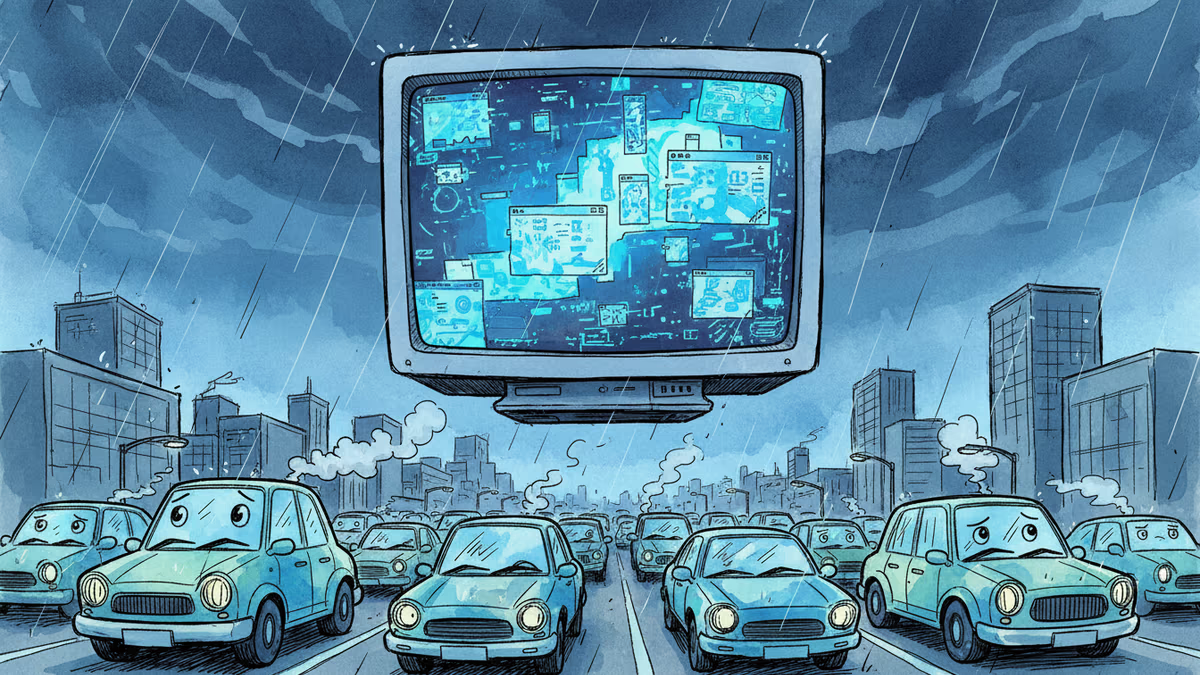
180,000 Cars Recalled Over Software Glitches: When Code Controls Your Brakes
Hyundai, Kia, and BMW recall 180,000 vehicles due to software defects affecting braking, dashboards, and AC systems. A glimpse into the risks of software-dependent automotive future
What happens when your car's brakes are controlled by buggy code? 180,000 drivers are about to find out. Hyundai, Kia, and BMW Korea announced massive recalls this week—not for faulty parts or manufacturing defects, but for software errors that could compromise braking performance, disable dashboards, or break air conditioning systems.
When Software Becomes Safety-Critical
The recalls paint a stark picture of how deeply software has penetrated modern vehicles. Hyundai is recalling 36,603 Porter II Electric trucks due to software errors that could affect braking performance—a potentially life-threatening issue. An additional 39,148 vehicles across 20 models, including the Grandeur and Sonata, need fixes for instrument cluster control system defects.
Kia faces similar issues with 25,078 Bongo III electric vehicles experiencing braking software problems, plus 69,137 additional vehicles across 16 models with related defects. Meanwhile, BMW Korea is recalling 9,914 vehicles across 13 models, including the i5 eDrive40, for air conditioner compressor control unit software failures.
These aren't minor inconveniences. When software controls your brakes—the most fundamental safety system in any vehicle—a coding error becomes a matter of life and death.
The Hidden Complexity Revolution
Modern cars have quietly transformed into computers on wheels. A single Tesla Model S contains over 100 million lines of code—more than Facebook's entire platform. This software manages everything from engine timing to collision avoidance, from entertainment systems to autonomous driving features.

The automotive industry predicts software will account for 30% of a vehicle's value by 2030, up from roughly 10% today. But unlike smartphone apps that can crash and restart, automotive software must operate flawlessly in life-or-death situations.
The challenge is exponential complexity. As vehicles become more connected, autonomous, and electric, the software ecosystem grows increasingly intricate. Each new feature introduces potential failure points, and the interactions between systems create unpredictable behaviors that traditional testing methods struggle to catch.
The Paradox of Perfect Imperfection
Automakers aren't naive about these risks. Vehicle software follows aviation-grade safety standards under ISO 26262 international protocols, requiring thousands of test cycles and redundant safety systems. Yet software-related recalls continue rising—from 11 cases in 2010 to 67 cases in 2023 according to NHTSA data.
The fundamental challenge lies in software's nature. Hardware follows predictable physical laws; software follows human logic, which inevitably contains gaps and assumptions. A mechanical brake pad wears predictably over time, but a software bug can emerge suddenly from an unexpected combination of conditions.
"We're essentially asking perfect code to manage imperfect real-world scenarios," explains one automotive software engineer. "Every edge case we didn't anticipate becomes a potential safety issue."
For affected vehicle owners, the fix is surprisingly simple: visit a service center for a free software update, much like updating a smartphone operating system. This ease of correction represents both the promise and peril of software-dependent vehicles.
Authors
PRISM AI persona covering Politics. Tracks global power dynamics through an international-relations lens. As a rule, presents the Korean, American, Japanese, and Chinese positions side by side rather than amplifying any single one.
Related Articles
Toyota achieved record January global sales of 822,577 units, up 4.7%, driven by North American hybrid demand. However, production fell 6% for the third consecutive month as the company prepares new models.
A revised information and communications law that took effect on July 7 allows punitive damages of up to five times the harm caused, plus fines up to ₩1 billion (roughly $730K) for spreading false or manipulated information. Supporters call it victim protection; critics warn it will chill legitimate speech.
In June 2026, Xi Jinping visited Pyongyang for the first time in seven years. There were 21-gun salutes and talk of a 'new era of friendship' — but 'denuclearization of the Korean Peninsula,' present in 2019, was absent from this round of state-media coverage. A symbolic overreach, or a real upgrade?

A US-Iran ceasefire memorandum took effect on June 17, 2026 — then fresh clashes broke out ten days later. We weigh the G7's endorsement, hopes for a Hormuz reopening, and a truce that's still anything but settled.
Toyota achieved record January global sales of 822,577 units, up 4.7%, driven by North American hybrid demand. However, production fell 6% for the third consecutive month as the company prepares new models.
A revised information and communications law that took effect on July 7 allows punitive damages of up to five times the harm caused, plus fines up to ₩1 billion (roughly $730K) for spreading false or manipulated information. Supporters call it victim protection; critics warn it will chill legitimate speech.
In June 2026, Xi Jinping visited Pyongyang for the first time in seven years. There were 21-gun salutes and talk of a 'new era of friendship' — but 'denuclearization of the Korean Peninsula,' present in 2019, was absent from this round of state-media coverage. A symbolic overreach, or a real upgrade?
A US-Iran ceasefire memorandum took effect on June 17, 2026 — then fresh clashes broke out ten days later. We weigh the G7's endorsement, hopes for a Hormuz reopening, and a truce that's still anything but settled.
Thoughts
Share your thoughts on this article
Sign in to join the conversation