
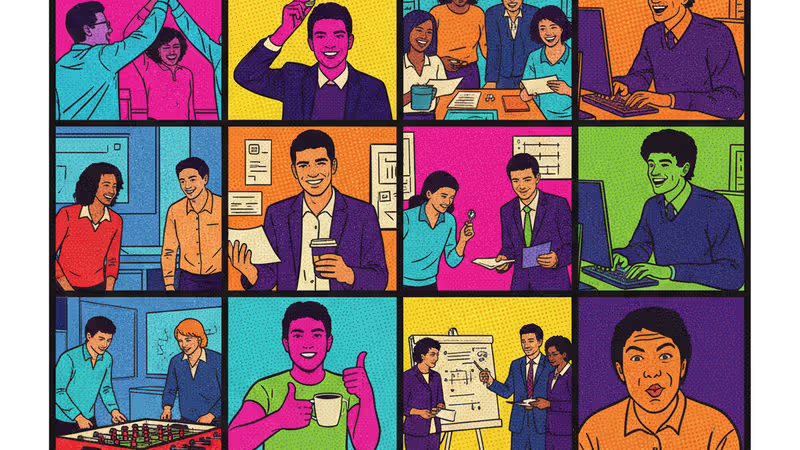
The Workday Snapshot: How Employee Photos Became Your Most Powerful Branding Asset
Beyond viral fluff: Discover why authentic employee photos are a powerful, untapped asset for employer branding, talent acquisition, and corporate strategy.
The Lede: The New ROI on Authenticity
Senior leaders often dismiss the flood of 'day-in-the-life' content on social media as trivial noise. This is a strategic error. What appears to be a simple photo of a police dog's retirement party or a game developer mocapping his pet is, in fact, the raw material of a powerful new economic engine: decentralized corporate storytelling. These authentic, employee-generated moments are achieving what multi-million dollar PR campaigns often fail to do—building genuine trust, attracting top-tier talent, and creating powerful brand affinity. This isn't just social media fluff; it's the future of employer branding and corporate reputation.
Why It Matters: The Collapse of the Corporate Monologue
For decades, a company's image was a carefully curated monologue, broadcast from the top down. Today, that model is obsolete. The real narrative is a dialogue, shaped by thousands of authentic 'workday snapshots' shared by your employees. This shift has profound second-order effects:
- The Talent Magnet: A stock photo of a diverse boardroom is no match for a genuine snapshot of a mother-daughter pilot crew. Top talent, particularly Gen Z and Millennials, are making career decisions based on this kind of social proof. They are vetting a company's culture not on its careers page, but through the unfiltered lens of its employees' Instagram and TikTok feeds.
- Radical Transparency as a Moat: Companies can no longer hide a toxic culture. The 'cleared the shelter' photo isn't just heartwarming; it's a verifiable testament to a team's successful execution and mission alignment. This level of on-the-ground validation builds a competitive moat of trust that is difficult for rivals to replicate.
- Product and Brand Humanization: Learning that a real dog, Uuno, is behind the animation in a video game forges an immediate emotional connection with the product. This user-generated context transforms a faceless corporation into a collective of passionate individuals, a critical differentiator in a crowded marketplace.
The Analysis: From 'Mad Men' to a Million Marketers
We've moved from the 'Mad Men' era of polished, aspirational advertising to the Creator Economy era of raw, relatable content. The critical evolution is that 'creator' is no longer a niche profession; every employee with a smartphone is now a potential brand ambassador and media channel. The photo of the 300-year-old cedar tree, taken by a gardener, does more to communicate a sense of heritage, care, and a quality work environment than any corporate brochure ever could.
This decentralization poses a threat to command-and-control leadership styles but offers immense opportunity for forward-thinking organizations. While legacy brands invested in monolithic ad campaigns, agile competitors are winning by cultivating a culture where employees feel proud and empowered to share their work. This isn't an HR initiative; it's a core business strategy that leverages the network effects of social media at near-zero marginal cost.
PRISM Insight: The Rise of the Employee Advocacy Stack
The strategic imperative is to shift from policing employee social media to enabling it. This is creating a new category of B2B technology—the 'Employee Advocacy Stack'. Platforms that help companies curate, amplify, and analyze employee-generated content are moving from 'nice-to-have' to essential infrastructure. Investment will flow towards tools that can identify the most compelling internal stories, provide simple guardrails for sharing, and measure the ROI of this organic reach on key metrics like recruitment funnels and brand sentiment. The smart money isn't just on the creators, but on the platforms that empower the employee-as-creator at enterprise scale.
PRISM's Take: Culture Is Your New Content Strategy
Ultimately, these viral photos are not the goal; they are the evidence. They are the tangible output of a healthy, engaging, and psychologically safe corporate culture. You cannot mandate authenticity. You cannot script a viral moment of an office worker befriending a bird. These moments emerge organically from an environment where people are genuinely passionate and proud of their work. The executive mandate is therefore clear: stop trying to *create* authentic content. Instead, build a culture so compelling that your employees become its most powerful storytellers. Your company's brand is no longer what you tell people it is. It's the sum of a million workday snapshots, shared willingly by the people on the front lines.
Related Articles
Discover how the simple act of peeling a banana reveals the hidden cognitive friction and behavioral debt crippling your organization's productivity and innovation.
Beyond the meme: How the 'chaotic good' alignment is becoming a key strategy for disruption, brand loyalty, and even ethical AI design.

Viral stories about life changes are more than inspiration—they're a critical signal about the future of work, talent retention, and non-linear career paths.
Viral 'day at work' photos are more than just entertainment. They're a powerful shift in corporate branding, talent acquisition, and the future of authentic marketing.