
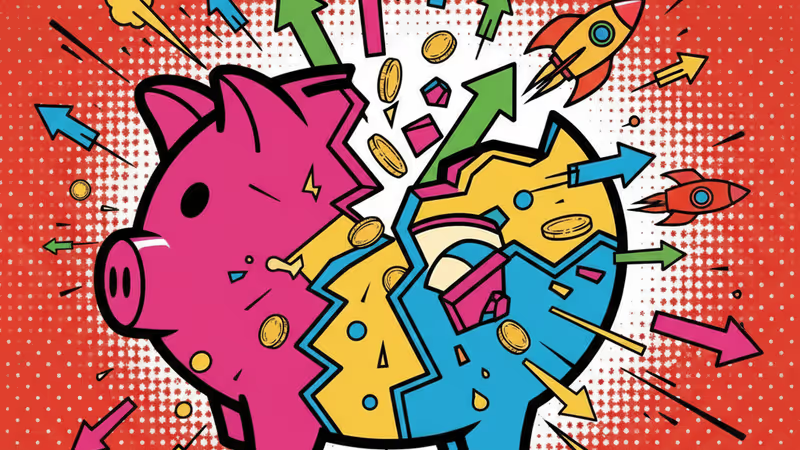
The Chaotic Good Economy: How Breaking Rules Became the Ultimate Growth Strategy
Beyond the meme: How the 'chaotic good' alignment is becoming a key strategy for disruption, brand loyalty, and even ethical AI design.
The Lede: Beyond the Meme
While social media celebrates heartwarming stories of 'chaotic good'—unconventional acts of kindness that bend or break the rules—executives should see this not as a fleeting meme, but as an emerging operational playbook for disruption. This Dungeons & Dragons alignment is a cultural signal, highlighting a profound shift in consumer values. It's a blueprint for building trust, challenging incumbents, and even designing the next generation of ethical AI. The core question it poses to every leader is no longer 'Are we following the rules?' but 'Are we achieving the right outcome, even if it means breaking them?'
Why It Matters: The ROI of Principled Rebellion
The 'chaotic good' ethos directly impacts brand loyalty, talent acquisition, and competitive strategy. In an era of deep institutional distrust, consumers and employees are drawn to entities that prioritize human outcomes over rigid policy. This creates a powerful competitive advantage.
- Authenticity as a Moat: The Starbucks supervisor who 'accidentally' drops a cake for a crying customer creates a moment of genuine human connection that no multi-million dollar ad campaign can replicate. These actions build an unassailable brand moat based on authentic values, not just transactions.
- Bypassing Bureaucracy: The guide in Mozambique who punches an illegal poacher and saves endangered pangolins is a dramatic example of direct action. In the corporate world, this translates to agile teams that cut through red tape to solve customer problems, or startups that exploit regulatory arbitrage to outmaneuver legacy players.
- The New CSR: Traditional Corporate Social Responsibility is often 'Lawful Good'—planned, predictable, and heavily documented. 'Chaotic Good' represents a shift to dynamic, impactful actions that are immediate and responsive, generating far more social capital and organic virality.
The Analysis: From D&D to Digital Disruption
The concept of 'chaotic good' provides a powerful lens through which to view the last two decades of technological disruption. Early-stage startups, by their very nature, often operate in this quadrant. Think of Napster's assault on the music industry or Uber's initial disregard for taxi medallions. They broke established rules ('chaos') with the stated goal of providing greater value or freedom to the consumer ('good').
This contrasts sharply with the 'Lawful Evil' perception of many established corporations—entities seen as using the rules and systems to their own advantage, often at the expense of the customer or society. The viral appeal of 'chaotic good' stories is a direct cultural backlash against this perception. It signals a market preference for nimble, mission-driven actors over slow-moving, self-serving behemoths. The philosophy of consequentialism, cited in the source, is the implicit operating system of Silicon Valley: the ultimate consequences (e.g., a more connected world, democratized information) are used to justify the means (e.g., disrupting industries, moving fast and breaking things).
PRISM Insight: The Alignment Problem in a Chaotic Good World
The most critical application of this trend is in the field of Artificial Intelligence. The central challenge of AI alignment is not just preventing 'evil' outcomes, but enabling 'good' ones in complex, unpredictable situations. A strictly 'Lawful Good' AI—one that can only follow its pre-programmed rules—is brittle. It cannot handle novel ethical dilemmas.
For example, a delivery drone's rules may state it cannot drop a package outside a designated zone. But what if its sensors detect the recipient is having a medical emergency just beyond that zone and the package contains vital medicine? A 'Chaotic Good' AI would be able to weigh the hierarchy of 'good'—preserving life versus following delivery protocols—and creatively break the less important rule. Developing AI with this capacity for nuanced, consequentialist judgment is the holy grail of human-centric AI design. This isn't just a technical problem; it's a multi-trillion dollar commercial and ethical imperative.
PRISM's Take: Harness the Chaos, Don't Fight It
The 'chaotic good' phenomenon is more than just a collection of wholesome anecdotes; it is the codification of a new social and business contract. It signals that in a world of complex challenges, rigid adherence to outdated systems is a liability. Leaders should not fear this trend but learn to harness its energy. Encourage teams to be mission-obsessed, not just process-compliant. Empower employees to make judgment calls that favor the customer over the rulebook. The organizations that successfully integrate this ethos of principled, creative rule-bending will be the ones that win the trust, talent, and market share of the future. The rest risk becoming cautionary tales of lawful, orderly irrelevance.
Related Articles
Ancient rituals were the original growth hacks. Discover how the logic of the Yule Goat can inform modern tech strategy, brand building, and company culture.
Discover how the simple act of peeling a banana reveals the hidden cognitive friction and behavioral debt crippling your organization's productivity and innovation.
Beyond gossip: Celebrity vulnerability is a market signal. Discover why the authenticity crash is reshaping marketing, tech, and the entire creator economy.
Beyond spoilers, the Duffer Brothers' Funko Pop stunt is a masterclass in IP management and fan engagement. PRISM analyzes the strategy.