
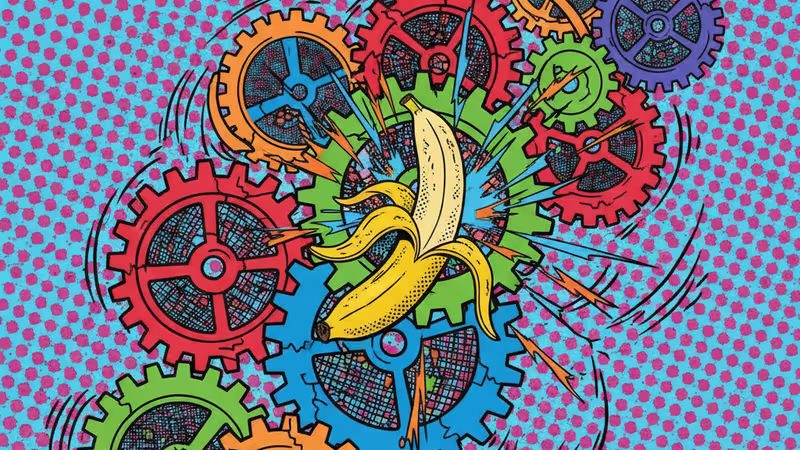
The Banana Fallacy: How Unseen Inefficiencies Are Silently Killing Your Company's Growth
Discover how the simple act of peeling a banana reveals the hidden cognitive friction and behavioral debt crippling your organization's productivity and innovation.
The Lede: The High Cost of 'Good Enough'
You’re probably breathing wrong. You’re also likely peeling bananas, pouring milk, and brushing your teeth sub-optimally. While these minor life-hacks seem trivial, they are a powerful metaphor for a multi-trillion-dollar problem hiding in plain sight within every organization: behavioral debt. Just as we perform daily tasks inefficiently without a second thought, your teams are clinging to legacy workflows and 'best practices' that are silently strangling productivity, innovation, and growth. The real question isn't whether you're peeling a banana from the stem, but what 'banana-peeling myths' are costing your company millions.
Why It Matters: The Compounding Tax of Cognitive Friction
Cognitive friction is the invisible resistance users—and employees—encounter when trying to complete a task. It's the extra click, the confusing interface, the redundant data entry. On an individual level, it's a minor annoyance. Scaled across an enterprise, it becomes a catastrophic drag on performance.
- Productivity Drain: A recent study suggests knowledge workers lose up to 40% of their productive time to context switching and navigating inefficient digital tools. This isn't about laziness; it's about a system designed with inherent friction.
- Innovation Stagnation: When teams are bogged down by clunky processes, their cognitive bandwidth for creative problem-solving evaporates. 'The way we've always done it' becomes an insurmountable barrier to 'what if we tried this?'
- Talent Repulsion: Top-tier talent, particularly Gen Z, has zero tolerance for poor user experience, whether in a consumer app or their internal expense reporting software. Clunky internal systems are a leading indicator of a stagnant culture, actively repelling the very people you need to hire.
The Analysis: From Taylorism to The Frictionless Enterprise
A century ago, Frederick Winslow Taylor’s 'Scientific Management' optimized manual labor by breaking down physical tasks into discrete, timed motions. We are now in a new era, requiring a 'Digital Taylorism'—not for the assembly line, but for the knowledge worker's desktop. The source article's list of everyday mistakes highlights a core human flaw: path dependence. We learn one way to do something and rarely revisit the process, even when superior methods exist.
This is precisely what happens with enterprise software and corporate workflows. An accounting process designed in 1998 gets digitized in 2010 and then migrated to the cloud in 2020, but the core, inefficient logic remains. We put a slick UI on a broken engine. The act of pouring milk from the 'wrong' side of the carton to avoid splashing is a perfect analog for redesigning a workflow to eliminate exceptions and errors, rather than just handling them better after they occur.
PRISM Insight: The Rise of the Process Intelligence Stack
The massive, untapped opportunity is not just in building new software, but in optimizing the interaction between humans and the software they already use. This has created a booming market for a new 'Process Intelligence' stack.
- Process Mining & Discovery: Companies like Celonis and UiPath are the 'MRIs' for corporate workflows. They analyze system logs to create a real-time, X-ray of how work actually gets done, revealing the bottlenecks and 'wrong-way banana peeling' that no one knew existed.
- AI-Powered Workflow Automation: The next frontier is not just identifying friction but proactively eliminating it. Imagine an AI assistant that observes your team's software usage and suggests, 'I see you export this report to Excel and manually create a pivot table every Friday. I can automate that for you.' This turns every employee into an efficiency expert.
- Low-Code/No-Code Platforms: Tools like Airtable, Notion, and Zapier are empowering non-technical employees to become 'citizen developers,' fixing their own frictional workflows without waiting for IT. This is the democratization of process optimization.
The investment thesis is clear: The next wave of enterprise unicorns won't sell features; they will sell friction removal as a service.
PRISM's Take: Declare War on Your 'Best Practices'
Your company's 'best practices' are likely its most dangerous liabilities. They are the institutionalized, unexamined habits that create the most significant drag on your forward momentum. The most critical leadership function for the next decade will be to foster a culture of profound dissatisfaction with the status quo.
Leaders must constantly ask their teams: 'What is the stupidest, most time-consuming thing you have to do every week? And how do we kill it?' Don't just ask your people to breathe better; redesign the entire corporate environment to filter out the pollutants of inefficiency. The ultimate competitive advantage is not a single piece of technology, but a relentless, cultural obsession with finding a better way to peel the banana.
Related Articles
Beyond the meme: How the 'chaotic good' alignment is becoming a key strategy for disruption, brand loyalty, and even ethical AI design.
New research shows swearing isn't just cathartic—it's a neurological hack that boosts strength and reduces pain. Discover the science behind this primal biohack.
An analysis of how social media and the creator economy are turning historic castles into high-value digital assets, fueling a new 'Castle Economy'.

Beyond gossip: Celebrity vulnerability is a market signal. Discover why the authenticity crash is reshaping marketing, tech, and the entire creator economy.