
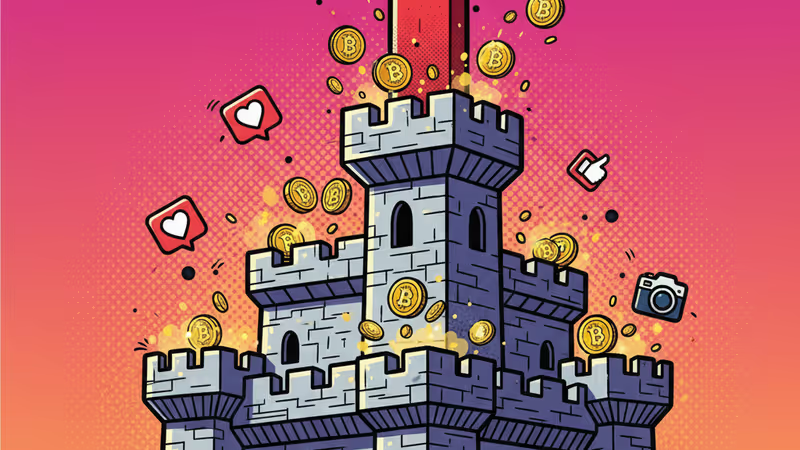
The Castle Economy: How Instagram Turned Ancient Fortresses into Billion-Dollar Digital Assets
An analysis of how social media and the creator economy are turning historic castles into high-value digital assets, fueling a new 'Castle Economy'.
The Lede: The Scarcity of the 'Unspoiled View'
A photographer's personal quest to capture "timeless castles" free from modern intrusions reveals a critical economic principle for the digital age: the 'unspoiled view' is now a scarce, high-value asset. These ancient stones are no longer just historical artifacts; they are the physical anchors for a multi-billion dollar digital ecosystem fueled by the creator economy and experience-hungry consumers. For executives in tech, travel, and marketing, understanding the dynamics of this new 'Castle Economy' is key to unlocking future growth.
Why It Matters: The Instagram Feedback Loop
The phenomenon showcased in these stunning photographs is not merely about tourism; it's about a powerful and volatile feedback loop with significant economic consequences. A single, viral image of a place like Germany's Burg Eltz, shrouded in autumn mist, can drive exponential growth in visitor numbers. This creates a boom for local economies but also births the critical challenge of our time: overtourism.
- Asset Degradation: The very 'authenticity' that attracts millions can be eroded by the crowds, infrastructure strain, and commercialization that follow. The empty pond and scaffolding at Poland's Moszna Zamek, noted by the photographer, are symptoms of this constant tension between access and preservation.
- Economic Concentration: Social media algorithms tend to amplify already-famous locations (like Neuschwanstein), concentrating tourist spending in a few key 'honeypots' while leaving other equally compelling sites under-monetized.
- The New Marketing Channel: Tourism boards no longer rely solely on traditional advertising. Creators like Vincent Croce are now a primary discovery engine, making their content—and the platforms they use—a critical part of the travel industry's infrastructure.
The Analysis: From Military Strongholds to Content Studios
Historically, castles were instruments of power projection. Their location, height, and fortifications were strategic calculations of defense and control. Today, their strategic value is calculated in likes, shares, and geotags. They have transitioned from military assets to global content studios.
Consider the case of Neuschwanstein Castle. It was commissioned by King Ludwig II in the 19th century not for defense, but as a romantic, idealized fantasy—a stage set for a Wagnerian opera. In essence, it was engineered for virality over a century before the internet existed. This inherent 'picturesqueness' is why it remains an apex asset in the digital age. The photographer's note that another castle has a strong "Disney force" is no accident; Disney's castle was directly inspired by Neuschwanstein. This demonstrates how a physical location becomes intellectual property, its value amplified through replication in digital and entertainment media.
PRISM Insight: The Tech-Enabled Future of Heritage
The challenges and opportunities of the Castle Economy are being met by a new wave of technology. The investment landscape is shifting from physical infrastructure to digital management and experience enhancement.
- AI and Digital Preservation: Artificial intelligence is already being used to digitally remove modern annoyances (like cranes or crowds) from marketing images. The next step is real-time augmented reality, allowing visitors to see castles not just as they are, but as they were in their prime, creating a premium, layered experience.
- Predictive Analytics for Crowd Control: Travel tech platforms are leveraging data from social media, flight bookings, and on-site sensors to predict crowd flows. This allows for dynamic pricing, timed ticketing, and the strategic promotion of 'B-list' locations (like France's Château de Miolans) to distribute tourist load and revenue.
- The Drone's-Eye View: As seen in the photographer's work, drone technology has democratized aerial photography, unlocking new perspectives that were once the exclusive domain of helicopter crews. This continually refreshes the content pool for even the most-photographed locations, keeping them relevant in fast-moving social feeds.
PRISM's Take: Managing the Digital Aura
The core takeaway is that the value of a physical heritage site is now inextricably linked to its digital aura. The photographer's search for the 'timeless' shot is a search for an authentic experience that can be captured and shared. The future of preserving these treasures lies not just in reinforcing their walls, but in intelligently managing their online identity. The most successful destinations will be those that embrace technology not simply as a promotional tool, but as a strategic instrument to balance global appeal with local sustainability. The 'unspoiled view' is no longer a matter of chance; it is a matter of design.
Related Articles
An artist's viral dog embroidery reveals key trends in the creator economy, pet humanization, and the future of authentic D2C commerce. Analysis for leaders.

A viral story about a keyboard reveals a deep societal shift from gratitude to transactionalism. Here's why it impacts your company's future.

A woman spent $1M to look like a star, then lost everything. Her story is a stark warning about the risks of the influencer and digital identity economy.
Viral comic artist Berkeley Mews isn't just funny—his work is a masterclass in the creator economy. We break down his formula for digital success.