
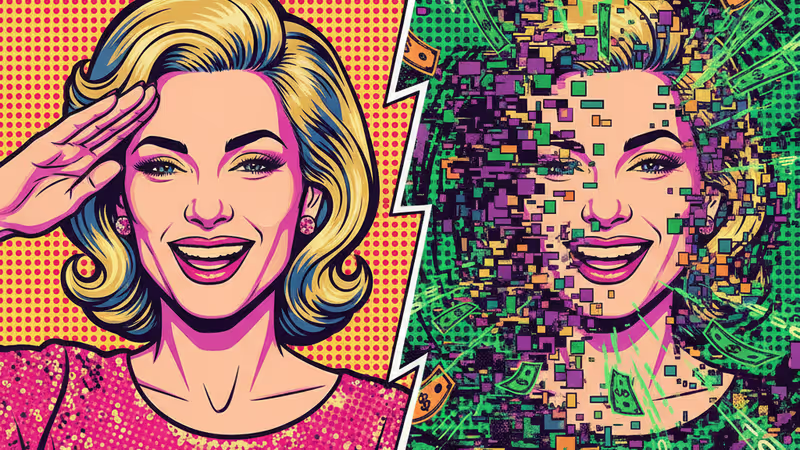
The $1M Doppelgänger: How a Celebrity Clone's Crash Foretells the Future of Digital Identity
A woman spent $1M to look like a star, then lost everything. Her story is a stark warning about the risks of the influencer and digital identity economy.
The Lede: The Human Stock That Crashed
A Chinese influencer spent nearly a million dollars and underwent 37 surgeries to become a living copy of a superstar. She effectively transformed herself into a human derivative asset, pegged to the celebrity’s fame. When the star’s reputation imploded overnight due to a government scandal, the doppelgänger's career and personal brand were instantly wiped out. This isn't just a bizarre pop culture story; it's a high-stakes, real-world case study on the extreme risks of brand affiliation and the fragile economics of identity in the creator economy.
Why It Matters: The High Volatility of Imitation
He Chengxi’s rise and fall exposes a critical vulnerability in the modern influencer ecosystem: building a brand on a borrowed or imitated identity is the equivalent of building on a fault line. When your entire value proposition is “I look like X,” your personal stock is inextricably tied to X's market performance.
- Second-Order Collapse: When actress Fan Bingbing was blacklisted for tax evasion, the market for her likeness vanished. He Chengxi, the “Little Fan Bingbing,” saw her acting roles, endorsements, and social capital evaporate, demonstrating the catastrophic ripple effects of a host brand's failure.
- The Platform Risk of a Person: We often discuss platform risk in terms of relying on Facebook or TikTok's algorithms. This case introduces the concept of “human platform risk”—pegging your career to the reputation and actions of a single, fallible individual.
- The Pivot to Authenticity: He Chengxi’s subsequent rebranding as a fashion blogger under her own identity is a forced pivot from a high-risk derivative to a more stable, original asset. It’s a painful but necessary business decision, mirroring how companies divest from toxic partnerships.
The Analysis: An Analog Precursor to a Digital Problem
He Chengxi's journey took place between 2008 and 2016, at the peak of China's “wanghong” (internet celebrity) boom and an era of monolithic beauty standards. Fan Bingbing's face was considered the aesthetic “gold standard,” a market ideal that He Chengxi invested in literally, with flesh and bone. Her strategy was, for a time, a brilliant success. She became a tradable commodity in the entertainment industry, offering a budget version of an A-list asset.
The system's fragility was exposed by the unique nature of the Chinese market. Fan Bingbing’s downfall wasn't a gradual decline in popularity; it was a sudden, state-enforced “cancellation.” This political black swan event revealed that He Chengxi hadn't just bet on a celebrity's fame, but on the stability of the entire regulatory environment surrounding that celebrity. Her divorce from a surgeon who had modified his own face to resemble Fan's boyfriend completes the metaphor: the entire ecosystem built around the imitation collapsed.
PRISM Insight: From Scalpels to Pixels
This story is an analog preview of the identity crises awaiting us in the metaverse and the AI-driven creator economy. He Chengxi used scalpels to achieve what can now be increasingly accomplished with code.
Consider the emerging tech trends:
- Digital Doppelgängers & VTubers: Creators are building entire careers using digital avatars, some of which heavily borrow from existing popular aesthetics. What happens when the art style they emulate falls out of favor or becomes embroiled in controversy? He Chengxi’s story suggests a similar market collapse is possible.
- Real-Time Deepfakes: As AI filters become powerful enough to convincingly morph a user's face into a celebrity's in real-time on a livestream, we will see a proliferation of digital He Chengxis. This raises immense questions not only about intellectual property but also about the economic viability of building a brand on a “digital mask.”
The investment implication is clear: the next frontier of the creator economy lies in tools for identity sovereignty. Platforms that enable creators to build, own, and protect a unique, defensible digital identity—divorced from imitation—will hold immense value. Provenance and originality will become the most valuable assets in a world of infinite copies.
PRISM's Take: The Ultimate Currency is Authenticity
He Chengxi’s million-dollar ordeal serves as a stark parable for the digital age: you can rent an identity, but you can never truly own it. The short-term gains from imitation are dwarfed by the long-term risk of catastrophic failure. Her painful journey from a human copy to an original creator is a microcosm of the essential pivot awaiting the entire influencer economy.
The future doesn’t belong to the best copy; it belongs to the most authentic and resilient original. In the end, the only brand you can truly control is your own.
Related Articles
An artist's viral dog embroidery reveals key trends in the creator economy, pet humanization, and the future of authentic D2C commerce. Analysis for leaders.

A viral story about a keyboard reveals a deep societal shift from gratitude to transactionalism. Here's why it impacts your company's future.
Viral comic artist Berkeley Mews isn't just funny—his work is a masterclass in the creator economy. We break down his formula for digital success.
Viral 'leap of faith' stories aren't just feel-good fluff. They're data points on a major economic shift in work, talent, and risk. Here's why leaders must pay attention.