
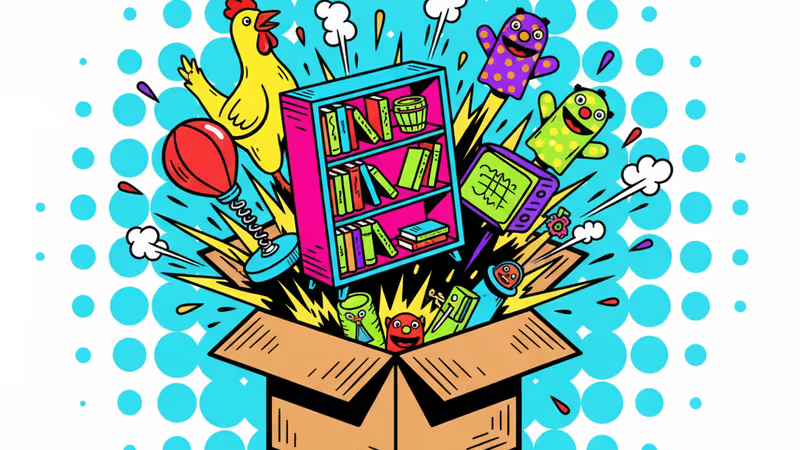
The 'Weird Gift' Economy: Why Your Next Competitor Sells Anxiety Bookshelves on Amazon
The rise of bizarre online gifts signals a seismic shift in e-commerce. Discover why the niche product economy is the future of retail and brand strategy.
The Lede: Beyond the Novelty
While your marketing team obsesses over mass-market appeal, a new breed of micro-brands is quietly capturing consumer loyalty by selling dinosaur egg candles and miniature 'anxiety bookshelves'. These seemingly trivial, bizarre products are not just holiday novelties; they are potent signals of a fundamental rewiring of consumerism. The rise of this 'Weird Gift' economy indicates a systemic shift from monolithic brand loyalty to a fragmented landscape where hyper-niche appeal, authenticity, and 'shareability' are the new currencies. Leaders who dismiss this as fringe behavior are ignoring the playbook for the next generation of commerce.
Why It Matters: The End of 'One-Size-Fits-All'
The success of these peculiar products reveals a critical vulnerability in legacy retail and CPG models. The core assumption of mass production—that a single product can satisfy millions—is collapsing under the weight of infinite choice and algorithmic discovery.
- Market Fragmentation: The 'Anxiety Bookshelf' doesn't target a broad demographic like 'millennial women'. It targets a hyper-specific psychographic: individuals who find solace in organization, appreciate novelty, and are active in online mental health communities. This level of precision is where mass-market brands, built on broad personas, are failing.
- Supply Chain Disruption: These products thrive on agile, small-batch manufacturing, often leveraging on-demand production and drop-shipping logistics. This model sidesteps the capital-intensive, slow-moving supply chains of incumbents, allowing micro-brands to test, iterate, and launch products at a speed established players cannot match.
- The New Moat is 'Story': A generic scented candle has no narrative. A candle shaped like a dinosaur egg from which a tiny dinosaur 'hatches' has a story. In an era of social media, products that are inherently shareable and create a personal narrative generate their own marketing flywheel, bypassing the need for massive ad spend.
The Analysis: From Department Store to Algorithmic Bazaar
Historically, retail gatekeepers (department store buyers, big-box merchandisers) curated a limited selection of goods, creating an artificial consensus on what was 'in demand'. The internet, and specifically platforms like Amazon, Etsy, and Shopify, obliterated these gatekeepers. We've moved from a push-based model of curated supply to a pull-based model of infinite demand.
The 'Weird Gift' economy is the ultimate expression of Chris Anderson's "Long Tail" theory. While major brands fight for diminishing returns in the crowded 'head' of the demand curve (e.g., the most popular smartphone case), immense value is being created in the 'tail'—the millions of niche interests that were previously uneconomical to serve. Algorithmic recommendation engines on Amazon and targeted ads on social platforms act as the connective tissue, linking a consumer searching for 'Dunder Mifflin Christmas' directly to a niche parody book, a connection impossible in a pre-digital world.
PRISM Insight: The Rise of the 'Micro-Brand Stack'
The investment opportunity here isn't just in backing the next viral pet rock. It's in the underlying technology stack that enables this Cambrian explosion of micro-brands. The 'picks and shovels' of the niche economy are where the real enterprise value lies. This includes:
- AI-Powered Product Discovery: Platforms that use sentiment analysis, search trend data, and social media listening to identify unmet niche demands before they become mainstream.
- On-Demand Manufacturing Networks: Services that connect creators with a global network of flexible factories, enabling rapid prototyping and inventory-free business models.
- Automated Logistics & Fulfillment: Companies that handle the entire backend for these micro-brands, from warehousing to international shipping, effectively democratizing global commerce.
This tech stack lowers the barrier to entry so dramatically that a single individual can now ideate, produce, market, and distribute a global product from their laptop, posing a death-by-a-thousand-cuts threat to complacent incumbents.
PRISM's Take: Adapt or Become the Boring Gift
The proliferation of products like exotic meat sticks and gumball machine art frames is not a fad; it's the new grammar of commerce. Consumers are not just buying products; they are buying identity signifiers, inside jokes, and conversation starters. For large corporations, the strategic imperative is twofold. First, they must develop internal innovation labs that can operate with the speed and risk-tolerance of a micro-brand, launching their own 'weird' products to test niche markets. Second, they must view the landscape of niche D2C brands not as a nuisance, but as a distributed R&D department and a pipeline for strategic acquisitions. Ignoring this trend is a choice to become the generic, forgettable gift card in a marketplace that increasingly rewards chaos and delight.
Related Articles
Beyond gossip: Celebrity vulnerability is a market signal. Discover why the authenticity crash is reshaping marketing, tech, and the entire creator economy.
Beyond the meme: How the 'chaotic good' alignment is becoming a key strategy for disruption, brand loyalty, and even ethical AI design.
Beyond spoilers, the Duffer Brothers' Funko Pop stunt is a masterclass in IP management and fan engagement. PRISM analyzes the strategy.
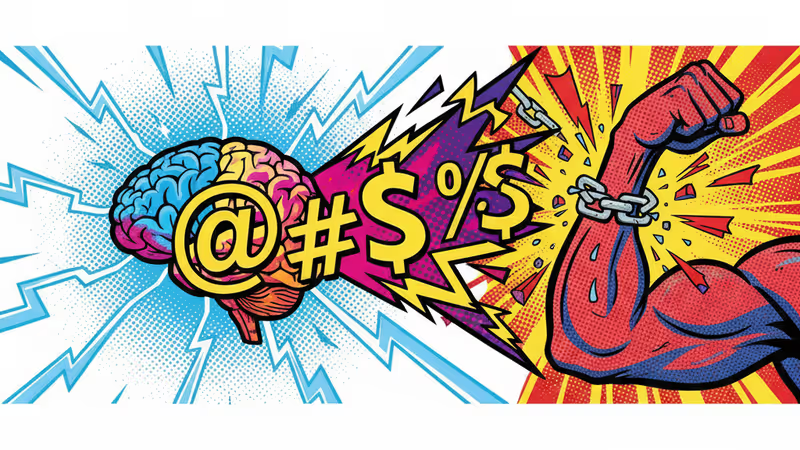
New research shows swearing isn't just cathartic—it's a neurological hack that boosts strength and reduces pain. Discover the science behind this primal biohack.