
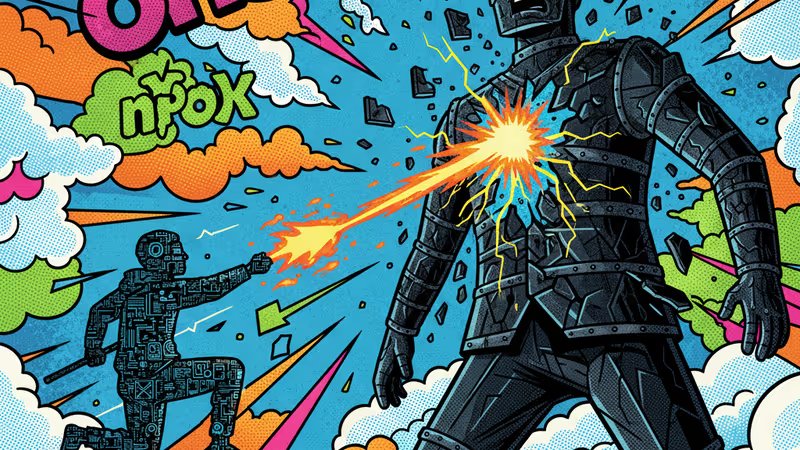
The Retaliation Equation: What Reddit's Revenge Sagas Teach CEOs About Asymmetric Risk
Viral revenge stories reveal critical lessons in game theory and corporate strategy. Learn how minor slights can trigger catastrophic, asymmetric risks.
The Lede: The High Cost of a Small Grudge
On the surface, a collection of Reddit stories about petty revenge seems like trivial internet fodder. A student duping a cheating classmate, a tenant reporting a landlord over a security deposit. Why should a busy executive care? Because these seemingly minor anecdotes are potent case studies in a force that shapes markets and topples empires: asymmetric retaliation. They reveal how small provocations can trigger disproportionate, system-breaking responses—a dynamic now amplified to a global scale by technology, with your company as a potential target.
Why It Matters: The New Battlefield of Reputation
In today's hyper-connected environment, the leverage held by individuals—customers, employees, partners—has grown exponentially. The line between a minor dispute and a full-blown reputational crisis has never been thinner. These viral stories illustrate critical second-order effects that leaders often ignore at their peril.
- Weaponized Grievances: The landlord who unethically kept a small deposit didn't just lose a tenant; she triggered a regulatory complaint that cost her the entire property. In the corporate world, this is the equivalent of a single disgruntled customer's viral video or an ex-employee's Glassdoor review sparking a regulatory probe or deterring top-tier talent. The initial cost of doing the right thing is dwarfed by the eventual cost of public recourse.
- Internal Systems Failure: The student who fed his cheating classmate wrong answers didn't just punish an individual; he exposed a flaw in the system of academic integrity. For a business, this mirrors how tolerating minor ethical lapses or 'cheating' on internal metrics can foster a culture of distrust, leading to acts of internal sabotage that cripple major projects. It reveals that your process is only as strong as its weakest, most exploitable point.
- The Irrationality Premium: The friend who psychologically tormented another with the *threat* of revenge highlights that human behavior is not always rational. People, and by extension markets, are driven by emotion, pride, and a desire for fairness. Models that assume rational actors will consistently fail to predict these emotionally-charged, high-impact 'Black Swan' events.
The Analysis: From Playground to Boardroom
These scenarios are not new; they are timeless examples of game theory and power dynamics. What's changed is the scale and speed at which they unfold. Leaders must understand the underlying principles to navigate this new landscape.
Game Theory in the Digital Age
Classic 'Tit-for-Tat' strategies rely on proportional, rational responses. But the internet removes the need for proportionality. The tenant-landlord situation was a terminal game; with nothing left to lose, the tenant opted for a mutually destructive outcome. Businesses that believe they 'won' a dispute with a customer or fired employee often fail to realize the other party is no longer playing by the same rules and can inflict damage with minimal personal cost.
Asymmetric Corporate Warfare
Just as a small insurgent force can challenge a superpower, a single actor can challenge a corporation. The tools of this warfare aren't weapons, but information: a leaked internal email, a video recorded on a smartphone, a well-placed tip to a journalist or regulator. Companies that operate with a 'might is right' mentality create vulnerabilities, assuming their size protects them. As the landlord discovered, compliance is a critical vulnerability that a determined, less-powerful adversary can easily exploit.
PRISM Insight: The Rise of Accountability-as-a-Service
The core tech trend amplifying this dynamic is the professionalization of public grievance. Platforms like Glassdoor, Yelp, Twitter, and even specialized whistleblower apps function as 'Accountability-as-a-Service'. They provide the infrastructure for individuals to scale their complaints, turning isolated incidents into aggregated data points that influence reputation, stock price, and regulatory scrutiny.
For investors, this introduces a new metric: Reputational Liability. Scrutinizing a company's pattern of minor legal disputes, customer service complaints, and employee reviews is no longer a soft-skill analysis. It is a hard-data indicator of systemic risk and potential exposure to a catastrophic, asymmetric retaliation event.
PRISM's Take: De-escalation as a Core Strategy
The ultimate lesson from these viral tales of revenge is that in a networked world, no slight is truly small and no actor is truly powerless. The strategic focus for 21st-century leadership must shift from 'winning' every minor conflict to a doctrine of systemic integrity and de-escalation.
Proactively addressing vulnerabilities—whether it's a flawed fire code, a toxic team culture, or an unfair customer policy—is no longer just good ethics; it is essential risk management. The cost of fixing the underlying problem is almost always lower than the cost of allowing an aggrieved party to fix it for you in the court of public opinion. The smartest move in a revenge game is not to play.
Related Articles
New research shows swearing isn't just cathartic—it's a neurological hack that boosts strength and reduces pain. Discover the science behind this primal biohack.
Discover how the simple act of peeling a banana reveals the hidden cognitive friction and behavioral debt crippling your organization's productivity and innovation.
An analysis of how social media and the creator economy are turning historic castles into high-value digital assets, fueling a new 'Castle Economy'.

Beyond gossip: Celebrity vulnerability is a market signal. Discover why the authenticity crash is reshaping marketing, tech, and the entire creator economy.