
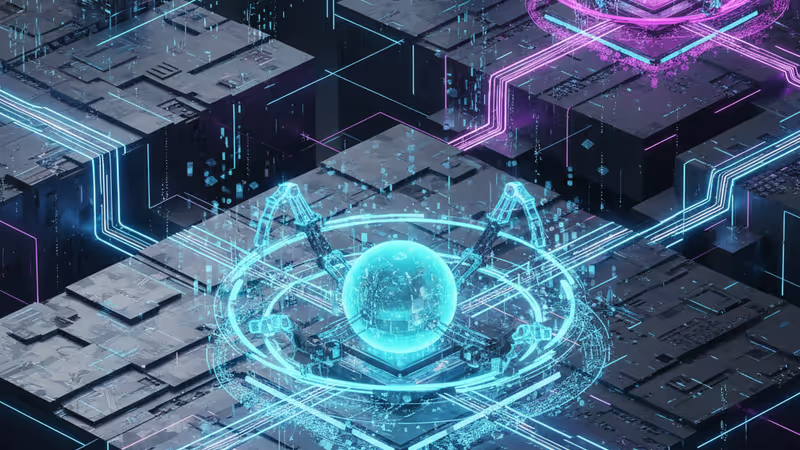
The Loop: OpenAI's Codex is Now Building Itself, Sparking an AI 'Arms Race'
OpenAI reveals its AI, Codex, is building itself—a recursive loop that signals a new 'arms race' in software development. An analysis of the new competitive frontier.
The Lede: A Sci-Fi Concept Becomes Commercial Reality
OpenAI has confirmed what many in the AI field have theorized: its advanced coding agent, Codex, is now a primary tool in its own development. According to product lead Alexander Embiricos, "the vast majority of Codex is built by Codex." This isn't merely a productivity boost; it's the commercialization of a recursive self-improvement loop, a concept once confined to the pages of science fiction. For tech leaders, investors, and developers, this signals a fundamental acceleration in the pace of software innovation and creates a formidable competitive moat that few can cross.
Why It Matters: The New Competitive Frontier
When a tool is used to improve itself, it creates a flywheel effect. Each improvement to Codex makes it a better developer, which in turn allows it to accelerate the next cycle of its own improvement. This creates a non-linear, potentially exponential, growth curve in capability.
- The Productivity Moat: Companies that can successfully implement this AI-driven development cycle can out-innovate and out-pace competitors operating on traditional human-led timelines. The gap between AI leaders and laggards is set to widen dramatically.
- Redefining the Developer's Role: This shifts the role of elite human engineers from writing line-by-line code to becoming high-level architects, prompters, and AI system supervisors. The most valuable skill is no longer just coding, but effectively directing AI agents to achieve complex goals.
- Second-Order Effects: As AI builds better AI, the complexity and power of the software it can create will grow exponentially. This will unlock new applications and services previously deemed too complex or resource-intensive to build.
The Analysis: Echoes of Computing History

From Self-Hosting Compilers to Self-Improving AI
This development has a clear historical precedent in computer science: the concept of a "self-hosting compiler." In the early days of computing, the first compiler for a new programming language had to be written in a different, existing language. The mark of maturity was when the compiler could be rewritten and compiled in its own language. This process, known as bootstrapping, proved the language's power and utility.
OpenAI is now applying this bootstrap principle to artificial intelligence itself. Where compilers self-hosted to validate a language, Codex is self-developing to accelerate its own intelligence. This is a paradigm shift from a static tool to a dynamic, evolving system, and it's a crucial milestone on the path toward more autonomous and capable AI.
The Industry's Inevitable Response
The admission from OpenAI is a strategic shot across the bow to its rivals. Google, with its Gemini models and internal developer tools, and Microsoft, through its deep integration with GitHub Copilot (powered by OpenAI's models), are the only players with the scale to compete directly. We anticipate an immediate and intense internal focus at these companies on replicating this self-improvement loop. For smaller AI labs and open-source projects, the bar has just been raised impossibly high, potentially leading to market consolidation and a reliance on platforms built by the tech giants.
- For Investors: When evaluating AI companies, ask: "To what extent is your AI building your AI?" A company that is deeply "dogfooding" its own advanced AI for core development is likely to have a superior growth trajectory and a more defensible market position.
- For Businesses: The future of software isn't just buying AI tools, but integrating them into the core creation process. Companies must plan a strategic transition from human-led development teams to human-managed, AI-augmented development systems to remain competitive.
PRISM's Take
OpenAI's revelation is more than a technical achievement; it's a declaration that the nature of software development has fundamentally changed. We are leaving the era of purely human-crafted code and entering the age of human-AI collaborative evolution. The ability to create a recursive self-improvement cycle is the most significant competitive advantage in the tech industry today. While this doesn't render human developers obsolete, it permanently elevates their role from digital bricklayers to grand architects of AI-powered systems. The race is no longer about having the smartest AI model; it's about creating the fastest self-improving development engine. OpenAI just revealed they're already running laps.
This content is AI-generated based on source articles. While we strive for accuracy, errors may occur. We recommend verifying with the original source.
Related Articles
Cerebras Systems has refiled for an IPO targeting mid-May, backed by a $23B valuation, a reported $10B OpenAI deal, and an AWS partnership. What does this mean for Nvidia's dominance and the AI chip landscape?
OpenAI's $852B valuation is drawing skepticism from its own backers as Anthropic's ARR tripled in three months. The secondary market is already voting with its feet.

OpenAI acquired Hiro Finance, an AI-powered personal finance startup. Is this just a talent grab, or is the ChatGPT maker quietly building a financial services empire?

OpenAI CEO Sam Altman's San Francisco residence was attacked twice in three days — first a Molotov cocktail, then a shooting. What does this say about tech power, public anger, and the real-world risks facing AI leaders?
Cerebras Systems has refiled for an IPO targeting mid-May, backed by a $23B valuation, a reported $10B OpenAI deal, and an AWS partnership. What does this mean for Nvidia's dominance and the AI chip landscape?
OpenAI's $852B valuation is drawing skepticism from its own backers as Anthropic's ARR tripled in three months. The secondary market is already voting with its feet.
OpenAI acquired Hiro Finance, an AI-powered personal finance startup. Is this just a talent grab, or is the ChatGPT maker quietly building a financial services empire?
OpenAI CEO Sam Altman's San Francisco residence was attacked twice in three days — first a Molotov cocktail, then a shooting. What does this say about tech power, public anger, and the real-world risks facing AI leaders?
Thoughts
Share your thoughts on this article
Sign in to join the conversation