
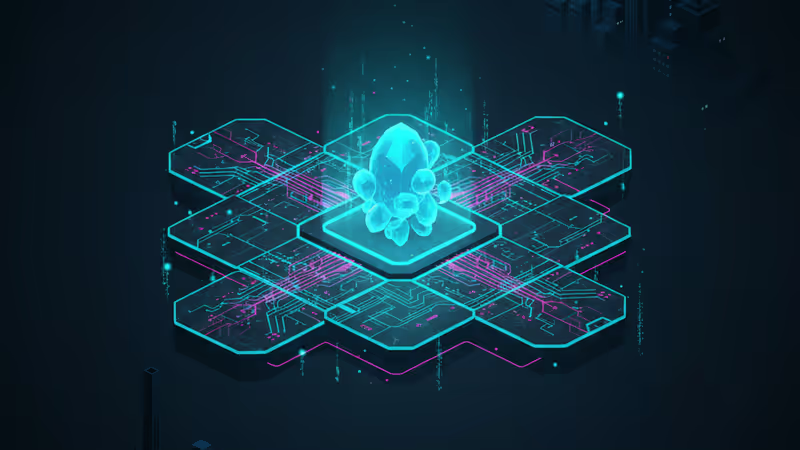
The $1.3B Signal: Chai Discovery Isn't Just Another Biotech Unicorn, It's a Bet on Re-platforming Pharma
Chai Discovery's $1.3B valuation isn't just funding; it's a bet on 'Generative Biology.' Our analysis explores the impact on pharma R&D and investors.
The Lede: The Real Story Isn't the Money, It's the Mission
While OpenAI-backed Chai Discovery's $130 million Series B is impressive, the headline number buries the lead. The real story is the staggering $1.3 billion valuation for a company barely two years old, a valuation that signals a strategic capital migration away from the slow, expensive world of traditional pharmaceutical R&D and toward a new category: Generative Biology. This isn't just about finding one new drug; it's a high-stakes bet on building the fundamental AI-powered 'operating system' for creating all future drugs.
Why It Matters: The Great Compression of Time and Capital
The pharmaceutical industry operates on timelines measured in decades and costs measured in billions. The average drug takes over 10 years and upwards of $2 billion to bring to market. Chai Discovery and its peers are not proposing a 10% improvement; they are proposing a paradigm shift. For executives and investors, the implications are profound:
- Second-Order Effect for Big Pharma: The rise of AI-native platforms creates a critical 'build vs. buy vs. partner' dilemma. Can internal R&D teams, burdened by legacy processes, compete with hyper-focused AI startups? We predict a wave of high-premium M&A and strategic partnerships as incumbents race to acquire this new capability.
- Redefining Venture Risk: Traditionally, biotech investing was a binary bet on the success or failure of a specific drug in clinical trials. Investing in a platform like Chai is different. It's a bet on the underlying technology—a 'picks and shovels' play where the platform can generate countless 'shots on goal,' fundamentally de-risking the business model compared to a single-molecule company.
- Talent Reshuffle: The fact that Chai’s CEO, Josh Meier, hails from Facebook and OpenAI is critical. This is not a biologist who learned to code; it's a world-class machine learning expert aiming to solve biology as an information problem. The most valuable talent in the next decade of biotech may come from big tech, not big pharma.

The Analysis: From Computation to Creation
The 'De Novo' Revolution Is Here
For years, 'AI in drug discovery' meant using algorithms to screen existing molecular libraries faster. This was an efficiency gain, not a creative one. Chai's focus on de novo antibody design is the real game-changer. 'De novo' means 'from scratch.' Their Chai 2 model isn't just finding a key for a known lock; it's designing a completely novel key for a lock that has proven impossible to pick. This is the difference between a search engine and a true engineering suite. By aiming to be the 'computer-aided design (CAD) suite' for molecules, Chai is positioning itself as the foundational software layer for a new generation of medicine.
The Foundation Model Playbook Hits Biology
We've seen this playbook before. Foundation models like GPT-4 transformed industries by creating a single, powerful base model that could be fine-tuned for countless specific tasks. Chai is applying this exact logic to the molecular world. Instead of building a narrow AI for one disease, they are building a foundational understanding of biochemical interactions. This approach, validated by top-tier investors like General Catalyst and OpenAI itself, suggests the market believes the core principles of LLMs are transferable to the language of life. The backing isn't just capital; it's a profound technical endorsement.
PRISM's Take
Chai Discovery’s funding is a landmark event that formalizes the arrival of the 'Generative Biology' era. The race is no longer just about chemistry and biology; it's about superior AI architecture and computational scale. However, the ultimate barrier remains the bridge between the digital and the physical. AI can design a perfect molecule in a simulation, but biology is notoriously messy and unpredictable in practice. The greatest challenge—and opportunity—for Chai will be creating a rapid, closed-loop system where real-world lab results continuously feedback into and improve the AI models. The companies that master this digital-to-physical feedback loop won't just lead the market; they will define the future of medicine.
This content is AI-generated based on source articles. While we strive for accuracy, errors may occur. We recommend verifying with the original source.
Related Articles
Cerebras Systems has refiled for an IPO targeting mid-May, backed by a $23B valuation, a reported $10B OpenAI deal, and an AWS partnership. What does this mean for Nvidia's dominance and the AI chip landscape?
OpenAI's $852B valuation is drawing skepticism from its own backers as Anthropic's ARR tripled in three months. The secondary market is already voting with its feet.
OpenAI acquired Hiro Finance, an AI-powered personal finance startup. Is this just a talent grab, or is the ChatGPT maker quietly building a financial services empire?

OpenAI CEO Sam Altman's San Francisco residence was attacked twice in three days — first a Molotov cocktail, then a shooting. What does this say about tech power, public anger, and the real-world risks facing AI leaders?
Cerebras Systems has refiled for an IPO targeting mid-May, backed by a $23B valuation, a reported $10B OpenAI deal, and an AWS partnership. What does this mean for Nvidia's dominance and the AI chip landscape?
OpenAI's $852B valuation is drawing skepticism from its own backers as Anthropic's ARR tripled in three months. The secondary market is already voting with its feet.
OpenAI acquired Hiro Finance, an AI-powered personal finance startup. Is this just a talent grab, or is the ChatGPT maker quietly building a financial services empire?
OpenAI CEO Sam Altman's San Francisco residence was attacked twice in three days — first a Molotov cocktail, then a shooting. What does this say about tech power, public anger, and the real-world risks facing AI leaders?
Thoughts
Share your thoughts on this article
Sign in to join the conversation