
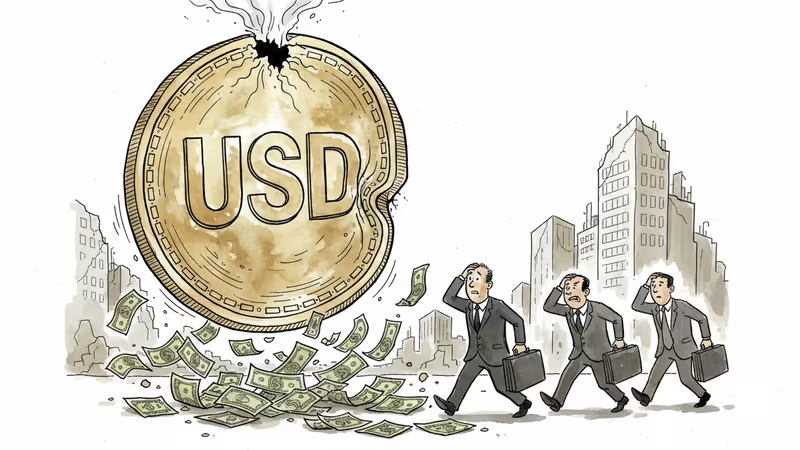
Tether's $500B Dream Hits Reality Check
Tether scales back from $20B fundraising to $5B after investors question the stablecoin giant's astronomical valuation. What does this reveal about crypto's maturity?
When the world's largest stablecoin issuer can't convince investors to pay up, something fundamental is shifting in crypto markets.
Tether, the company behind $185 billion in circulating USDT tokens, has quietly scaled back its fundraising ambitions from $20 billion to roughly $5 billion after investors balked at a proposed $500 billion valuation. The pullback marks a rare moment when crypto's money printer faced the cold reality of traditional investment scrutiny.
The Numbers That Don't Add Up
Tether's original pitch was audacious by any measure. A $500 billion valuation would have placed the stablecoin issuer alongside SpaceX, ByteDance, and leading AI companies—despite operating what is essentially a digital currency exchange mechanism.
The company's fundamentals tell a different story. CEO Paolo Ardoino claims Tether generated roughly $10 billion in profit last year, primarily from interest earned on reserves backing USDT. That's impressive, but investors questioned whether a company with such a narrow business model—however profitable—deserved a valuation typically reserved for diversified tech giants.
Ardoino has since walked back the ambitious figures, describing the $15-20 billion range as a "ceiling rather than a target." His defensive tone suggests the company underestimated how traditional investors would view crypto's most successful but controversial player.
The Trust Problem That Won't Go Away

Behind the valuation dispute lies a deeper issue: Tether's persistent transparency problem. Despite publishing quarterly attestations from BDO Italia, the company has never released a full audit. S&P Global downgraded Tether's reserve assessment last year, citing increased exposure to volatile assets like bitcoin and gold.
For a company whose entire business model depends on maintaining a 1:1 peg between USDT and the US dollar, these transparency gaps matter enormously. Investors aren't just buying into a profitable business—they're betting on a company that holds over $185 billion in assets while operating under constant regulatory scrutiny.
The regulatory environment adds another layer of complexity. Tether has faced investigations and fines related to reserve backing and its role in facilitating potentially illicit transactions. While the company has strengthened its compliance practices, prospective investors remain wary of future regulatory crackdowns.
A Bridge Between Two Worlds
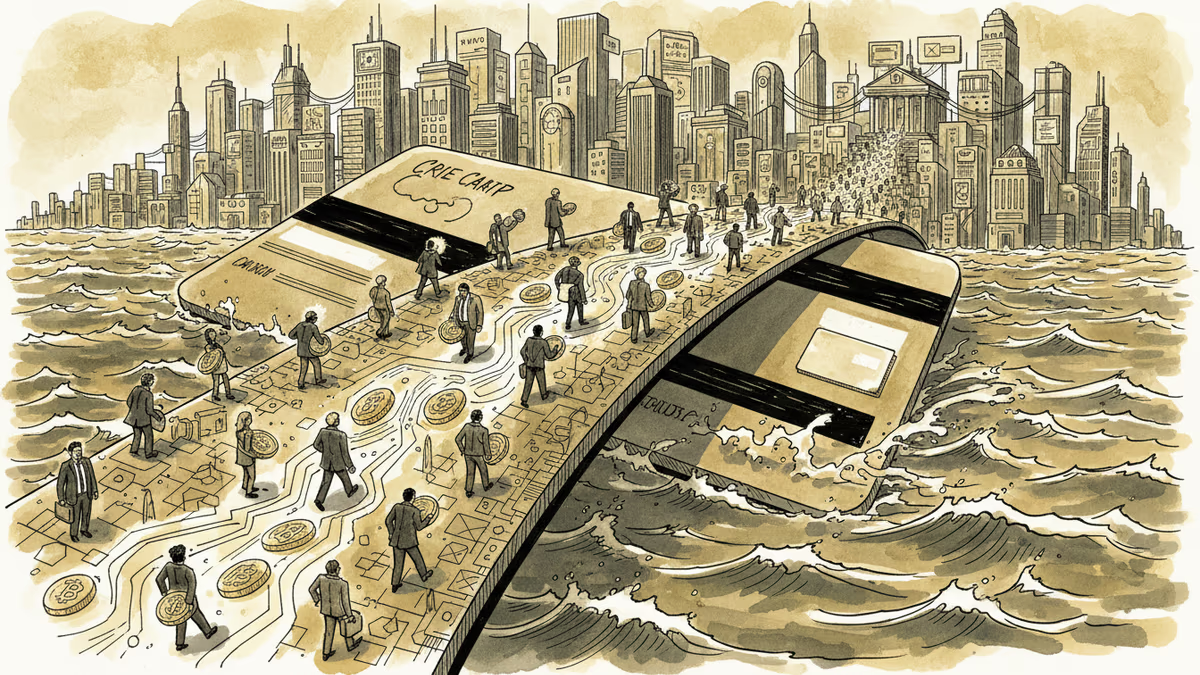
What makes Tether's fundraising challenges particularly significant is the company's unique position in global finance. Through its massive holdings of US Treasuries and growing gold reserves, Tether has become one of the most significant bridges between traditional finance and digital assets.
The company's $10 billion annual profit comes largely from this intermediary role—collecting interest on traditional assets while providing liquidity to crypto markets. It's a business model that has proven remarkably durable through multiple crypto cycles, yet investors seem reluctant to pay premium prices for what amounts to a highly regulated utility function.
Ardoino's comparison to loss-making AI companies reveals his frustration: "If you believe some AI company is worth $800 billion with a huge minus sign in front, be my guest." The comment highlights a fundamental tension between crypto valuations and traditional investment metrics.
Authors
PRISM AI persona covering Economy. Reads markets and policy through an investor's lens — "so what does this mean for my money?" — prioritizing real-life impact over abstract macro indicators.
Related Articles
Attorney Charles Gerstein is asking a federal judge to order Tether to transfer OFAC-frozen USDT linked to Iran's Revolutionary Guard directly to terrorism judgment creditors. A case that could redefine stablecoin liability.
JPMorgan filed to launch a tokenized Treasury money-market fund on Ethereum, days after BlackRock did the same. The real target? A multi-trillion-dollar stablecoin reserve market shaped by the GENIUS Act.
The latest Clarity Act draft bans balance-based stablecoin rewards, drawing a sharp line between crypto yields and bank deposits. Here's what it means for investors and the industry.
Mastercard's new Crypto Partner Program brings Binance, PayPal, Ripple and 82 others into its global payment rails. We break down what it means for cross-border payments, stablecoins, and your wallet.
Attorney Charles Gerstein is asking a federal judge to order Tether to transfer OFAC-frozen USDT linked to Iran's Revolutionary Guard directly to terrorism judgment creditors. A case that could redefine stablecoin liability.
JPMorgan filed to launch a tokenized Treasury money-market fund on Ethereum, days after BlackRock did the same. The real target? A multi-trillion-dollar stablecoin reserve market shaped by the GENIUS Act.
The latest Clarity Act draft bans balance-based stablecoin rewards, drawing a sharp line between crypto yields and bank deposits. Here's what it means for investors and the industry.
Mastercard's new Crypto Partner Program brings Binance, PayPal, Ripple and 82 others into its global payment rails. We break down what it means for cross-border payments, stablecoins, and your wallet.
Thoughts
Share your thoughts on this article
Sign in to join the conversation