
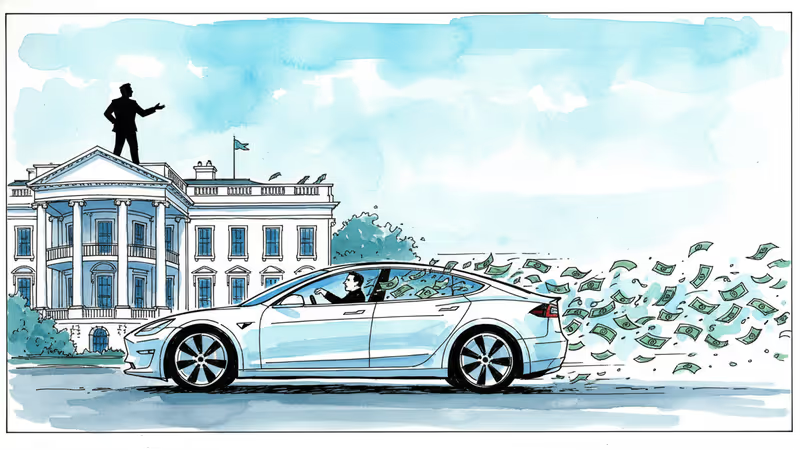
Tesla's 46% Profit Plunge Exposes the Cost of Musk's Political Gambit
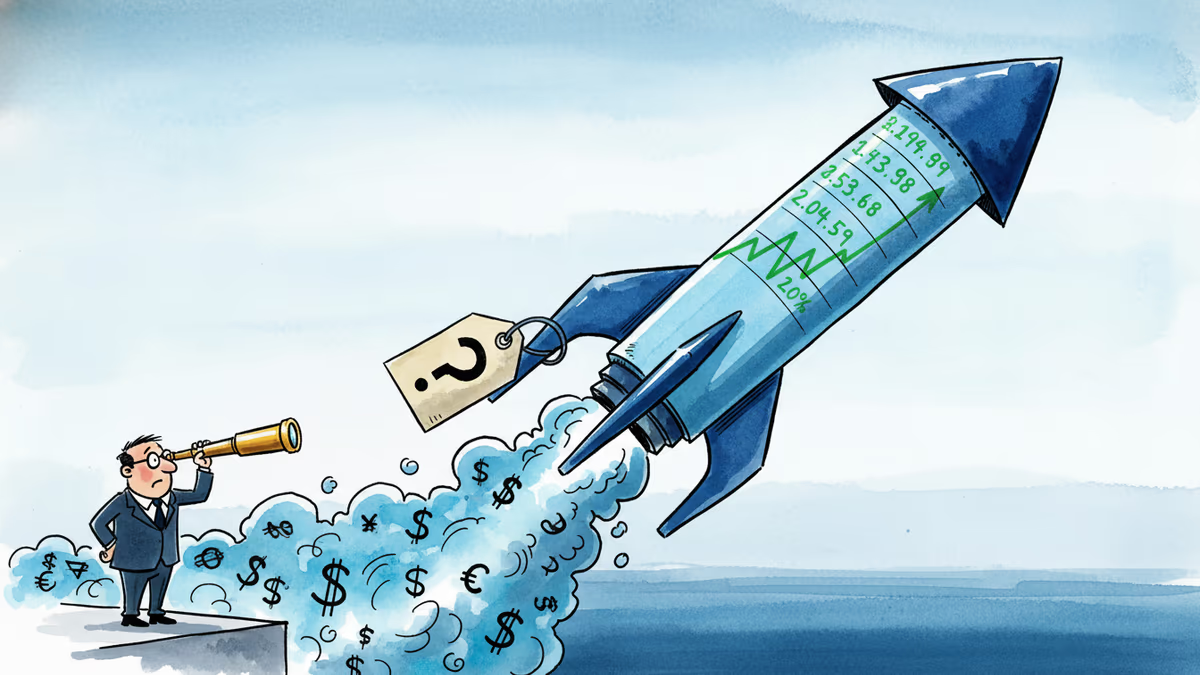
Tesla's 2025 profits crashed 46% to $3.8B as Musk joined Trump admin and EV subsidies vanished. The pivot to AI company shows promise, but can it offset automotive decline?
$3.8 billion. That's all Tesla managed to earn in 2025—a 46% nosedive from the previous year. As Elon Musk juggled his new role in the Trump administration and Congress axed federal EV subsidies, the world's most valuable automaker discovered that political power comes with a hefty price tag.
The Second Consecutive Sales Decline
Tesla delivered 1.63 million vehicles globally in 2025, marking the second straight year of declining sales. This directly contradicts Musk's years-long promise of 50% average annual growth. Total automotive revenue dropped 11% year-over-year, painting a stark picture of a company struggling to maintain its market dominance.
The timing couldn't be more telling. As Musk assumed his government role, his attention was inevitably divided. Meanwhile, the elimination of federal EV subsidies—a policy shift that ironically benefited from Musk's political influence—backfired spectacularly on his own company's sales.
Yet Wall Street had largely anticipated this decline. Tesla actually beat earnings and revenue estimates, sending shares higher in after-hours trading. The market seems to be betting on the company's broader transformation story rather than its automotive performance.
The AI Pivot: Salvation or Distraction?
"2025 marked a critical year for Tesla as we continued our transition from a hardware-centric business to a physical AI company," the company declared in its shareholder letter. This wasn't just corporate speak—the numbers back it up.
While car sales slumped, other divisions showed impressive growth. Solar and energy storage revenue jumped 25%, while services revenue (including Full Self-Driving software, insurance, and Supercharging) grew 18%. The company even managed to improve its gross margins compared to prior quarters.

The most significant move? A $2 billion investment in Musk's AI startup xAI. This isn't just diversification—it's a signal that Tesla views its future through an AI lens rather than an automotive one.
Long-Awaited Promises Finally Materializing?
Tesla claims several delayed projects will enter production in the first half of 2026. The Tesla Semi, first unveiled in 2017, and the Cybercab, which debuted in 2024 but has been teased for years, are supposedly ready for prime time.
The company has also started pilot production at its Texas lithium refinery, is developing in-house inference chips for autonomy and robotics, and plans to unveil the third-generation Optimus robot this quarter.
Given Tesla's track record of ambitious timelines, investors are right to remain skeptical. But the breadth of these initiatives suggests the company is serious about diversifying beyond traditional automotive.
The Broader Market Implications
Tesla's struggles create opportunities for competitors like Ford, GM, and international players such as BYD and Hyundai. The EV market isn't shrinking—it's just becoming more competitive. Tesla's early-mover advantage is clearly eroding.
For investors, the question isn't whether Tesla will remain profitable—it's whether the company can successfully redefine itself. The automotive industry has seen hardware companies attempt software transformations before, with mixed results.
The regulatory environment adds another layer of complexity. While the elimination of EV subsidies hurt Tesla in the short term, the company's scale and vertical integration might give it advantages as the market matures without government support.
Authors
Related Articles
Waymo's new Ojai robotaxi isn't just a vehicle upgrade. It's the company's most serious attempt yet at cracking the cost problem that has kept autonomous vehicles from scaling. Here's what's really at stake.
SpaceX's IPO filing puts AI at the center, claiming a $26.5 trillion market opportunity. But can Grok compete with OpenAI and Anthropic for enterprise customers?
SpaceX filed a nearly 400-page S-1 with the SEC, targeting an IPO as early as June 12. Here's what the filing reveals—and what it doesn't.
SpaceX has filed its S-1 with the SEC, targeting the Nasdaq under ticker SPCX. With $18.67B in revenue but a $4.9B loss, the IPO forces investors to answer one hard question.
Waymo's new Ojai robotaxi isn't just a vehicle upgrade. It's the company's most serious attempt yet at cracking the cost problem that has kept autonomous vehicles from scaling. Here's what's really at stake.
SpaceX's IPO filing puts AI at the center, claiming a $26.5 trillion market opportunity. But can Grok compete with OpenAI and Anthropic for enterprise customers?
SpaceX filed a nearly 400-page S-1 with the SEC, targeting an IPO as early as June 12. Here's what the filing reveals—and what it doesn't.
SpaceX has filed its S-1 with the SEC, targeting the Nasdaq under ticker SPCX. With $18.67B in revenue but a $4.9B loss, the IPO forces investors to answer one hard question.
Thoughts
Share your thoughts on this article
Sign in to join the conversation