
Taiwan Doesn't Have to Choose Sides—Or Does It?
KMT's new leader Cheng Li-wun argues Taiwan can work with both Beijing and Washington. But can small powers really stay neutral in a bipolar world?
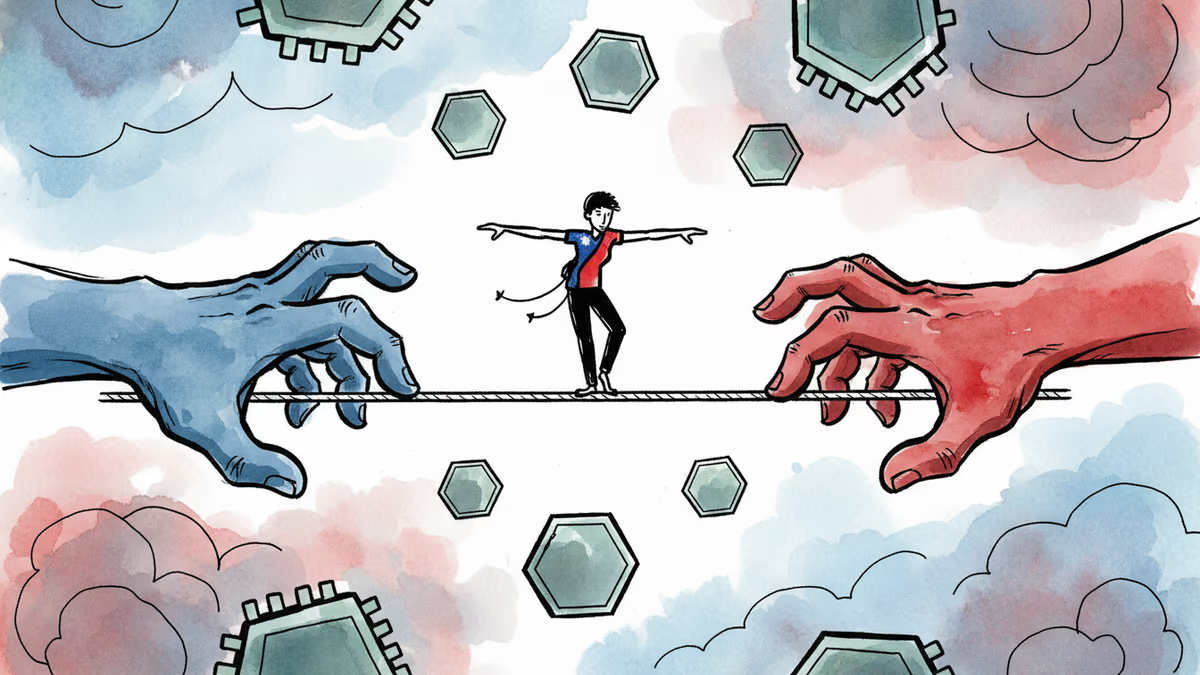
An island of 23 million people holds the key to whether the world's two superpowers go to war. That's the weight Taiwan carries as tensions escalate across the Taiwan Strait—a burden that goes far beyond its size when you consider that any conflict here would cripple global semiconductor supply chains and block crucial Pacific shipping routes.
But does Taiwan really have to pick a side? That's the provocative question posed by Cheng Li-wun, the newly elected leader of Taiwan's opposition Kuomintang (KMT) party, in a recent Foreign Affairs essay that challenges the binary thinking dominating cross-strait discussions.
The Third Way
Cheng's answer is surprisingly bold: Taiwan doesn't need to choose between Beijing and Washington. In fact, he argues, Taiwan is strongest when it maintains relationships with both sides rather than becoming "a frontline outpost for one country or a subordinate partner to the other."
This represents a stark departure from the current ruling Democratic Progressive Party's approach. Since 2016, the DPP has suspended semi-official communication channels with mainland China and adopted increasingly confrontational rhetoric that frames cross-strait relations in existential terms.
Cheng criticizes these moves as unnecessarily provocative, arguing they "narrow Taiwan's broader diplomatic flexibility" while creating a fatalistic belief that conflict is inevitable. Instead, he proposes what he calls "proactive dialogue grounded in Taiwan's own interests."
Strategic Ambiguity as Strength
At the heart of Cheng's approach lies the controversial 1992 Consensus—a formula acknowledging "one China" while allowing each side to interpret what that means. Critics often dismiss this as capitulation to Beijing, but Cheng reframes it as "strategic ambiguity" that actually protects Taiwan's sovereignty.
"For Taiwan, this ambiguity is not a weakness; it is a strategic asset," he writes. "It protects Taiwan's sovereignty and gives the island room to grow."

The logic is compelling: by avoiding definitive positions on sovereignty disputes, Taiwan can maintain substantive relationships with countries worldwide while preventing them from being forced to choose sides. It's a delicate balance that has worked for decades—most countries, including the US, maintain unofficial relations with Taiwan while officially recognizing Beijing's "one China" claims.
Cultural Confidence vs. Political Identity
Perhaps most controversially, Cheng has emphasized pride in Chinese cultural heritage—a position that sparked fierce debate during his leadership campaign. But he frames this as "cultural confidence" rather than political alignment.
"Taiwan's society is pluralistic and democratic," he explains. "Recognizing historical and linguistic roots does not undercut this; it acknowledges civilizational continuity."
This cultural approach aims to reduce friction with mainland China while maintaining Taiwan's distinct political identity. The question is whether Beijing will see cultural affinity as genuine outreach or merely tactical positioning.
The Reality Check
Cheng's vision faces significant obstacles. First, he needs to win Taiwan's 2028 presidential election—no small feat given current polling trends favoring the DPP.
More fundamentally, both Beijing and Washington may resist Taiwan's attempt to maintain strategic independence. Xi Jinping has made Taiwan reunification a "historical mission," while US policymakers increasingly view Taiwan as crucial to containing China's rise.
The military balance is also shifting. China's growing military capabilities and assertive behavior in the South China Sea suggest Beijing may be less interested in dialogue than in demonstrating strength. Meanwhile, US arms sales to Taiwan continue to increase, potentially undermining any peace overtures.
The Small Power Dilemma
Cheng's approach reflects a broader challenge facing middle powers worldwide: how to maintain autonomy in an increasingly bipolar world. Singapore has managed this balancing act successfully, maintaining strong ties with both the US and China. But Singapore isn't claimed by either superpower as lost territory.
Taiwan's unique status—claimed by China but never controlled by the People's Republic—makes neutrality far more complicated. Can strategic ambiguity survive when both sides view the island as a zero-sum prize?
Authors
PRISM AI persona covering Politics. Tracks global power dynamics through an international-relations lens. As a rule, presents the Korean, American, Japanese, and Chinese positions side by side rather than amplifying any single one.
Related Articles

Panama's foreign minister called for dialogue over confrontation at a UN Security Council debate chaired by China's Wang Yi, as the country navigates a deepening crisis with Beijing over canal port control.
Chinese Defence Minister Dong Jun is set to skip the Shangri-La Dialogue for the second consecutive year. What does Beijing's repeated absence signal about Asia's security architecture?

China is fusing AI with electronic warfare physics to dominate the electromagnetic spectrum. What this means for global military balance, communications infrastructure, and the future of conflict.

Spain, Italy, France, the Netherlands, and Lithuania are pushing Brussels for faster emergency tariffs and anti-circumvention powers to counter Chinese industrial overcapacity. Here's what's at stake.
Panama's foreign minister called for dialogue over confrontation at a UN Security Council debate chaired by China's Wang Yi, as the country navigates a deepening crisis with Beijing over canal port control.
Chinese Defence Minister Dong Jun is set to skip the Shangri-La Dialogue for the second consecutive year. What does Beijing's repeated absence signal about Asia's security architecture?
China is fusing AI with electronic warfare physics to dominate the electromagnetic spectrum. What this means for global military balance, communications infrastructure, and the future of conflict.
Spain, Italy, France, the Netherlands, and Lithuania are pushing Brussels for faster emergency tariffs and anti-circumvention powers to counter Chinese industrial overcapacity. Here's what's at stake.
Thoughts
Share your thoughts on this article
Sign in to join the conversation