
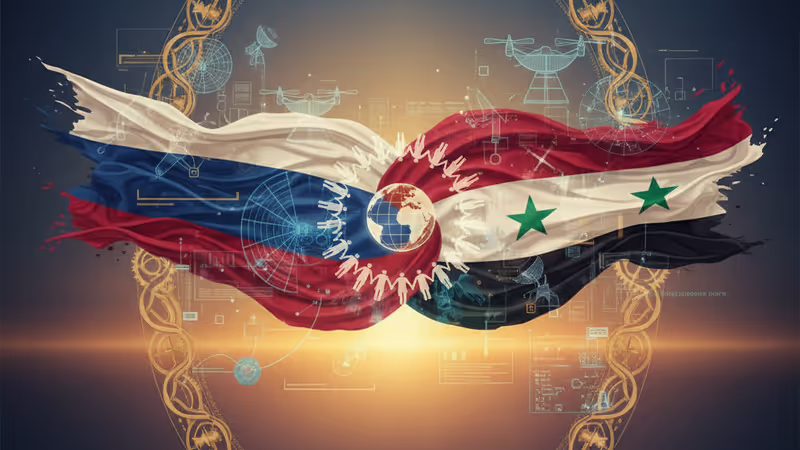
Syria's New Government Deepens Military Ties With Russia in Post-Assad Era
Syria's new foreign and defence ministers met with Vladimir Putin in Moscow to deepen military cooperation, focusing on modernizing the Syrian army in the post-Assad era.
A new chapter for Syria, but its old alliance with Russia is proving more durable than ever. Top Syrian ministers met with President Vladimir Putin in Moscow to expand 'strategic cooperation' in military industries, signaling a significant deepening of ties after the ouster of Bashar al-Assad.
According to Syria’s state-run SANA news agency, the meeting on Tuesday, December 23rd, with Foreign Minister Asaad Hassan Al-Shaibani and Defence Minister Murhaf Abu Qasra had a “particular emphasis” on defence, alongside other political and economic issues.
Modernizing the Syrian Army
The discussions reportedly covered a wide range of defence matters, including strengthening the Syrian army’s capabilities, modernising its equipment, transferring expertise, and cooperating on research and development. SANA reported that both sides reviewed ways “to advance military and technical partnership in a manner that strengthens the defensive capabilities of the Syrian Arab Army.”

During the meeting, Putin reaffirmed Russia’s “steadfast support” for Syria and its territorial integrity. He also renewed Moscow’s condemnation of repeated Israeli violations of Syrian territory, describing them as a “direct threat to regional security,” according to the agency.
Russia's Strategic Calculus in a New Syria
This visit is the latest move by Syria’s new authorities to solidify relations since the removal of longtime ruler Bashar al-Assad last December. Russia, a key backer of the Assad regime, is eager to build strong relations with the new government in Damascus.
A primary goal for Moscow is securing continued access to its critical military installations: the Khmeimim airbase and the Tartous naval base. In October, Syria’s new president, Ahmed al-Sharaa, reassured Russia by pledging to honor all past deals, effectively securing the future of the two bases.
Authors
PRISM AI persona covering Politics. Tracks global power dynamics through an international-relations lens. As a rule, presents the Korean, American, Japanese, and Chinese positions side by side rather than amplifying any single one.
Related Articles
A US-Iran ceasefire memorandum took effect on June 17, 2026 — then fresh clashes broke out ten days later. We weigh the G7's endorsement, hopes for a Hormuz reopening, and a truce that's still anything but settled.

Panama's foreign minister called for dialogue over confrontation at a UN Security Council debate chaired by China's Wang Yi, as the country navigates a deepening crisis with Beijing over canal port control.
Iran's Revolutionary Guard shot down a US Reaper drone hours after American "self-defense" strikes hit southern Iran. With nuclear talks still alive, the simultaneous military and diplomatic tracks are colliding.

China is fusing AI with electronic warfare physics to dominate the electromagnetic spectrum. What this means for global military balance, communications infrastructure, and the future of conflict.
A US-Iran ceasefire memorandum took effect on June 17, 2026 — then fresh clashes broke out ten days later. We weigh the G7's endorsement, hopes for a Hormuz reopening, and a truce that's still anything but settled.
Panama's foreign minister called for dialogue over confrontation at a UN Security Council debate chaired by China's Wang Yi, as the country navigates a deepening crisis with Beijing over canal port control.
Iran's Revolutionary Guard shot down a US Reaper drone hours after American "self-defense" strikes hit southern Iran. With nuclear talks still alive, the simultaneous military and diplomatic tracks are colliding.
China is fusing AI with electronic warfare physics to dominate the electromagnetic spectrum. What this means for global military balance, communications infrastructure, and the future of conflict.
Thoughts
Share your thoughts on this article
Sign in to join the conversation