

How AI Avatars Built a $4 Billion Corporate Training Empire
Synthesia doubles valuation to $4B in one year using AI-generated avatars for enterprise training, while pioneering employee stock liquidity programs for UK startups.
While most AI startups struggle to find profitable business models, British company Synthesia just raised $200 million at a $4 billion valuation—nearly doubling from $2.1 billion just one year ago. Their secret? Making fake people teach real skills.
Synthesia's AI platform creates interactive training videos using AI-generated avatars, serving enterprise clients including Bosch, Merck, and SAP. The London-based startup crossed $100 million in annual recurring revenue (ARR) last April, proving that corporate training might be AI's most lucrative application yet.
This Series E round, led by existing investor GV (Google Ventures), attracted participation from previous backers including Kleiner Perkins, Accel, NEA, and NVIDIA's venture arm NVentures. New investors Evantic and secretive VC firm Hedosophia also joined the cap table.
Breaking New Ground for Employee Equity
What makes this funding round particularly interesting isn't just the valuation jump—it's Synthesia's pioneering approach to employee equity. The company is facilitating a coordinated secondary sale through Nasdaq, allowing early team members to cash out their shares at the same $4 billion valuation as the Series E.
This structured approach prevents the typical chaos of employee stock sales, which often happen at prices disconnected from the company's official valuation. "This secondary is first and foremost about our employees," CFO Daniel Kim told TechCrunch. "It gives employees a meaningful opportunity to access liquidity and share in the value they've helped create."
For a UK startup, this coordinated secondary sale is unusual but likely signals a trend. As private companies stay private longer, structured employee liquidity programs may become increasingly common across Europe.

Beyond Videos: The AI Agent Pivot
Synthesia isn't content with just creating training videos. The company is developing AI agents that will let employees "interact with company knowledge in a more intuitive, human-like way by asking questions, exploring scenarios through role-play, and receiving tailored explanations."
Early pilots have reportedly shown higher engagement and faster knowledge transfer compared to traditional training formats. This positive response explains why Synthesia now plans to make agents a "core strategic focus" alongside improvements to its existing platform.
CEO Victor Riparbelli sees a "rare convergence of two major shifts: a technology shift with AI agents becoming more capable, and a market shift where upskilling and internal knowledge sharing have become board-level priorities."
The Corporate Training Revolution
The timing couldn't be better. As AI reshapes entire industries, companies face unprecedented pressure to retrain their workforce quickly and effectively. Traditional training methods—whether in-person seminars or static e-learning modules—simply can't keep pace with the speed of change.
Synthesia's success suggests that AI-powered training isn't just more efficient; it's becoming essential for competitive advantage. With over 500 employees and offices spanning London, Amsterdam, Copenhagen, Munich, New York, and Zurich, the company has built a global infrastructure to serve this growing demand.
Founded in 2017, Synthesia represents a new breed of AI company: one that found profitability not in consumer applications or flashy demos, but in solving a fundamental business problem that every large organization faces.
Authors
Related Articles

Samsung and SK unveiled a chip and AI investment package worth thousands of trillions of won on June 29. The headline number swings wildly by outlet, but the real contest isn't capital — it's water and power.
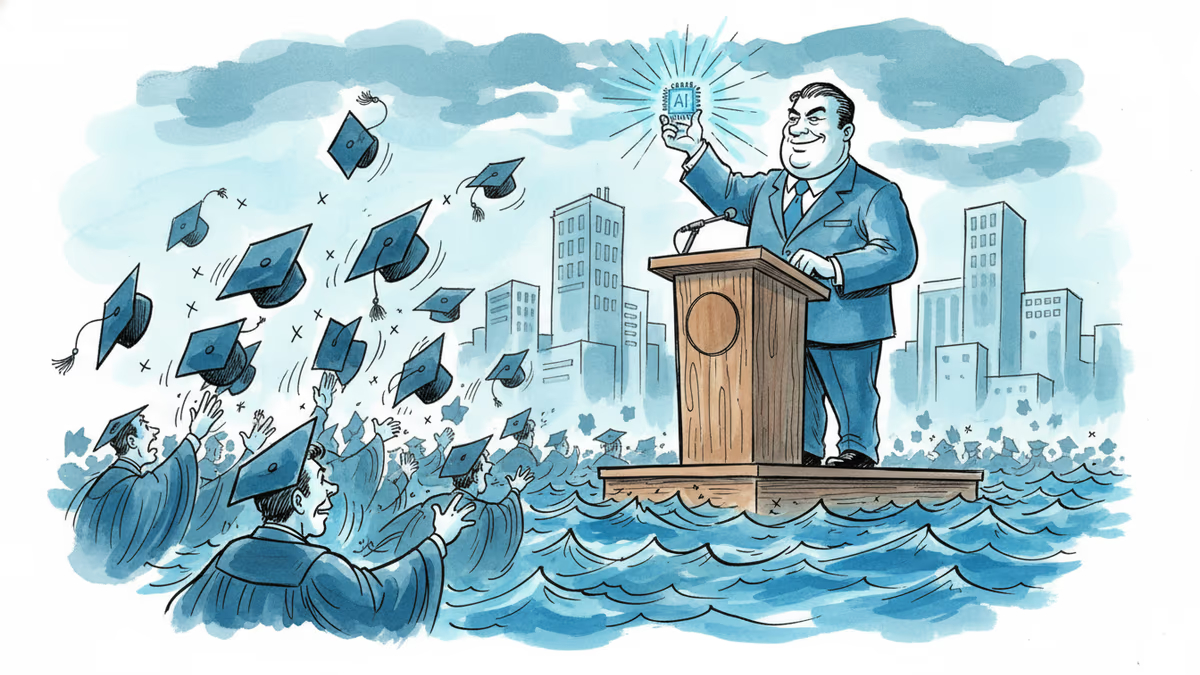
Viral videos show 2026 graduates jeering executives who praise AI at commencement ceremonies. It's not just rudeness — it's a signal about who pays for technological optimism.

Filipino virtual assistants using AI to ghost-manage LinkedIn profiles for executives is now a structured industry. 30 comments a day, fake engagement rings, and a platform struggling to tell real from fabricated.
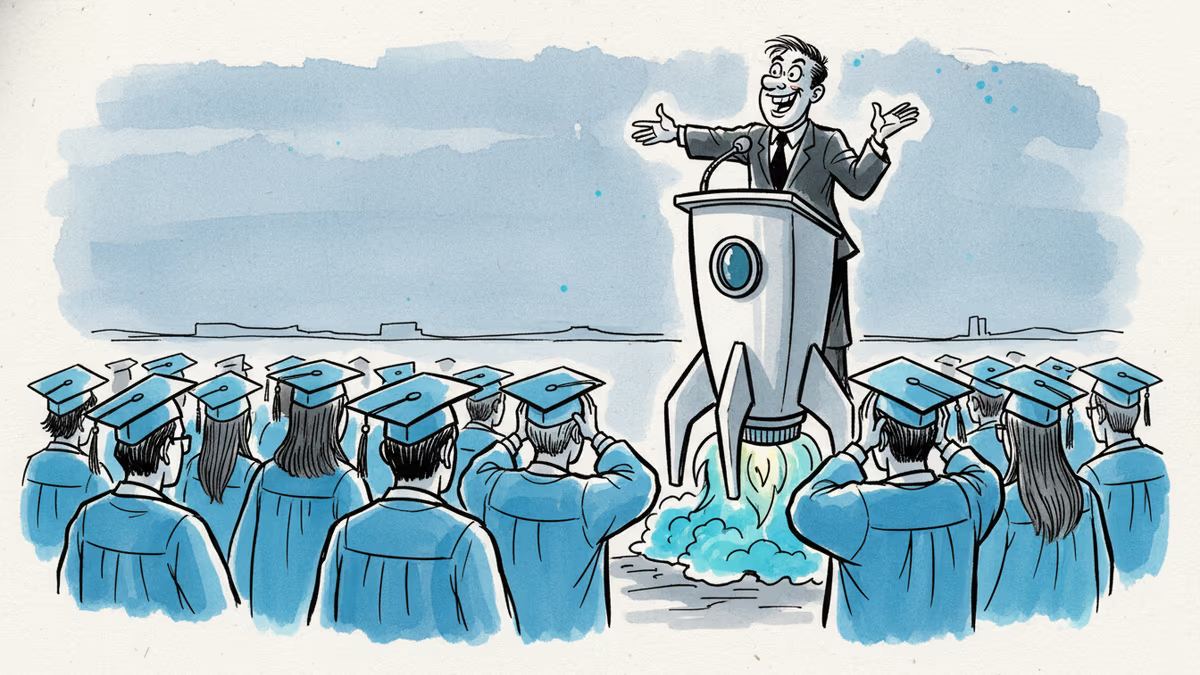
Two commencement speakers learned the hard way that AI enthusiasm doesn't land well with today's graduates. The backlash reveals a widening gap between tech optimism and Gen Z's economic reality.
Samsung and SK unveiled a chip and AI investment package worth thousands of trillions of won on June 29. The headline number swings wildly by outlet, but the real contest isn't capital — it's water and power.
Viral videos show 2026 graduates jeering executives who praise AI at commencement ceremonies. It's not just rudeness — it's a signal about who pays for technological optimism.
Filipino virtual assistants using AI to ghost-manage LinkedIn profiles for executives is now a structured industry. 30 comments a day, fake engagement rings, and a platform struggling to tell real from fabricated.
Two commencement speakers learned the hard way that AI enthusiasm doesn't land well with today's graduates. The backlash reveals a widening gap between tech optimism and Gen Z's economic reality.
Thoughts
Share your thoughts on this article
Sign in to join the conversation