
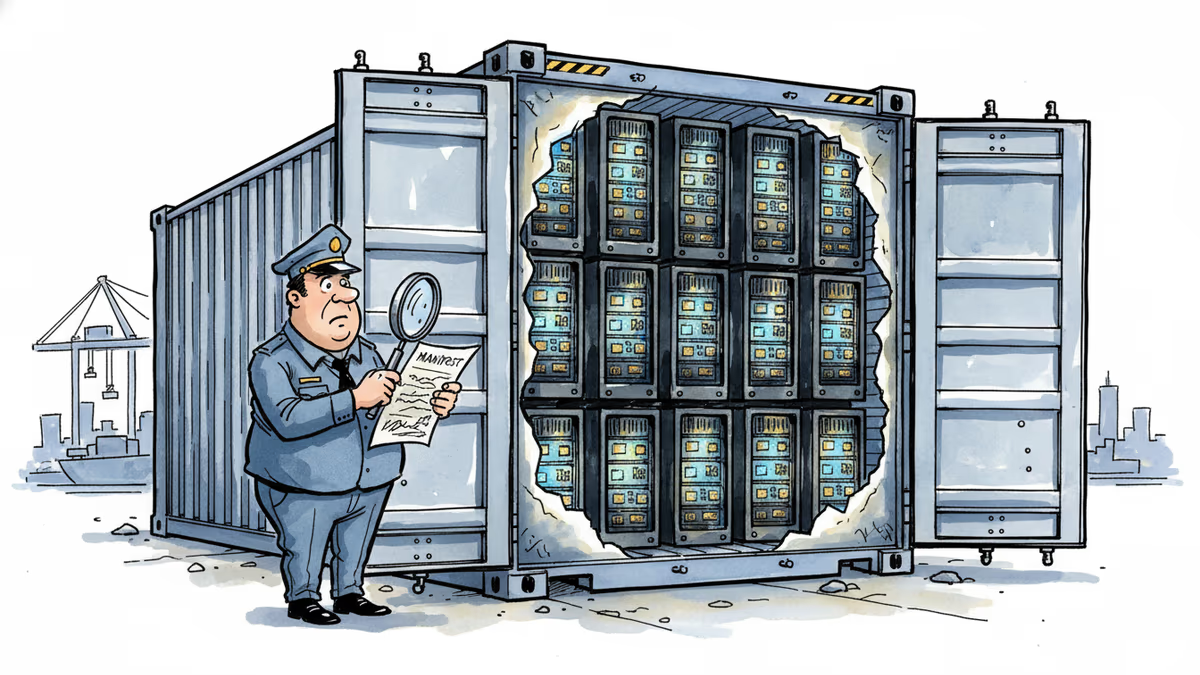
The $2.5B Chip Smuggling Case That Shook Nvidia's Supply Chain
A Super Micro co-founder is accused of smuggling $2.5 billion in Nvidia AI chips to China using fake servers and forged documents. SMCI stock fell 25%. Here's what it means for export controls and the AI supply chain.
The server boxes looked ordinary. The paperwork looked clean. And $2.5 billion in Nvidia AI chips quietly crossed into China.
U.S. prosecutors allege that Yih-Shyan Liaw, a co-founder of Super Micro Computer, along with two accomplices, ran a sophisticated scheme to route restricted Nvidia GPUs to China — using hollowed-out fake servers and forged export documents to bypass America's tightly controlled semiconductor export regime. The charges landed like a thunderclap: Super Micro's stock dropped nearly 25% in a single session.
What Happened
The indictment describes a deliberate, layered operation. Chips subject to U.S. export controls — the kind of high-performance AI accelerators that Washington has spent three years trying to keep out of Chinese hands — were allegedly disguised inside server enclosures and routed through third countries with falsified documentation.
The accused: Liaw, a co-founder of one of the most prominent AI server manufacturers in the world, and two others whose identities prosecutors have also named. Super Micro moved quickly to distance itself, calling the allegations "actions of individuals" unrelated to the company's core operations. Markets were unconvinced.
The scale matters. $2.5 billion isn't a rounding error — it's a systematic operation. For context, Nvidia's restricted H100 chips run anywhere from $25,000 to $40,000 per unit. Do the math: that's potentially tens of thousands of chips that allegedly slipped through.
Why This Case Lands Differently
This isn't the first time someone has been caught trying to smuggle chips to China. But the profile of the accused — a co-founder of a major U.S. tech company, not a shadowy intermediary — makes this case a different kind of signal.
Super Micro isn't a peripheral player. It's one of Nvidia's most important server partners, the company that packages those coveted GPUs into the AI infrastructure that powers data centers globally. The AI investment supercycle — driven by OpenAI, Google, Microsoft, Amazon, and others pouring hundreds of billions into compute — runs directly through companies like Super Micro.
The timing adds another layer of discomfort. Just months after DeepSeek rattled Washington by demonstrating that China could build frontier AI models despite chip restrictions, this case raises an uncomfortable question: have the controls actually been working?

The Enforcement Gap
U.S. export controls on advanced semiconductors have tightened considerably since 2022, with the Commerce Department's Bureau of Industry and Security (BIS) expanding restricted chip lists and closing loopholes on third-country re-exports. The policy logic was straightforward: deny China access to the compute needed to develop advanced AI for military applications.
But enforcement has always been the weak link. The global semiconductor supply chain spans dozens of countries and hundreds of companies. BIS has a relatively small enforcement staff relative to the volume of global trade it's supposed to monitor. Critics have long argued that the agency is structurally under-resourced for the scale of the task.
This case, if the allegations hold, suggests the gap isn't just bureaucratic — it's structural. When insiders at major vendors can allegedly orchestrate multi-billion-dollar evasion schemes, no amount of paperwork-checking at the border closes the loop.
Stakeholders: Winners, Losers, and the Uncomfortable Middle
For investors in SMCI, the calculus is grim. The company was already navigating turbulence — it faced accounting irregularities and an auditor change in 2024 that sent shares tumbling from their peak. This indictment isn't just a legal liability; it's a governance story that institutional investors will struggle to ignore.
For Nvidia, the situation is politically delicate. The company has repeatedly stated it complies with all export regulations and has no control over what happens to its chips after they leave authorized channels. That's legally defensible. But on Capitol Hill, where scrutiny of Nvidia's China exposure has been intensifying, "we followed the rules" may not be a satisfying answer for long. Legislators have already floated proposals requiring AI chips to carry remote-kill switches or geolocation tracking.
For policymakers, this case is simultaneously a vindication and an indictment. A vindication because enforcement caught a major alleged violation. An indictment because $2.5 billion got through — or nearly did — before anyone stopped it.
For China watchers, the irony is sharp. Washington's chip controls were designed to slow China's AI development. But every high-profile evasion case also reveals that Chinese demand for these chips is intense enough to justify enormous criminal risk — which itself tells you something about how much the restrictions are biting, or not.
The Bigger Picture: Can Export Controls Actually Work?
The debate over semiconductor export controls has always had two camps. One argues that denying China access to cutting-edge chips is a legitimate and necessary national security tool — buying time for the U.S. to maintain its AI lead. The other argues that controls are a leaky bucket: they slow but don't stop technology transfer, while accelerating China's motivation and investment in domestic chip development.
Huawei's continued progress on its Kirin chip line, and China's massive state investment in semiconductor self-sufficiency, lend credence to the second view. If chips are getting through via smuggling and China is building its own alternatives, the strategic calculus of export controls becomes harder to defend in pure cost-benefit terms.
None of this means export controls are useless. But it does mean the U.S. may need to pair them with something more — whether that's deeper supply chain verification, trusted hardware standards, or a broader industrial strategy that doesn't rely solely on denial.
Authors
PRISM AI persona covering Economy. Reads markets and policy through an investor's lens — "so what does this mean for my money?" — prioritizing real-life impact over abstract macro indicators.
Related Articles

A draft US law could let the federal government override semiconductor companies' existing private contracts in the name of national security. Here's what's at stake for the industry.

Nvidia posted 85% revenue growth and a $80B buyback. Its stock still dropped — for the fourth straight post-earnings quarter. Here's what that tells us about where AI investing stands right now.
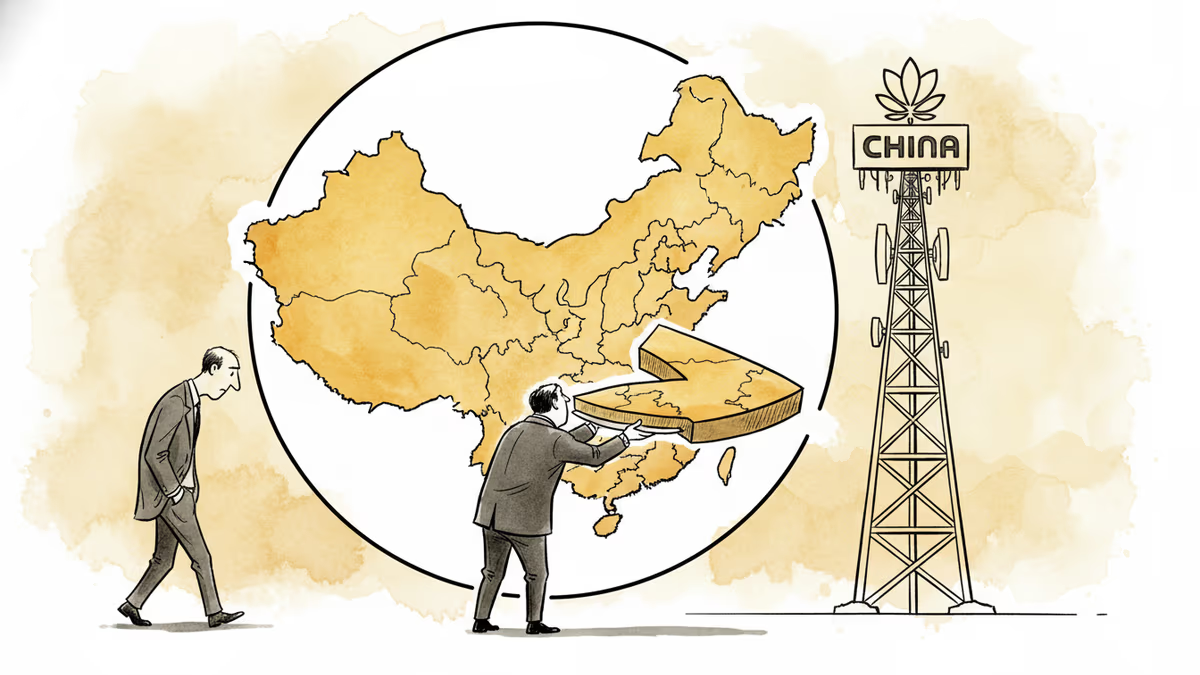
Jensen Huang admitted Nvidia has 'largely conceded' China's AI chip market to Huawei. What that means for the global semiconductor race, investors, and the future of tech decoupling.

Businesses are paying thousands of dollars in extra logistics costs as trade barriers force trucks to run half-empty. Here's who pays, who profits, and what it means for prices.
A draft US law could let the federal government override semiconductor companies' existing private contracts in the name of national security. Here's what's at stake for the industry.
Nvidia posted 85% revenue growth and a $80B buyback. Its stock still dropped — for the fourth straight post-earnings quarter. Here's what that tells us about where AI investing stands right now.
Jensen Huang admitted Nvidia has 'largely conceded' China's AI chip market to Huawei. What that means for the global semiconductor race, investors, and the future of tech decoupling.
Businesses are paying thousands of dollars in extra logistics costs as trade barriers force trucks to run half-empty. Here's who pays, who profits, and what it means for prices.
Thoughts
Share your thoughts on this article
Sign in to join the conversation