

Corning's Fiber Deals Just Got Bigger Than Anyone Thought
Corning CEO Wendell Weeks confirmed two unnamed hyperscaler deals are each larger than the $6B Meta contract, putting a $12B+ floor on AI fiber commitments. Here's what that means for investors.
A 175-year-old glassmaker is now signing the biggest commercial deals in its CEO's career — and the counterparties include Nvidia and at least two of the world's largest cloud companies.
On Thursday night, Corning CEO Wendell Weeks sat down with Jim Cramer on "Mad Money" and dropped a number that quietly rewrote the investment thesis: those two mystery hyperscaler supply agreements disclosed during last week's earnings call? They're not just similar in size to the Meta deal — they're larger.
What We Know — And What We Don't
The Meta deal, announced in January, was already eye-catching: up to $6 billion through 2030 to supply fiber optic cables for data centers. On the April 28 earnings call, Weeks said Corning had wrapped up two more "large, long-term agreements" with hyperscale customers, each "similar in size and duration." The market took that as roughly $6 billion each.
Then came Thursday's revision. "These other two major ones are larger than the Meta deal," Weeks said plainly. The math isn't complicated: two deals, each exceeding $6 billion, puts the combined floor at $12 billion. Stack the Nvidia optical partnership on top, and Corning's AI-related commitment pipeline is running well into the tens of billions.
The identities of the two hyperscalers remain undisclosed — Weeks said customers will announce on their own timeline. That silence is itself informative: these companies treat supply chain decisions as competitive intelligence. Industry speculation centers on Microsoft, Amazon Web Services, and Google, all of whom are spending aggressively on data center buildouts.
Why Corning, Why Now

The short answer is physics. Copper cables can't keep up with the bandwidth demands of modern GPU clusters. Nvidia's Blackwell architecture, for instance, requires thousands of chips to communicate at near-zero latency — and that means fiber, lots of it, running inside the data center itself. Corning is the dominant U.S. manufacturer with the production scale and decades of process knowledge to meet that demand.
Jensen Huang, Nvidia's CEO, called the Corning alliance a move that will "revitalize American manufacturing" — a framing that lands differently in a policy environment where onshoring supply chains is a bipartisan priority.
But the more interesting story is how Corning structured these deals. The company was badly burned during the early-2000s telecom bubble, when it expanded capacity ahead of demand that evaporated almost overnight. This time, the contracts require customers to share in the cost and risk of capacity expansion — not just enjoy the upside. Weeks described it as sharing "the risk and rewards of the required expansions with our strategic customers." That's a structurally different relationship than a standard purchase order.
The Investor's Dilemma
For shareholders, the picture has two sides. Corning will need to raise capital to fund the manufacturing buildout, which means equity dilution is coming. That's a real near-term drag on earnings per share. The bull case — held by Jim Cramer's Charitable Trust, which is long GLW, NVDA, and META — is that a deeper, risk-sharing relationship with the dominant AI chip company is worth absorbing some dilution.
The bear case is less dramatic but worth noting: Corning's stock has already surged more than 100% this year. A significant amount of good news may already be priced in. If hyperscaler capital spending cycles turn — as they have before — the contracts provide some buffer, but they are not unconditional guarantees.
There's also a competitive dimension. Prysmian, Fujikura, and other global fiber manufacturers are not standing still. Corning's advantage is real, but it's a manufacturing advantage, not a patent moat. The question is how long the runway stays clear.
This content is AI-generated based on source articles. While we strive for accuracy, errors may occur. We recommend verifying with the original source.
Related Articles

Nvidia posted 85% revenue growth and a $80B buyback. Its stock still dropped — for the fourth straight post-earnings quarter. Here's what that tells us about where AI investing stands right now.
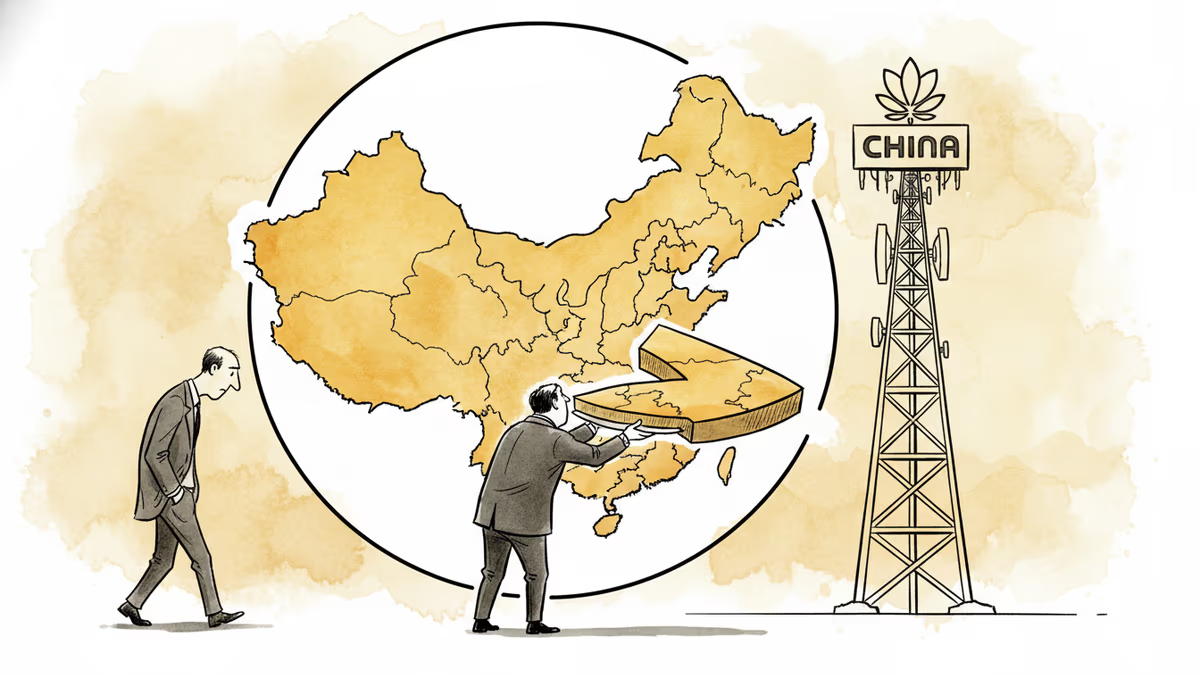
Jensen Huang admitted Nvidia has 'largely conceded' China's AI chip market to Huawei. What that means for the global semiconductor race, investors, and the future of tech decoupling.

Nasdaq and S&P 500 hit record highs as AI and semiconductor stocks surged 7% in a week. Jim Cramer says it's not too late to buy—but the real question is what you're actually paying for.
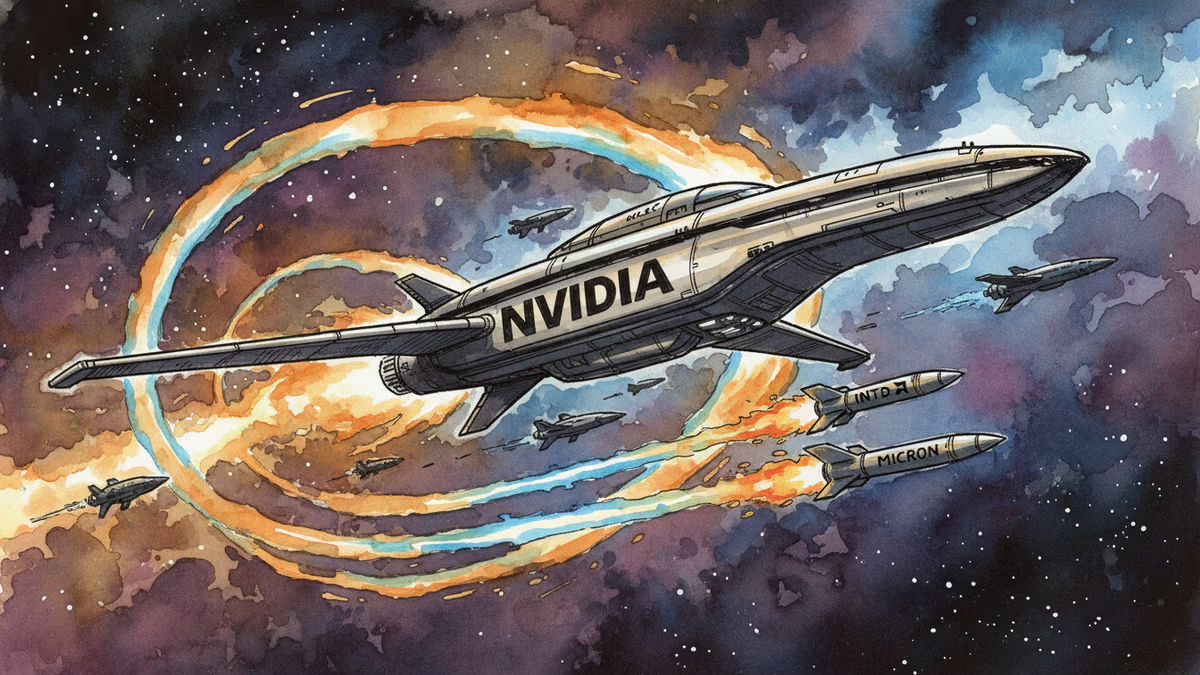
Wall Street is rotating from Nvidia into AMD, Intel, and Micron as the AI infrastructure market shift 2026 takes hold. Discover why CPUs and memory are the new gold.
Nvidia posted 85% revenue growth and a $80B buyback. Its stock still dropped — for the fourth straight post-earnings quarter. Here's what that tells us about where AI investing stands right now.
Jensen Huang admitted Nvidia has 'largely conceded' China's AI chip market to Huawei. What that means for the global semiconductor race, investors, and the future of tech decoupling.
Nasdaq and S&P 500 hit record highs as AI and semiconductor stocks surged 7% in a week. Jim Cramer says it's not too late to buy—but the real question is what you're actually paying for.
Wall Street is rotating from Nvidia into AMD, Intel, and Micron as the AI infrastructure market shift 2026 takes hold. Discover why CPUs and memory are the new gold.
Thoughts
Share your thoughts on this article
Sign in to join the conversation