
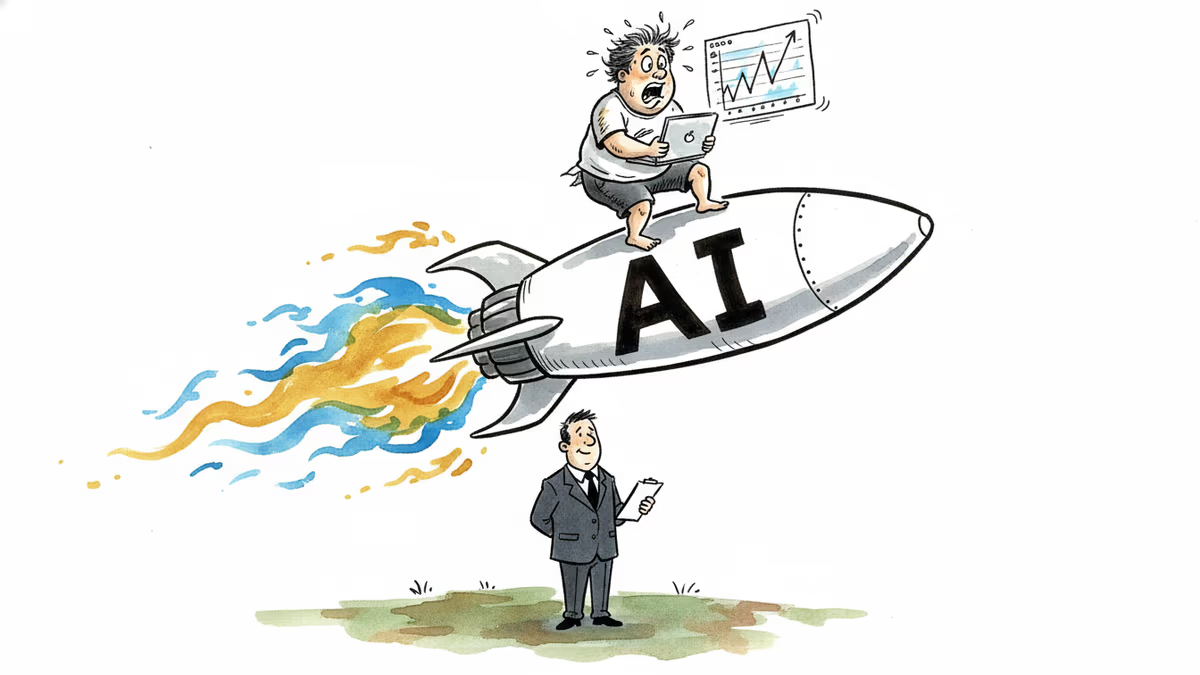
Is It Still Safe to Chase AI Infrastructure Stocks?
Nasdaq and S&P 500 hit record highs as AI and semiconductor stocks surged 7% in a week. Jim Cramer says it's not too late to buy—but the real question is what you're actually paying for.
The S&P 500's technology sector just posted 7% in a single week. The question isn't whether AI stocks are running—it's whether you can afford to miss the train, or whether you're about to board at the wrong station.
On Friday, both the Nasdaq Composite and the S&P 500 closed at all-time highs, powered almost entirely by AI-related semiconductors and data center infrastructure names. The broader S&P 500 gained 2.3% on the week. Jim Cramer, host of CNBC's Mad Money, summed up the market's mood with unusual candor: "This market keeps going up and up on the same old stuff: news about semiconductors, even old news about semiconductors, retreaded news about semiconductors, even pure conjecture. Anything remotely positive moves the group higher."
The Bull Case—and What It's Actually Saying
Cramer's core argument has shifted from tactical to structural. He now describes AI infrastructure stocks as "foundational"—companies that must be owned as a long-term position, not traded around short-term catalysts. His advice: buy on down days if you can, but "if you don't have the patience to wait, it's better to pay up than to not own them at all."
The week ahead will test that conviction with a string of earnings reports. Constellation Energy opens Monday, with investors less focused on its quarterly numbers than on its symbolic role supplying nuclear power to AI data centers—what Cramer calls the "zeitgeist" trade. Tuesday brings the Consumer Price Index reading, which could reignite Fed rate-cut expectations if it comes in soft, adding another layer of fuel to an already hot market.

Midweek, Nebius—a cloud infrastructure company that recently secured a $2 billion investment from Nvidia—reports alongside networking heavyweight Cisco Systems. Cramer noted Cisco's valuation remains relatively reasonable compared to other AI names, even as its stock has "galloped like it's 1999." On Thursday, semiconductor equipment maker Applied Materials closes out the heavy earnings week, with Cramer expecting strong demand for chipmaking machinery to drive results.
Where the Skeptics Have a Point
Cramer himself introduced the 1999 comparison—and it cuts both ways. The internet was transformational. But the companies that built its infrastructure in 1999 took more than a decade to recover their peak valuations after the bubble burst. Being right about a technology and being right about a stock price are two different bets.
The structural bull case rests on a real foundation: hyperscalers are committing hundreds of billions to AI infrastructure buildout, and the picks-and-shovels players—chipmakers, equipment suppliers, power providers—are capturing that spending. Nvidia's $2 billion bet on Nebius signals that even the dominant chip supplier sees value in backing the broader ecosystem.
But the bear case is equally coherent. If "anything remotely positive" moves the entire sector higher, the market is pricing in a near-perfect scenario. Any disappointment—a softer-than-expected earnings beat, a delay in AI monetization timelines, or a macro shock—could reprice the group quickly. Cramer acknowledged this implicitly by urging diversification: don't make your entire portfolio a data center play.
For individual investors, the practical tension is real. Sitting out a 7% weekly move feels costly. But entering at record highs, on sentiment-driven momentum, carries its own risks that don't show up in the rally headlines.
This content is AI-generated based on source articles. While we strive for accuracy, errors may occur. We recommend verifying with the original source.
Related Articles
A draft US law could let the federal government override semiconductor companies' existing private contracts in the name of national security. Here's what's at stake for the industry.

The US president lands in Beijing for a two-day summit. Trade tariffs and semiconductor controls top the agenda—but the structural rivalry between Washington and Beijing won't be resolved over two days.

Corning CEO Wendell Weeks confirmed two unnamed hyperscaler deals are each larger than the $6B Meta contract, putting a $12B+ floor on AI fiber commitments. Here's what that means for investors.
Five Big Tech giants reported Q1 earnings after committing a combined $700B+ to AI data centers. The results reveal a clear divide between smart spenders and expensive mistakes.
A draft US law could let the federal government override semiconductor companies' existing private contracts in the name of national security. Here's what's at stake for the industry.
The US president lands in Beijing for a two-day summit. Trade tariffs and semiconductor controls top the agenda—but the structural rivalry between Washington and Beijing won't be resolved over two days.
Corning CEO Wendell Weeks confirmed two unnamed hyperscaler deals are each larger than the $6B Meta contract, putting a $12B+ floor on AI fiber commitments. Here's what that means for investors.
Five Big Tech giants reported Q1 earnings after committing a combined $700B+ to AI data centers. The results reveal a clear divide between smart spenders and expensive mistakes.
Thoughts
Share your thoughts on this article
Sign in to join the conversation