
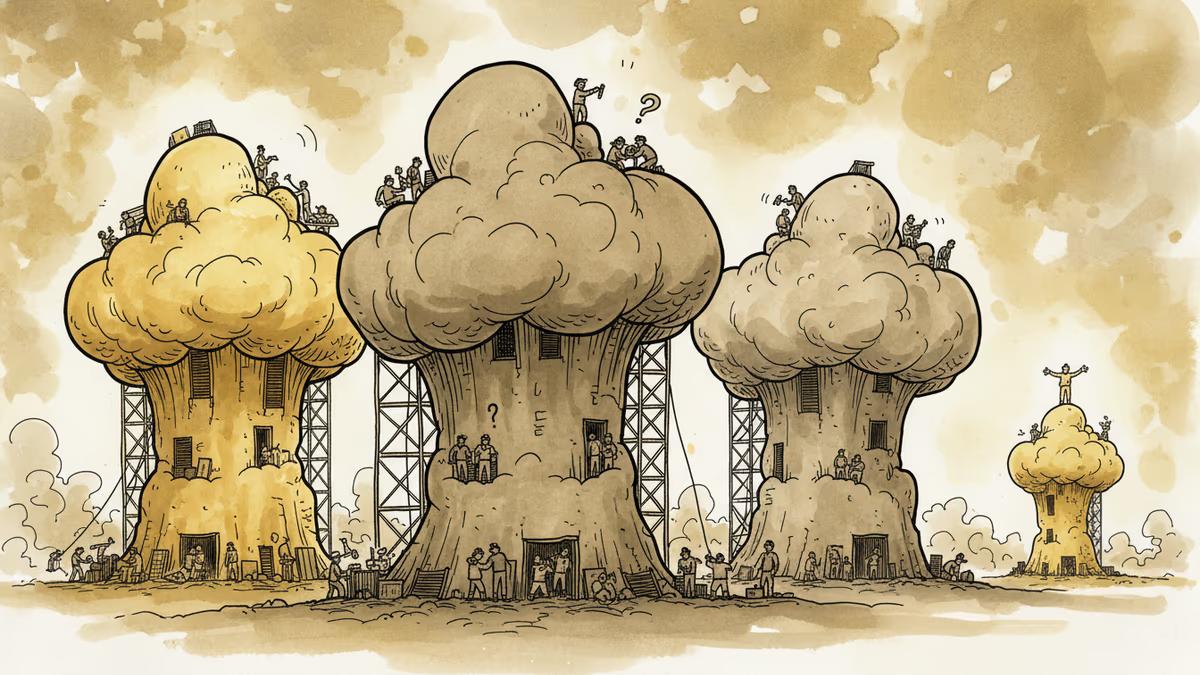
$700 Billion Spent. Who Won, Who Didn't.
Five Big Tech giants reported Q1 earnings after committing a combined $700B+ to AI data centers. The results reveal a clear divide between smart spenders and expensive mistakes.
Sundar Pichai said it quietly on an earnings call, but it landed like a verdict: "Our cloud revenue would have been higher if we had more compute." For years, critics warned that Big Tech's AI spending was a bubble waiting to burst. This quarter, five of the world's largest companies handed in their report cards. The bubble thesis didn't survive.
The Scorecard: Same Game, Very Different Results
The numbers are staggering in aggregate. Alphabet plans to spend $180–190 billion on data centers this year. Amazon, $200 billion. Microsoft, $190 billion. Meta, $125–145 billion. Apple, a comparatively modest $13 billion. Together, that's roughly $700 billion — more than the GDP of Switzerland — committed to AI infrastructure in a single year.
But the market didn't treat them equally.
Alphabet was the clearest winner. Google Cloud grew 63% year-over-year, posting $20 billion in quarterly revenue with an annualized run rate north of $80 billion. The stock jumped 12% in a single week. Amazon wasn't far behind: AWS grew 28% — its fastest pace in 15 quarters — generating $37.6 billion in revenue. The stock gained 1.6%.
Apple, spending the least of the five, pulled off something quietly elegant. With 2.5 billion devices in the field, it negotiated access to Google's Gemini at minimal cost — while Google pays Apple handsomely to remain the default search engine on iPhones. Services revenue grew 16% at a gross margin of 77%. The stock added 3.4%. Least spent, most leveraged.
Then there's the other side of the ledger.
Microsoft spent aggressively but its stock fell 2.4% for the week. Azure grew 40% — faster than the 36% Wall Street expected — yet analysts couldn't tell how much of that growth came from OpenAI compute rather than paying enterprise customers. Copilot, Microsoft's flagship AI product, has 20 million paid users but is still widely considered underwhelming. Worse, AI itself may be eroding the moat around Microsoft's core enterprise software business. Customers who once paid per seat for Office and Teams are now asking whether AI-native alternatives from Anthropic or OpenAI might replace them entirely.
Meta took the hardest hit — down 9.8% for the week. It has no cloud business to monetize its infrastructure investment, and rather than reassure investors, it announced a $10 billion increase in data center spending. Meta AI hasn't generated the kind of consumer enthusiasm that would justify the outlay, and the company's ad-driven revenue model makes it the most exposed of the five to any economic slowdown.

Why This Isn't a Bubble — And What the Critics Missed
The bubble argument always had a logic problem: it assumed spending without asking what the spending produces.
For Amazon and Alphabet, the answer is clear. AWS and Google Cloud are the two most critical pieces of enterprise infrastructure on the planet, and both are growing faster than analysts expected — not despite the spending, but because of it. Every dollar of compute capacity translates into cloud revenue that wouldn't otherwise exist. Pichai's comment about constrained supply wasn't a warning; it was a confession that demand is outrunning investment.
Nvidia CEO Jensen Huang has been making this case for years. "The more you buy, the more you make" — a claim that once sounded like a sales pitch now reads like a financial statement. Amazon has publicly championed its own custom chips — Trainium, Graviton, Inferentia — but quietly committed to purchasing 1 million Nvidia chips by end of 2027. Actions speak.
The broader infrastructure ecosystem is equally telling. Broadcom designs custom AI chips for Google, Meta, OpenAI, and Anthropic. Marvell Technology partners with Amazon and Microsoft. Fiber connectivity companies like Lumentum and Coherent, networking firms like Arista Networks, and materials suppliers like Corning are all expanding capacity to meet demand that, by every measurable signal, is real and growing.
The bubble narrative, it turns out, confused scale with excess. These aren't companies building empty offices. They're building toll roads — and traffic is accelerating.
The Uncomfortable Question About Microsoft and Meta
None of this means every dollar is equally well-spent.
Microsoft's challenge is structural. Its enterprise software dominance — the business that made it one of the most valuable companies in history — is now the thing most at risk from the AI wave it's trying to ride. OpenAI and Anthropic, both of which are reportedly eyeing public listings as early as late 2025, could become direct competitors to Microsoft's core products. The company is in the paradoxical position of funding its own disruption.
Meta's situation is different but equally unresolved. Mark Zuckerberg has made a long-term bet that open-source AI and internal infrastructure will eventually pay off — but "eventually" is doing a lot of work in that sentence. With no cloud revenue to offset the spend and an advertising business sensitive to economic cycles, the market is running out of patience. The 9.8% weekly drop wasn't panic; it was a question: when does this pay off?
This content is AI-generated based on source articles. While we strive for accuracy, errors may occur. We recommend verifying with the original source.
Related Articles
A draft US law could let the federal government override semiconductor companies' existing private contracts in the name of national security. Here's what's at stake for the industry.
Court documents from Musk v. Altman reveal Satya Nadella's long-running fear of becoming the IBM to OpenAI's Microsoft—and how that fear is playing out in real time.
The US president lands in Beijing for a two-day summit. Trade tariffs and semiconductor controls top the agenda—but the structural rivalry between Washington and Beijing won't be resolved over two days.
Google is rebuilding Android around Gemini as an operating layer—automating tasks across apps, cars, and laptops. Samsung Galaxy users get it first. Here's what it means for your device, your data, and Apple.
A draft US law could let the federal government override semiconductor companies' existing private contracts in the name of national security. Here's what's at stake for the industry.
Court documents from Musk v. Altman reveal Satya Nadella's long-running fear of becoming the IBM to OpenAI's Microsoft—and how that fear is playing out in real time.
The US president lands in Beijing for a two-day summit. Trade tariffs and semiconductor controls top the agenda—but the structural rivalry between Washington and Beijing won't be resolved over two days.
Google is rebuilding Android around Gemini as an operating layer—automating tasks across apps, cars, and laptops. Samsung Galaxy users get it first. Here's what it means for your device, your data, and Apple.
Thoughts
Share your thoughts on this article
Sign in to join the conversation