
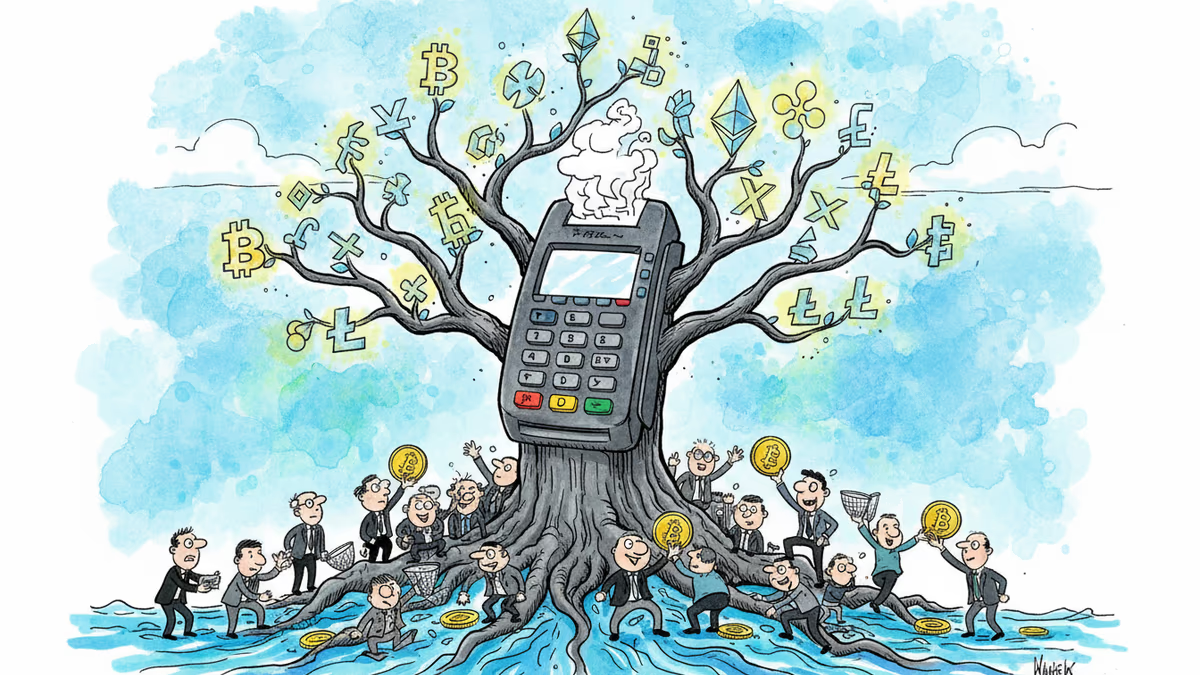
Stripe's $159B Valuation Jump: Why Stablecoins Changed Everything
Stripe's valuation soars 74% to $159 billion in one year, driven by explosive stablecoin growth and crypto infrastructure investments. Is this the new fintech playbook?
$159 Billion. How Stripe Cracked the Stablecoin Code
Another year, another jaw-dropping Stripe valuation. The payments giant just announced its latest employee stock sale program, valuing the company at $159 billion—a staggering 74% jump from last February's $91.5 billion mark.
Thrive Capital, Coatue, Andreessen Horowitz, and Stripe itself participated in this secondary transaction. But here's what's really interesting: this isn't just another tech valuation bubble. There's a fundamental shift happening in how money moves around the world, and Stripe positioned itself right at the center.
The $400 Billion Stablecoin Explosion
The numbers tell the story. Global stablecoin payment volume doubled to around $400 billion in 2025, with 60% coming from B2B transactions. That's not speculative trading—that's real businesses using crypto rails for actual commerce.
Think about it: cross-border B2B payments have been a nightmare for decades. Wire transfers taking days, hefty fees, compliance headaches. Stablecoins cut through all that bureaucracy like a hot knife through butter. Same-day settlements, transparent fees, programmable money.
Stripe didn't just watch this happen—they built the infrastructure for it. July's Privy acquisition brought crypto wallet capabilities in-house. September's Tempo blockchain launch created their own payment rails. And Bridge, the stablecoin platform they acquired last year? Volume quadrupled.
Traditional Finance vs. Crypto Rails

Here's where it gets interesting. While traditional payment processors are still fighting over basis points on credit card transactions, Stripe's betting on a completely different game. They're not just processing payments—they're rebuilding the plumbing of global commerce.
Consider the stakeholder perspectives:
CFOs love it: Faster settlements, lower fees, better cash flow management Regulators worry: Less oversight, potential for money laundering, systemic risks Banks fear it: Disintermediation of their most profitable services Developers embrace it: Programmable money, easier integration, global reach
The Infrastructure Play
What investors are really buying isn't just Stripe's current revenue—it's their position as the connective tissue of the internet economy. As one Andreessen Horowitz partner put it, "Stripe is becoming the operating system of internet commerce."
That's the key insight here. While competitors fight over market share in existing payment methods, Stripe's building entirely new categories. They're not just facilitating transactions—they're creating the financial infrastructure that powers digital-first businesses.
The Timing Question
Why now? Why this massive valuation jump in 2026? Three factors converged:
- Regulatory clarity: Stablecoin regulations finally provided the certainty businesses needed
- Enterprise adoption: Major corporations started using crypto rails for treasury operations
- Infrastructure maturity: The technical stack finally became reliable enough for mission-critical applications
Stripe's annual letter from the Collison brothers isn't just corporate PR—it's a roadmap showing how they've positioned themselves at each of these inflection points.
Authors
Related Articles
Despite fierce competition, the CEOs of Polymarket and Kalshi have co-invested in 5(c) Capital, a $35M VC fund targeting prediction market infrastructure. What this signals for the industry.
A class action lawsuit accuses Kalshi of changing payout rules after Iran's Supreme Leader Khamenei was killed. The case cuts to the heart of prediction market credibility.

A massive dispute over Iran's supreme leader prediction market exposes the dark side of betting on world events. How Kalshi's rule interpretation sparked trader revolt.
Iran bombing predictions drew $529M in bets, raising insider trading concerns. Exploring the ethical dilemmas of prediction markets in conflict zones.
Despite fierce competition, the CEOs of Polymarket and Kalshi have co-invested in 5(c) Capital, a $35M VC fund targeting prediction market infrastructure. What this signals for the industry.
A class action lawsuit accuses Kalshi of changing payout rules after Iran's Supreme Leader Khamenei was killed. The case cuts to the heart of prediction market credibility.
A massive dispute over Iran's supreme leader prediction market exposes the dark side of betting on world events. How Kalshi's rule interpretation sparked trader revolt.
Iran bombing predictions drew $529M in bets, raising insider trading concerns. Exploring the ethical dilemmas of prediction markets in conflict zones.
Thoughts
Share your thoughts on this article
Sign in to join the conversation