
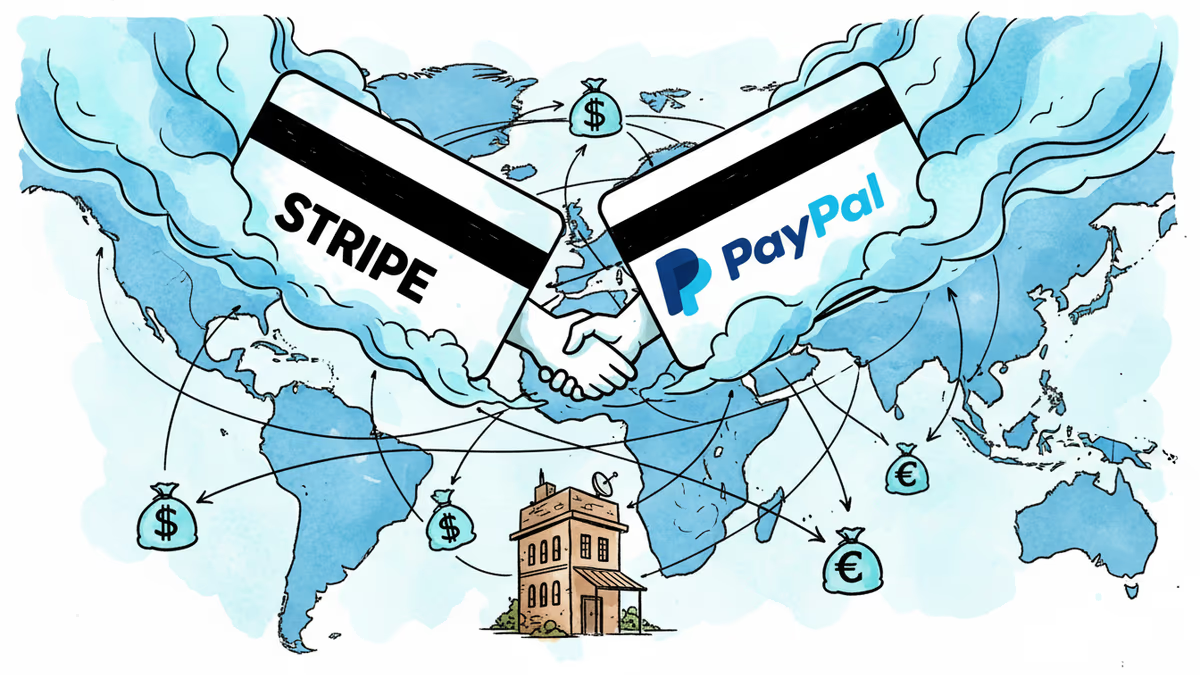
Why Stripe and PayPal Both Invested in the Same Indian Fintech
Xflow raised $16.6M with backing from rivals Stripe and PayPal Ventures. What makes this cross-border payments startup worth the unusual collaboration?
Rivals Don't Usually Write Checks Together
When was the last time you saw fierce competitors invest in the same startup? Yet that's exactly what happened when Stripe and PayPal Ventures both backed Xflow, an Indian fintech, in its $16.6 million Series A round. The Bengaluru-based company processed nearly $1 billion in cross-border payments last year—a 10x jump from 2024.
The math tells a story. Cross-border B2B payments remain stubbornly analog in a digital world. While India's UPI revolutionized domestic transfers, businesses moving money internationally still deal with opaque bank fees, unpredictable settlement times, and currency conversion guesswork.
Xflow's founders—all former Stripe India executives—saw this friction firsthand. "Cross-border B2B payments were stuck in a different age compared to UPI," says co-founder Anand Balaji. Their solution? Build the infrastructure that others can plug into, rather than another direct payments app.
The API-First Bet
Here's where Xflow gets interesting. Instead of building "the next Wise," as Balaji puts it, they want to "power the next thousand Wises." The company offers APIs that let platforms and exporters embed cross-border money movement into their own products.
The strategy is working. Xflow now serves 15,000 businesses across segments that couldn't be more different. Global capability centers (offshore units of multinationals) average $1-2 million per transaction. Goods exporters handle $30,000-$40,000. Freelancers move around $3,000.
This range matters because it shows Xflow isn't just serving one niche. They're building horizontal infrastructure that scales across use cases—exactly what investors love to see.
AI Meets Foreign Exchange

Xflow's newest feature sounds almost too good to be true: an AI tool that helps businesses optimize currency conversion timing. Instead of accepting whatever rate their bank quotes, companies can set target conversion rates—like limit orders in stock trading.
The model provides three-day forecasts with claimed 92% confidence. While TechCrunch couldn't independently verify that figure, the concept addresses a real pain point. Currency volatility can eat into profits, especially for businesses moving large sums regularly.
Think of it this way: if you're a software company collecting $500,000 monthly from US clients, even a 2% improvement in conversion timing could save you $120,000 annually.
Why Competitors Became Co-Investors
So why did Stripe and PayPal—two companies that compete directly in payments—both write checks to Xflow? The answer reveals something important about market dynamics.
For these giants, Xflow isn't a competitor—it's an enabler. Every business Xflow brings into the cross-border payments ecosystem potentially becomes a customer for Stripe or PayPal's other services. Sometimes growing the pie matters more than fighting over slices.
This backing also gives Xflow credibility with banks and regulators—crucial when you're handling large international transfers. "The credibility factor has been huge," Balaji notes.
The Bigger Infrastructure Play
Xflow's ambitions extend beyond India. They're pursuing licenses in Singapore while already holding payments authorization in Canada. The company just received final approval from India's central bank for a Payment Aggregator–Cross Border license covering both exports and imports.
Import capabilities are rolling out soon—a logical next step given that money flows both ways in international trade. Platform partnerships with Easebuzz and Drip Capital show how the embedded strategy is playing out in practice.
With 65 employees and fresh capital, Xflow is positioning itself as infrastructure for the next wave of global commerce. The timing feels right: remote work, digital nomadism, and distributed teams are all driving demand for seamless cross-border payments.
Authors
Related Articles

Despite fierce competition, the CEOs of Polymarket and Kalshi have co-invested in 5(c) Capital, a $35M VC fund targeting prediction market infrastructure. What this signals for the industry.

A class action lawsuit accuses Kalshi of changing payout rules after Iran's Supreme Leader Khamenei was killed. The case cuts to the heart of prediction market credibility.

A massive dispute over Iran's supreme leader prediction market exposes the dark side of betting on world events. How Kalshi's rule interpretation sparked trader revolt.
Iran bombing predictions drew $529M in bets, raising insider trading concerns. Exploring the ethical dilemmas of prediction markets in conflict zones.
Despite fierce competition, the CEOs of Polymarket and Kalshi have co-invested in 5(c) Capital, a $35M VC fund targeting prediction market infrastructure. What this signals for the industry.
A class action lawsuit accuses Kalshi of changing payout rules after Iran's Supreme Leader Khamenei was killed. The case cuts to the heart of prediction market credibility.
A massive dispute over Iran's supreme leader prediction market exposes the dark side of betting on world events. How Kalshi's rule interpretation sparked trader revolt.
Iran bombing predictions drew $529M in bets, raising insider trading concerns. Exploring the ethical dilemmas of prediction markets in conflict zones.
Thoughts
Share your thoughts on this article
Sign in to join the conversation