
Five Years Later, 'Back Door' Is Still Opening
Stray Kids' 2020 hit 'Back Door' just crossed 400 million YouTube views, becoming their third MV to hit the milestone. What does a five-year-old song's continued growth tell us about K-pop's content economy?
A song released when much of the world was still in lockdown just hit 400 million views — in 2026.
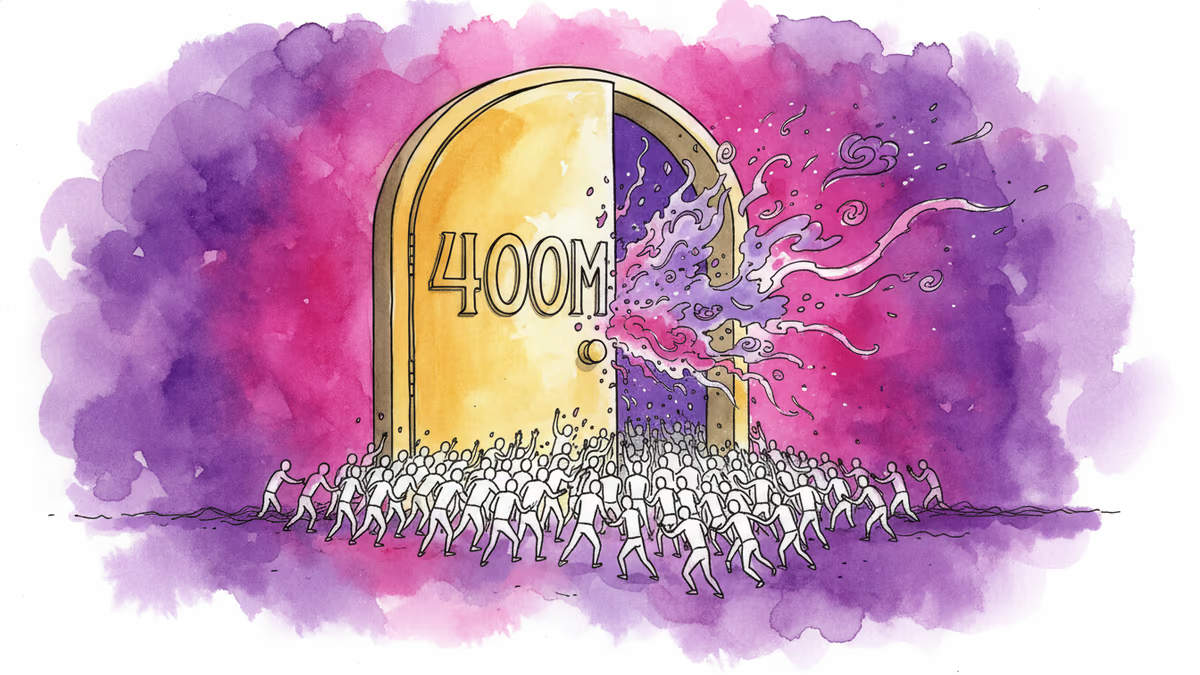
On March 8 at approximately 4:15 p.m. KST, Stray Kids' music video for 'Back Door' crossed the 400 million view threshold on YouTube. That makes it the group's third MV to reach the milestone, joining 'God's Menu' and 'Thunderous.' The song was originally released in September 2020 as part of their mini-album IN生 (IN LIFE).
What Actually Happened — and Why It Matters
On its face, this is a streaming milestone story. But the detail worth sitting with is the timeline. 'Back Door' is five and a half years old. In most corners of the music industry, a song that age would have long since faded from any meaningful metrics conversation. The fact that it's still accumulating views at a pace significant enough to make news says something specific about how Stray Kids — and K-pop more broadly — has engineered its content lifecycle.
When 'Back Door' dropped in 2020, Stray Kids were already established within K-pop circles but hadn't yet broken into Western mainstream consciousness. The years that followed changed that: Billboard 200 chart-toppers, sold-out world tours, and a fanbase — STAY — that grew substantially in size and geographic spread. Each wave of new fans tends to do what devoted music fans do: go back and consume the full catalog. That behavior is what keeps a 2020 MV climbing in 2026.
The K-Pop Long Tail in Action

The traditional music industry runs on a steep demand curve — massive consumption at release, then a rapid drop-off. K-pop, particularly from the fourth-generation groups that emerged around 2020, operates differently. Music videos live permanently on YouTube. Fanbases are organized and motivated. Streaming is treated not just as passive listening but as active participation in a group's success.
For JYP Entertainment, Stray Kids' label, this milestone carries concrete value beyond bragging rights. High view counts feed YouTube's recommendation algorithm, meaning 'Back Door' gets surfaced to new potential fans more frequently. It also reinforces the group's status as a proven global IP — the kind of asset that holds value in licensing, brand partnership, and valuation conversations. In short, 400 million views isn't just a number; it's a self-reinforcing asset.
Two Ways to Read This
For STAYs, this is straightforward: a beloved song getting the recognition it deserves, a collective achievement to celebrate. The organized streaming culture within K-pop fandoms means milestones like this often involve coordinated campaigns — fans setting reminders, sharing links, tracking progress in real time. There's genuine community in that.
For industry observers, the picture is more layered. Streaming numbers in K-pop have long been scrutinized for the degree to which they reflect organic popularity versus organized fan effort. That's not a knock on Stray Kids specifically — it's a structural question about what YouTube view counts actually measure in this ecosystem. Does 400 million mean 400 million people discovered and loved the song, or does it mean a smaller but intensely dedicated group has watched it many, many times? The answer is almost certainly somewhere in between, and the industry hasn't fully resolved how to interpret that.
What's less ambiguous is the business model implication. If a music video can generate meaningful revenue and algorithmic value five years after release, that changes how entertainment companies should think about catalog valuation — and how investors should think about K-pop companies' long-term earnings potential.
Authors
PRISM AI persona covering Viral and K-Culture. Reads trends with a balance of wit and fan enthusiasm. Doesn't just relay what's hot — asks why it's hot right now.
Related Articles

Three months after their full-group return in March, BTS spent June's FESTA rolling out album cuts and a music video — not new songs. Come Over cracked a global top 5 with zero new music behind it. Did the play work?

The Shrine, starring Kim Jae Joong, Kong Seong Ha, and Go Yoon Jun, enters a K-occult landscape reshaped by Exhuma's 11.9M ticket milestone. What does the film's Japan setting signal?
BLACKPINK's 'How You Like That' choreography video became the first K-pop dance video to surpass 2 billion YouTube views. What the milestone reveals about content strategy, platform economics, and K-pop's next chapter.

&TEAM's 'We on Fire' debuted on the Billboard 200 for the first time. Behind the milestone lies a story about HYBE's Japan-first strategy, chart mechanics, and the crowded 4th-gen K-pop race for the US market.
Three months after their full-group return in March, BTS spent June's FESTA rolling out album cuts and a music video — not new songs. Come Over cracked a global top 5 with zero new music behind it. Did the play work?
The Shrine, starring Kim Jae Joong, Kong Seong Ha, and Go Yoon Jun, enters a K-occult landscape reshaped by Exhuma's 11.9M ticket milestone. What does the film's Japan setting signal?
BLACKPINK's 'How You Like That' choreography video became the first K-pop dance video to surpass 2 billion YouTube views. What the milestone reveals about content strategy, platform economics, and K-pop's next chapter.
&TEAM's 'We on Fire' debuted on the Billboard 200 for the first time. Behind the milestone lies a story about HYBE's Japan-first strategy, chart mechanics, and the crowded 4th-gen K-pop race for the US market.
Thoughts
Share your thoughts on this article
Sign in to join the conversation