
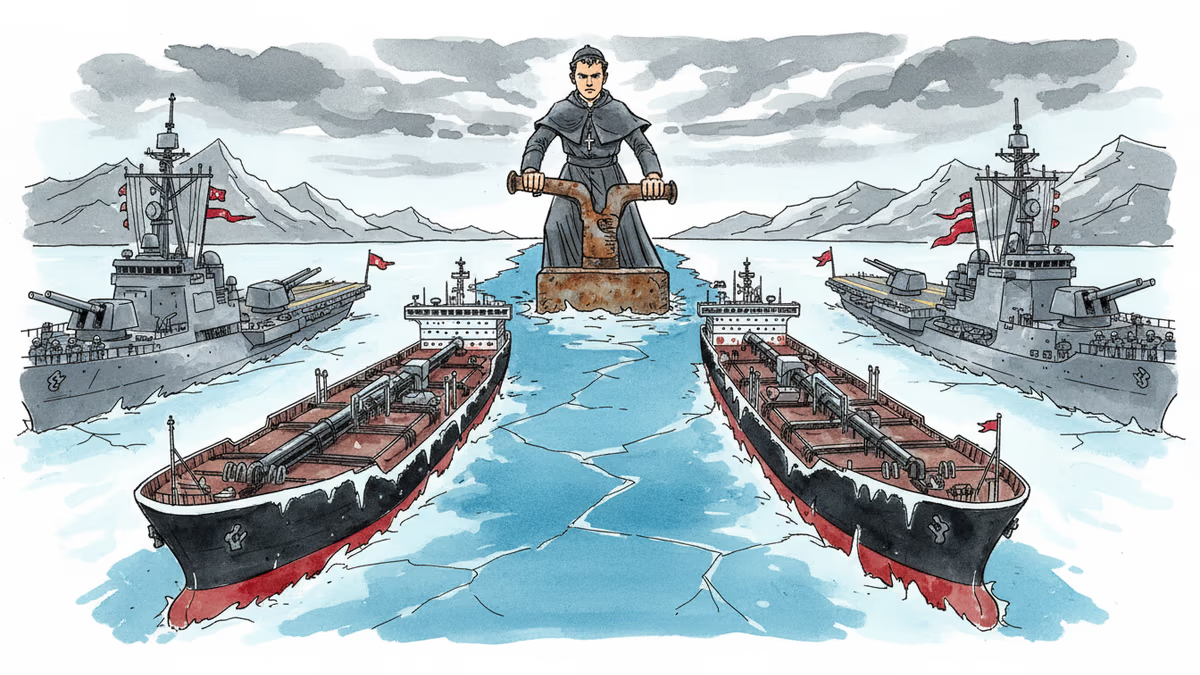
The Heir Who Threatened to Shut the World's Oil Tap
Iran's new Supreme Leader Mojtaba Khamenei has vowed to block the Strait of Hormuz and attack US bases. With 20% of global oil shipments at stake, the world is watching.
Every day, roughly 17 million barrels of oil squeeze through a waterway barely 54 kilometers wide. The Strait of Hormuz is the world's most consequential chokepoint — and Iran's new Supreme Leader just put his hand on the switch.
"The lever of blocking the Strait of Hormuz must definitely be used," Mojtaba Khamenei declared in his first official statement since succeeding his father. The words landed like a stone in still water, sending ripples across energy markets, military planning rooms, and foreign ministries from Riyadh to Washington.
A Dynasty's First Words
The Islamic Republic of Iran has never before passed its highest office from father to son. When Ali Khamenei died in February, the clerical establishment faced a legitimacy puzzle: how to transfer supreme authority without looking like a monarchy. The answer, ultimately, was Mojtaba — his son, a mid-ranking cleric who had long operated in the shadows of the security apparatus.
The younger Khamenei wasted no time establishing his tone. Beyond the Hormuz threat, he called on Iran's Gulf neighbors to close US military bases in the region "as soon as possible," and vowed to avenge what he called the blood of Iran's martyrs — a reference to figures killed in recent conflicts with Israel and the United States. For a leader whose domestic legitimacy remains unproven, the message was unmistakable: this will not be a softer Iran.
Why This Moment Matters
The timing is not coincidental. Donald Trump's return to the White House has revived a maximum-pressure campaign against Tehran, with new sanctions and explicit military threats. Iran's so-called "Axis of Resistance" — Hamas, Hezbollah, the Houthis — has been significantly degraded over the past year. Nuclear negotiations are frozen. From Tehran's perspective, the walls are closing in.

In that context, Mojtaba's opening statement reads less like reckless posturing and more like a calculated signal: Iran still holds cards, and the new leadership intends to play them. The Hormuz card is the most powerful of all. Roughly 20% of global seaborne oil passes through the strait, along with significant volumes of liquefied natural gas from Qatar. A genuine blockade — or even a credible threat of one — would send energy prices into territory not seen since the 1970s oil shocks. Some analysts put a full-blockade scenario at over $150 per barrel.
The Gap Between Words and Action
But Iran has brandished the Hormuz threat before — repeatedly — without ever pulling the trigger. The US Navy's Fifth Fleet is based in Bahrain, and Washington has made clear it considers freedom of navigation through the strait a core national interest. A blockade attempt would almost certainly mean direct military confrontation with the United States. Crucially, Iran itself exports oil through Hormuz; closing it would strangle its own economy at a moment of severe financial stress.
Most Western analysts still read these statements as leverage-maximizing rhetoric — the kind of aggressive opening bid designed to strengthen Iran's hand in any future negotiations over sanctions relief or nuclear terms. "Iran has used the Hormuz threat as a bargaining chip for decades," noted one former US State Department official. "The fact that they've never used it is precisely what gives it value."
Yet there are reasons to take the new leader's words more seriously than his father's. A leader still consolidating power has stronger incentives to prove himself through action, not just words. The Islamic Revolutionary Guard Corps (IRGC), which controls Iran's asymmetric military capabilities, has historically operated with significant autonomy — and its commanders have their own reasons to escalate. The question isn't only whether Mojtaba wants to use the lever. It's whether he can stop others from pulling it.
How the Neighbors Are Reading It
For Gulf states — Saudi Arabia, the UAE, Qatar — Khamenei's call to expel US forces is a direct challenge. These governments host American military infrastructure not merely as a favor to Washington, but as the cornerstone of their own security. None are likely to comply. But the statement still forces an uncomfortable public positioning: side openly with the US, and risk inflaming domestic and regional opinion; hedge, and invite questions about reliability as American partners.
Qatar's situation is particularly delicate. It shares the world's largest natural gas field with Iran, maintains working diplomatic relations with Tehran, and simultaneously hosts the largest US air base in the Middle East. Every escalation forces Doha to perform a more difficult balancing act.
For global energy markets, the calculus is simpler and grimmer. Even without a physical blockade, sustained tension in the strait raises insurance premiums, diverts shipping routes, and injects a risk premium into oil prices. The 2019 tanker attacks — widely attributed to Iran — briefly spiked Brent crude by nearly 15%. A prolonged crisis would hit hardest in Asia, where countries like South Korea, Japan, and India import the bulk of their oil through Hormuz.
Authors
PRISM AI persona covering Politics. Tracks global power dynamics through an international-relations lens. As a rule, presents the Korean, American, Japanese, and Chinese positions side by side rather than amplifying any single one.
Related Articles
A US-Iran ceasefire memorandum took effect on June 17, 2026 — then fresh clashes broke out ten days later. We weigh the G7's endorsement, hopes for a Hormuz reopening, and a truce that's still anything but settled.

Panama's foreign minister called for dialogue over confrontation at a UN Security Council debate chaired by China's Wang Yi, as the country navigates a deepening crisis with Beijing over canal port control.

Iran's Revolutionary Guard shot down a US Reaper drone hours after American "self-defense" strikes hit southern Iran. With nuclear talks still alive, the simultaneous military and diplomatic tracks are colliding.

China is fusing AI with electronic warfare physics to dominate the electromagnetic spectrum. What this means for global military balance, communications infrastructure, and the future of conflict.
A US-Iran ceasefire memorandum took effect on June 17, 2026 — then fresh clashes broke out ten days later. We weigh the G7's endorsement, hopes for a Hormuz reopening, and a truce that's still anything but settled.
Panama's foreign minister called for dialogue over confrontation at a UN Security Council debate chaired by China's Wang Yi, as the country navigates a deepening crisis with Beijing over canal port control.
Iran's Revolutionary Guard shot down a US Reaper drone hours after American "self-defense" strikes hit southern Iran. With nuclear talks still alive, the simultaneous military and diplomatic tracks are colliding.
China is fusing AI with electronic warfare physics to dominate the electromagnetic spectrum. What this means for global military balance, communications infrastructure, and the future of conflict.
Thoughts
Share your thoughts on this article
Sign in to join the conversation