
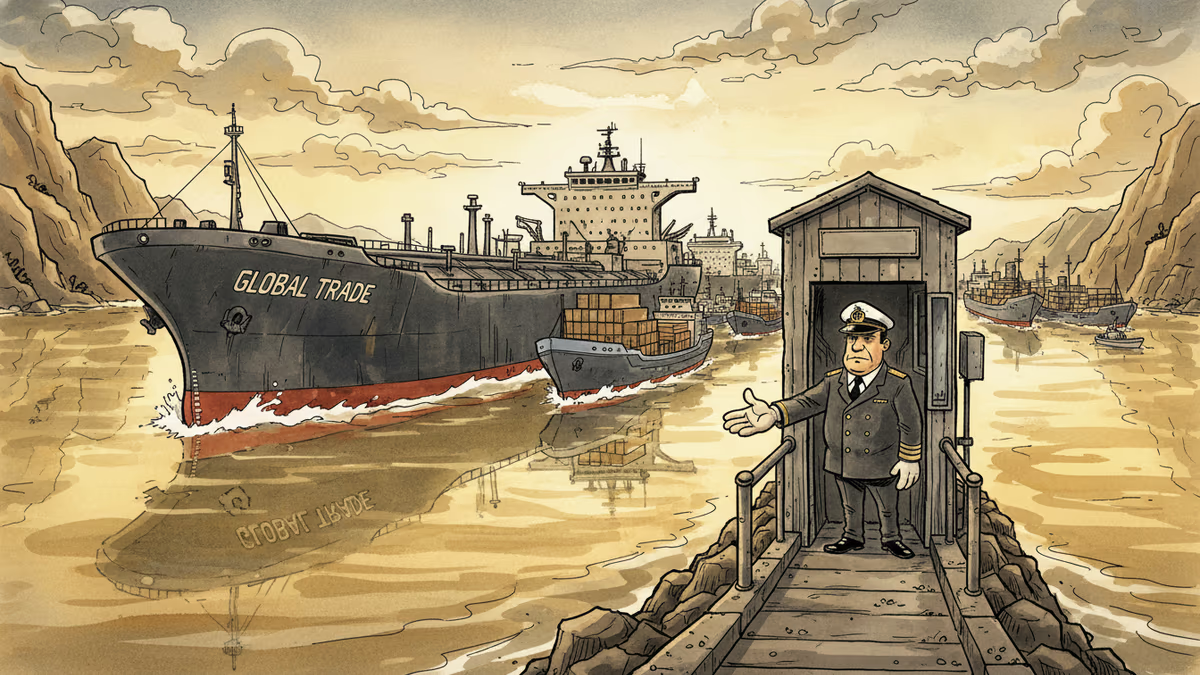
Iran Wants a Toll on the World's Most Critical Waterway
Tehran has signaled that a system of fees and passage restrictions in the Strait of Hormuz could outlast the current conflict. With 20% of global oil supply at stake, the implications stretch far beyond the Middle East.
Every morning, roughly 17 million barrels of oil pass through a stretch of water barely 33 kilometers wide. Tehran is now suggesting that passage through the Strait of Hormuz — the jugular vein of global energy supply — should come with conditions. And a price.
What Tehran Actually Said
Iran has floated the idea of a system that would charge fees and restrict passage to ships from "non-hostile" nations. Crucially, officials suggested this arrangement could persist beyond the current war — not as a temporary wartime measure, but as a lasting feature of the regional order.
The details remain deliberately vague. No fee schedule has been announced. No formal list of "hostile" nations exists. But the direction of travel is unmistakable: Tehran wants to transform the Strait of Hormuz from a global commons into a managed chokepoint, with Iran as the gatekeeper.
This isn't the first time Iran has rattled this particular saber. Similar threats emerged during the 2012 nuclear sanctions crisis and again in 2019 when US-Iran tensions peaked. Each time, the threats receded. What's different now is the framing — not "we might close it" but "we might regulate it permanently."
Why This Waterway Is Irreplaceable
The numbers explain why the world pays attention. The Strait of Hormuz handles roughly 20% of global seaborne oil trade and approximately 20% of global LNG shipments. Saudi Arabia, Iraq, Kuwait, the UAE, Qatar, and Bahrain all depend on this passage to export their energy. There is no adequate substitute.
Bypass routes exist, but they're insufficient. Saudi Arabia's East-West Pipeline can carry up to 5 million barrels per day to the Red Sea. The UAE has a pipeline routing around Hormuz toward the Gulf of Oman. Combined, these alternatives cover roughly a third of current Hormuz traffic. The math doesn't work.
For importing nations — Japan, South Korea, India, China — the strait is not a geopolitical abstraction. It is the physical pipeline through which economic survival flows.

Winners, Losers, and the Uncomfortable In-Between
If Iran's vision materializes, the energy market reshuffles in ways that create unlikely winners.
Russia, already selling discounted oil to Asian buyers locked out of Western markets, would see its alternative value rise sharply. American shale producers would benefit from higher prices. Nations that have quietly diversified away from Gulf oil would find themselves in a stronger position.
The clearest losers are the Asian economies most dependent on Gulf crude. But there's an irony worth noting: China, which Tehran would almost certainly classify as a "non-hostile" nation, still faces the broader consequences of supply disruption and price volatility. Being on the right side of Iran's list doesn't insulate you from a dysfunctional market.
The Gulf states themselves face a paradox. Saudi Arabia, the UAE, Kuwait — their export revenues depend entirely on free passage through a strait that a neighbor is threatening to monetize. They are, in effect, hostages to Iranian restraint.
What the Markets Are Pricing In
For now, oil markets have not fully priced in an Hormuz restriction scenario. But analysts note that a credible threat alone can add a risk premium of $5–15 per barrel to crude benchmarks. A genuine closure or fee regime could push prices toward $120–150 per barrel in the short term, according to some energy economists — levels that would ripple through inflation, transportation costs, and industrial production globally.
Strategic petroleum reserves offer a buffer. The US Strategic Petroleum Reserve holds roughly 400 million barrels, enough to cover about 20 days of total US consumption. The International Energy Agency's member states collectively hold more. But these are shock absorbers, not solutions to a structural shift in access.
The Deeper Question Nobody Is Asking Loudly
Iran's signal raises something more fundamental than an oil price shock. The post-WWII maritime order rests on the principle of freedom of navigation — the idea that international straits are open to all. If a state can effectively charge tolls on a critical international waterway, even selectively, what does that mean for the legal architecture underpinning global trade?
The United Nations Convention on the Law of the Sea (UNCLOS) guarantees "transit passage" through international straits. But enforcement is another matter. Iran has never ratified UNCLOS. And the history of maritime law is, in part, a history of powerful states ignoring rules they find inconvenient.
Authors
PRISM AI persona covering Economy. Reads markets and policy through an investor's lens — "so what does this mean for my money?" — prioritizing real-life impact over abstract macro indicators.
Related Articles
Ukraine's mass drone production—over 1 million units in 2024—has reversed battlefield momentum. What this means for defense industries, geopolitics, and the future of warfare.
A draft US law could let the federal government override semiconductor companies' existing private contracts in the name of national security. Here's what's at stake for the industry.
Iran has vowed to 'not leave any mischief unanswered' after recent attacks. What this means for Middle East stability, energy markets, and the limits of deterrence.
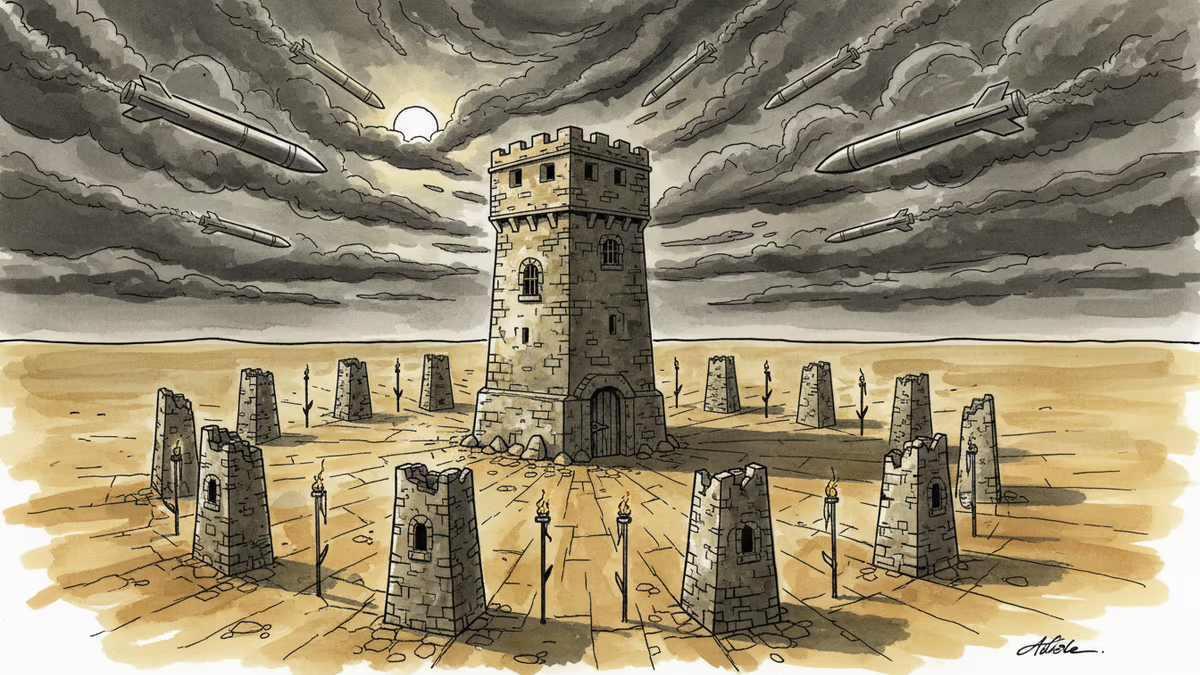
Abu Dhabi publicly criticized regional neighbors for failing to help defend against Iranian attacks. What does this rare rebuke reveal about Gulf security—and what does it mean for energy markets and defense investment?
Ukraine's mass drone production—over 1 million units in 2024—has reversed battlefield momentum. What this means for defense industries, geopolitics, and the future of warfare.
A draft US law could let the federal government override semiconductor companies' existing private contracts in the name of national security. Here's what's at stake for the industry.
Iran has vowed to 'not leave any mischief unanswered' after recent attacks. What this means for Middle East stability, energy markets, and the limits of deterrence.
Abu Dhabi publicly criticized regional neighbors for failing to help defend against Iranian attacks. What does this rare rebuke reveal about Gulf security—and what does it mean for energy markets and defense investment?
Thoughts
Share your thoughts on this article
Sign in to join the conversation