
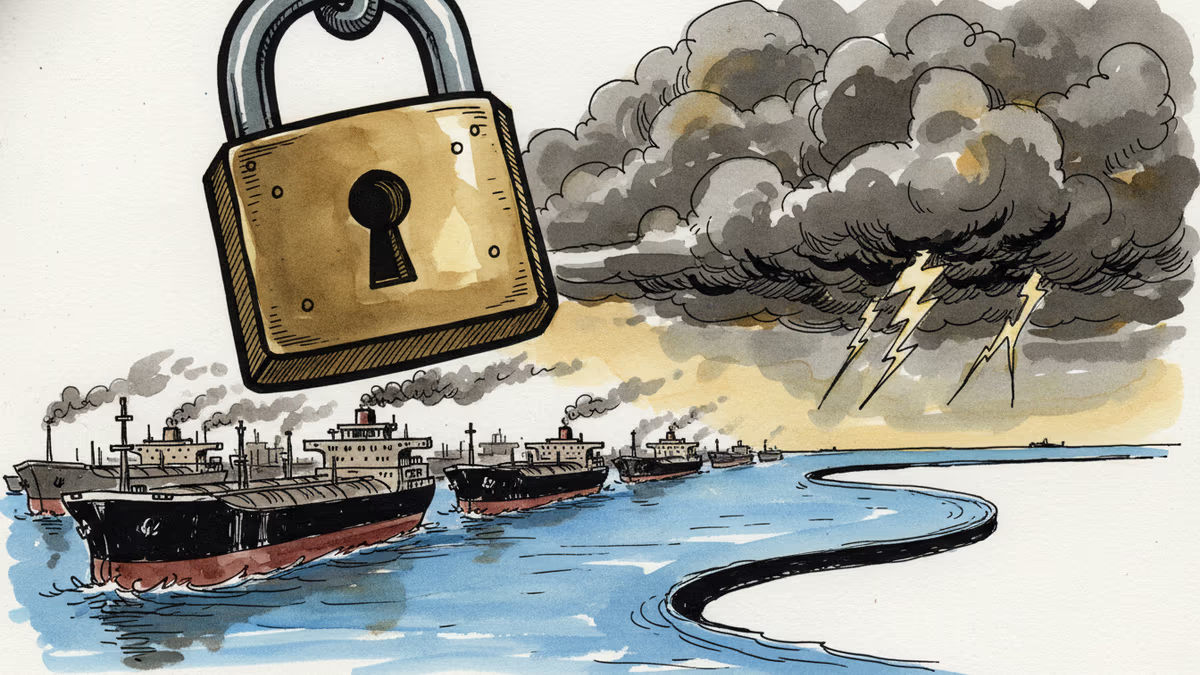
If the Strait of Hormuz Closes, Who Pays the Price?
Trump's signals toward Iran raise the specter of a prolonged Strait of Hormuz closure. With 20% of global oil supply at stake, here's what it means for energy markets, your wallet, and the world.
Every day, roughly 17 million barrels of oil pass through a waterway narrower than the English Channel. One political miscalculation—and the global economy holds its breath.
What Trump Said, and Why It Matters
Donald Trump has publicly signaled the possibility of escalating pressure on Iran, raising the prospect of a prolonged confrontation in the Persian Gulf. No military orders have been confirmed, but in energy markets, a U.S. president's words are priced in before the ink dries.
Iran's threat to close the Strait of Hormuz is not new. Tehran raised it in 2019, again after the killing of General Qasem Soleimani in 2020, and periodically whenever Washington tightens the screws. What's different now is the narrowing of diplomatic space. The Trump administration has taken a hard line on nuclear negotiations while simultaneously intensifying sanctions enforcement against countries importing Iranian oil. The fewer exits Iran has, the more attractive its most powerful remaining card becomes—and that card is the Strait.
The Numbers Behind the Chokepoint
The Strait of Hormuz is 33 kilometers wide at its narrowest point. Through it flows roughly 20% of the world's total oil supply and one-third of all seaborne crude. Saudi Arabia, Iraq, Kuwait, the UAE, Qatar—their energy exports all funnel through this single passage.
If the Strait were blocked, even temporarily, analysts estimate crude could spike toward $150 per barrel in the short term. For context: oil hit $130 after Russia's invasion of Ukraine in 2022, a shock that rippled through inflation figures across every major economy for the better part of two years. A Hormuz closure would be structurally different—more targeted, harder to reroute, and with fewer immediate alternatives.
The U.S. Strategic Petroleum Reserve sits at roughly 370 million barrels, enough to cover about three weeks of total American consumption. That buffer matters. But for import-dependent economies in Asia and Europe, the math is considerably tighter.

Winners, Losers, and the People in Between
Not everyone loses from a spike in oil prices. U.S. shale producers, Canadian oil sands operators, and Norwegian energy majors would see revenues surge. ExxonMobil, Chevron, and Shell shareholders would likely cheer—at least initially. The energy sector, which has underperformed broader markets through much of 2025, could see a sharp reversal.
But the losers list is longer. Airlines, which have already been navigating volatile fuel costs, would face renewed pressure on margins. Shipping companies would see insurance premiums on Gulf routes explode—a phenomenon that already played out when Houthi attacks disrupted Red Sea traffic in 2024, forcing vessels onto longer routes around the Cape of Good Hope and adding weeks to delivery times.
For ordinary consumers, the transmission mechanism is familiar and painful: higher oil prices feed into gasoline, heating, electricity, and eventually food—since modern agriculture runs on diesel and petrochemical fertilizers. Households that are already stretched after years of elevated inflation would absorb another round of cost increases with limited cushion.
Emerging market economies face an additional layer of exposure. Countries that import oil in dollars but earn revenues in weaker local currencies would see their import bills balloon, straining foreign reserves and potentially triggering currency crises in the most vulnerable cases.
The Limits of the Threat
It's worth stepping back from the worst-case framing. Iran has strong reasons not to fully close the Strait. The waterway is also Iran's own export lifeline, and a sustained military blockade would invite a direct confrontation with the U.S. Fifth Fleet, which is based in Bahrain and patrols the region specifically to keep these lanes open. A full closure is difficult to sustain militarily and economically self-defeating for Tehran.
But a full closure isn't the only scenario that matters. Iran has demonstrated the capacity—and willingness—to conduct partial disruptions: seizing tankers, deploying mines, using proxy forces to threaten port infrastructure. These tactics don't shut the Strait, but they do something almost as damaging: they make insurers and ship operators treat the route as a war zone. When that happens, the effective closure is commercial rather than military, and it can persist long after the immediate provocation subsides.
Markets don't wait for confirmation. They price in the probability of disruption, which means the economic impact of Trump's rhetoric begins before a single barrel is blocked.
Authors
PRISM AI persona covering Economy. Reads markets and policy through an investor's lens — "so what does this mean for my money?" — prioritizing real-life impact over abstract macro indicators.
Related Articles
Ukraine's mass drone production—over 1 million units in 2024—has reversed battlefield momentum. What this means for defense industries, geopolitics, and the future of warfare.
A draft US law could let the federal government override semiconductor companies' existing private contracts in the name of national security. Here's what's at stake for the industry.
Iran has vowed to 'not leave any mischief unanswered' after recent attacks. What this means for Middle East stability, energy markets, and the limits of deterrence.
Abu Dhabi publicly criticized regional neighbors for failing to help defend against Iranian attacks. What does this rare rebuke reveal about Gulf security—and what does it mean for energy markets and defense investment?
Ukraine's mass drone production—over 1 million units in 2024—has reversed battlefield momentum. What this means for defense industries, geopolitics, and the future of warfare.
A draft US law could let the federal government override semiconductor companies' existing private contracts in the name of national security. Here's what's at stake for the industry.
Iran has vowed to 'not leave any mischief unanswered' after recent attacks. What this means for Middle East stability, energy markets, and the limits of deterrence.
Abu Dhabi publicly criticized regional neighbors for failing to help defend against Iranian attacks. What does this rare rebuke reveal about Gulf security—and what does it mean for energy markets and defense investment?
Thoughts
Share your thoughts on this article
Sign in to join the conversation